The sun has finally arrived in Brighton, and your bird is on the wing, breathing in the smell of summer. The North Laine on a hot afternoon is every gull’s dream; shoppers from out of town just can’t keep their eyes on their ice creams as the delights of Gardner Street distract just long enough for a quick dive at a double scoop of Gelato Gusto. And what joy as they head up to the rooftop bar of Trading Post for a glass of Prosecco with a little nibble on the side.
For the more discerning bird, it’s over to join the arty types flocking to Voya, a twice monthly pop up popular after a spot of culture at 35 North Gallery next door. Your bird has found a delightfully eclectic mix of wonton and birria, masala and habanero on the menu, with very few pickings after hours, such is the appetite of the cool crowd soaking up the vinyl and negronis. Even the cocktail straws had been sucked clean from the basho margarita, an oolong green tea tequila, lime, banana that your gull had her beady eye on.
Hopping on a thermal, she breezed over to Blue Man, the Algerian café which has perched in Kemptown for the last 25 years, but has landed in Gloucester Road, replacing Neighbourhood with its delicious lamb sausages, vegan spiced aubergine stew and rosemary fries. With tables on the terrace shared with La Choza, it’s promising to be a summer of rich pickings for the gulls in Brighton’s coolest quarter.
Hovering over Jubilee Square has always been a delight for a bird of taste, with aromas of cardamon and cumin floating up from the Chilli Pickle kitchen into a summer evening sky. But news that the friendly family who’ve got a thing for pets and always save a couple of naans for the young gulls hanging out by the bins after hours, are moving on after 14 years on the MyHotel site, has hit the bird world hard. A flock of seagulls is already scouting for a new location for the beloved 115-seater which has appeared in Restaurant Magazine’s top 100 places to eat in the UK, and only this spring scooped a place yet again in Brighton Best’s Top 30.
Gliding over to the beach for a spot of evening jazz at Drifter, your gull spots hyperlocal chef, Isaac Bartlett-Copeland setting up at East Street Tap. It seems he has reinvented himself yet again as a hot dog man. The once fine dining genius behind Isaac At who sourced every ingredient, including wines and soft drinks, from within 40 miles, went on to collaborate with fellow chef, Dave Marrow on Embers in The Lanes to much acclaim, not least among the peckish gull gang. Now, he’s off to the pub to serve hot dogs – but not any old hot dog; keeping his commitment to sourcing locally, his pork will come from the pigs at West Sussex’s Calcot Farm where this bird has witnessed them larking around in open fields, happily playing with their siblings and pals until their time comes. Expect smoked pork dog with chunky ketchup, and even a serving of Ritz crackers and sage with stilton in the soon to be infamous Hugh Grant dog.
Changing the Game: How Brighton’s companies are leading the way to a greener future. Gilly Smith reports
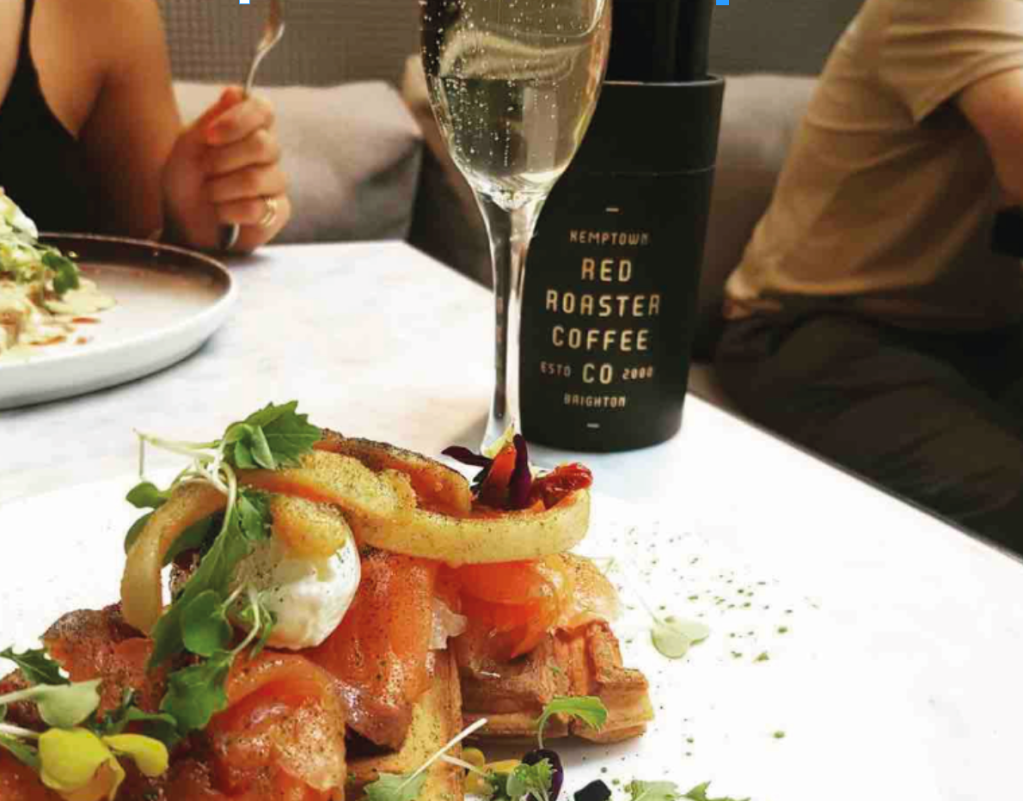
I’m waiting for Ella Byass from Marketing at the new Red Roaster restaurant in New Road on a warm afternoon in November. The nice young waiter asks me where I’d like to sit, and I choose the quieter terrace outside as I’m about to record Ella’s interview. He fiddles with a remote and pops off to get my coffee. He’s turned the heating on. Outside.
It’s not a great start to an interview about Red Roaster’s hard-won battle for B Corp, the global accreditation that aims to shift the behaviour, structure and very culture of capitalism by exacting excellence in every inch of a business. As Ella tells me that they’re one of just 7000 companies in the world to be given its stamp of approval after its rigorous three-year assessment process, I’m still trying to square the heater issue.
Red Roaster has been one of Brighton’s most sustainable companies for years; its coffee roastery in Kemp Town is the only organic coffee roastery in the South East, and its beachfront café, Lucky Beach which won the Food Made Good People’s Favourite Restaurant award in partnership with delicious. Magazine in 2017, has been collecting gongs ever since.
Membership of the Sustainable Restaurant Association keeps the company focussed on sourcing responsibly, which includes supporting farmers who employ good animal husbandry and contribute positively to carbon capture with regenerative farming techniques to keep the soil healthy. The SRA keeps its members up to date on how best to trade, use energy and keep its carbon footprint low, but also how to interact with the community and treat its teams.
In Brighton, they’ve switched all of their delivery vehicles to electric or bikes, and are the largest employer of learning-disabled adults in Brighton. Ella tells me that 75% of their produce for their Brighton cafes are sourced locally; its cider comes from Whistler favourite, Trenchmore Farm which operates its own micro circular economy. Its organic eggs are from Rookery Farm in West Sussex and most of its seasonal produce are from Shrub Provisions, one of the increasing numbers of sustainable food hubs working with regenerative or organic local farms for next day delivery to restaurants. And where it can’t buy local, it supports the farmers’ own communities; Red Roaster’s coffee beans come from Brazil, Honduras and most notably from Rwanda where they run most of their social projects, including building schools and medical centres.
Led by early sustainability adopters, Diana and Mike Palmer, Red Roaster’s B Corp badge is only the beginning. “With B Corp, you have to constantly show how you’re improving” Ella tells me. “They’ll come back in three years’ time and say, ‘Right, this is was great three years ago, but what have you done since?’ We can’t just be like, great, we’ve got the B Corp. They’ll want to know how we’ve reduced our carbon footprint even further. They don’t allow you to use it as a green washing technique.”
As businesses try to attract and retain late millennials and Gen Z into a post Lockdown workplace where all the rules have been thrown out of the pram, sustainability is one of the most popular keywords in the search for employment. According to the Institute for Advertising Ethics, 64% of millennials will no longer work for a company that fails to show a strong corporate social responsibility. The data also shows that Gen Z are so concerned about what their peers think of their employers, that their choices are increasingly those that can prove they’re doing the right thing.
It’s an amazing story, but how will anyone know while the only connection the customer has is with a waiter who turns an outdoor heater on without even asking? Ok, so it turns out that the heaters are solar powered, but the point is how would we know? A brunch with a mate a couple of days after our interview revealed the waitresses weren’t acquainted with the company line either, and the bacon was from Ireland.
“Our sustainability story is on the menu”, Ella tells me. Now, come on; who salivates over the food options, ponders over the cocktails and then scrolls through to the last page to read the diversity pledge? We’re Whistling big time for Red Roaster, but maybe by the time the B Corp team come back to check, their waiters will be wearing the t-shirt.
Of the tiny clutch of B Corp companies in the world, we’ve got quite a handful in Brighton. And if you’re thinking about booking your next holiday, you might like to know that one of them is a sustainable travel company which says that it’s not really very cool to fly at all. “There is no denying the fact that if you fly long haul, it will make up a very, very significant proportion of your year’s carbon footprint,” says Nick Pulley, founder of Selective Asia. You’re not even going to get a virtue signalling offset plan as part of the cost of your flight at Selective Asia. “With an increasing number of reports casting doubt on the benefits of carbon mitigation, we don’t have the necessary clarity and confidence on this approach that we would ideally like,” proclaims the website.
Instead, the travel agency works with Brighton-based carbon calculating company, C-Level which works directly with environmental scientists and communities on the front line of climate change to develop conservation projects that can provide locals with an income. This is not so much about mitigating the impact of travel, but actively supporting local economies to thrive. Call it distribution of wealth.
“Travelling with a tour operator like us means introducing clients properly to the cultures and steering them away from the heavy footfall area”, says Nick. Encouraging them to eat on the streets and in family-run restaurants rather than in the larger hotels means shaking the hands that feeds, while keeping the tourist spend local. Travelling in-country by train not only avoids the carbon heavy short hop flights, but gives the traveller a chance to see the landscape and feel the distance.
Eco-tourism is about understanding impact, and we’ve got to stop flying if we’re to save the planet. But if you’ve just got to make that trip of a lifetime, make sure it helps to secure the D’ering-Dibru Saikhowa Elephant Corridor in the northeast Indian states of Assam and Arunachal Pradesh or support Lone Buffalo, the Laos community project giving free English tuition, sport and creative skills tutoring to local kids.
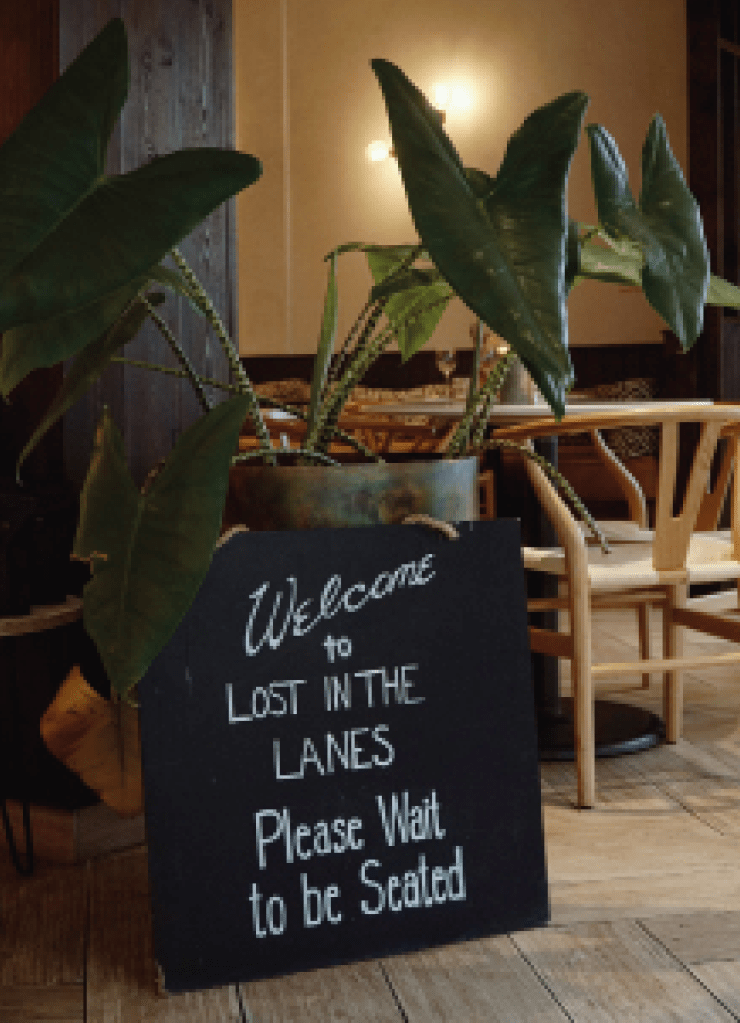
We love The Lanes with all its nooks and crannies and jewelery shops and maybe the odd tourist, but it’s easy to get Lost In The Lanes. And that’s a terrible line about a very nice place. Food editor Gilly Smith found out more
LOST in the Lanes has been a bit of a tranquil refuge in the middle of tourist Brighton, a place for a coffee and a sit down away from the buzz since it opened in 2017. But who knew that its owners were all about local produce, that it had sustainability at its core?
Since August, its launch of LOST Nights has been showcasing an evening menu, plucked from Brighton’s natural pantry, with meat from the South Downs, fish from the day boats, dairy from our neighbours at Downsview and wines from Wiston, Stopham and Hallgarten.
Owner Natalie Demetriou and chef Sophie Taverner are keeping it simple and slow, evolving it gently to keep its values at its heart. One day, all restaurants will be like this. I asked chef, Sophie Taverner why local sourcing is so important to her.
“The reasoning behind keeping a short and changing menu in the evenings at LOST is that it really allows us to work closely with local suppliers and make the most of produce when it is at its peak.
“Sourcing locally isn’t just an ethical choice but also means getting the best produce at the peak of its flavour. Part of the ethos we have built is grounded in excellent relationships with suppliers who will tell us what the best catch is coming in off the fishing boats, or they’ll send us a message when new crops are being harvested. It means being able to put food on a plate that has been harvested that same day which then allows us to create menus that really showcase those ingredients”.
Tell me about your favourite local product right now and what you love to make with it.
“Right now we are coming to the end of the season for the most wonderful Culver corn from Culver Farm in Sussex. It is exactly what corn should be, so sweet and fresh with a perfect crisp to it. We have been serving it as fritters with a chilli vinaigrette, keeping it simple to allow the flavour of the corn to really shine through. It is also the most amazing time of year for fruit and we have strawberries, raspberries, redgages and damsons dotted around the menu and plans for preserving so we can also enjoy these later in the year. Part of really working with the seasons is thinking ahead to what we can make into jams or ferments so that in those months where less is growing, we have stores of things that can add some interest to our menus”.
How do you let your customers know how much care you put into sourcing well?
“We keep telling our story and reflecting our ethos in the menus we are creating as well as constantly highlighting our suppliers and the work they are doing. Shrub, who are our produce supplier for LOST Nights, work with small organic farms to get their produce to restaurants like LOST and that means we know exactly where our produce is coming from and who is growing it. That kind of transparency we hope will translate in what we are doing and is something that customers increasingly value.
What’s the stand out dessert on the menu right now?
“Like the rest of our menu, our desserts change regularly to reflect the seasons and what´s coming from the farms. This week’s standout favourite was fresh Sussex poached quince, baked cream and almonds. The quince right now is perfect and sits so well to balance out the tart sweetness of the lemon. It was so good we might keep it on for another week”.
They’re a smart lot over at the Flour Pot bakery in Seven Dials. Marching steadily but sassily across the city, from Sydney Street in 2014 to Elm Grove to Fiveways, zigzagging back to First Avenue, they sashayed in to Seven Dials in 2017. Bringing us unbeatable bread and a coffee culture that spread onto the pavements and into a reclaimed secret garden, wherever the Flour Pot went, we followed.
They were even among the leaders in the hospitality revolution during Lockdown, swivelling their business plan when all doors were closed to scoop up the smallest but greatest local suppliers – Gunn’s the Florist, Smors hummus, cheese from the Cheeseman and Curing Rebels charcuterie – in a genius home delivery service.
And so when Small Batch was suddenly gone, leaving landlord Pembertons a vacant space until October when they can issue a new lease, Flour Pot boss, Oli Hyde spotted an opportunity. “I decided that if we could put together a crack team of local businesses, The Flour Pot, Curing Rebels, Curio Wines, a local artist called She Paints, we could create a collaborative space here.” In partnership with Pembertons, Night Shift was born. “We asked ourselves; ‘what would the Flour Pot be if it was open at night?’” he said. “I don’t know what the future holds, but it seemed an absolute crying shame having such a site like this empty for that period of time.”
When we met, Night Shift had been open just three days, but already the locals were pouring in. Oli, who started his hospitality days at Terre a Terre in the 90s, moving to Sam’s in the heydays of the Dials, through clubs like Audio and Excape and on to the Mesmerist, knows how a thing or two about the night shift. “I think this is a lovely idea’ he says. “ It’s just early evening Wednesday to Saturday, closing at 10 or 11, depending on the numbers, and offers a local British charcuterie, a terrific wine list and local art on the walls.”
Mention the name Wolfox among the chattering classes of West Hill and Seven Dials and a hush descends. Who are these people? Aren’t they something to do with the Mafia? Brighton is no stranger to property tycoons with interesting connections, but Wolfox, according to those who’ve heard the rumours – or maybe that should be “those who spread the rumours” – is like some kind of hungry animal stalking the streets by night, sneaking into empty shops and restaurants whose throats were ripped out in Lockdown, settling in and serving up the city’s best cup of coffee to an unsuspecting passer-by. I could stretch the metaphor and suggest that Fabio Lauro, sporting a fetching apron in the kitchen of his latest opening, Fumi in Circus Street does have some pretty big teeth, but hey, this is just a fairy tale. Isn’t it?
“Sorry about the heavy breathing,” Lauro – Mr Wolfox – pants, “but I’ve just been running.” I daren’t ask from what. We’re here to talk about Fumi after a stunning meal the weekend before. I’d met him in the kitchen, sous cheffing to Reuben Waller who’s “been around” but cut his teeth with the legendary Nico Ladenis at Chez Nico back in the day. “Yeah, Gavroche too”, he tells me. He had taken me on the “culinary adventure” offered on the Carte Blanche, an opportunity to see what Fumi is all about, a trail through the aubergine and enoki mushroom tempura, tuna and salmon nigiri staples, and a silky belly pork in red wine and soy sauce. It turns out that the signature design-led fine dining experience is very fine indeed, although they could get their Wagyu from Trenchmore for better local creds. Still, they do have their own hydroponic farm.
Lauro’s breathing has calmed now and he’s very happy to tell me about the rise and rise of Wolfox. “The main expansion happened during Lockdown when quite a few landlords asked us to take some of the properties which tenants had left. So we took over one in Kemptown, then one in Prestonville. Our desire was never to expand everywhere but to be present within the communities. We weren’t even paying rent. They were just given to us. That was the thing”. I try to dismiss the image of Marlon Brando purring into my phone and replace it with one of Brighton’s biggest employers swooping in to sort out a crisis. Damn; same thing.
Fumi is the elegant big sister of Kusaki, the brightly-coloured Asian plant kitchen in Preston Circus which has cleverly scooped up the vegan pound and raised the game in town. Fumi, all gold leaf walls, massive doors and Insta-happy coffee grind table tops, reused and crafted in Lewes from the many Wolfox café leftovers, takes design to a new level; Lauro, the Studio Six designer who began in Milan, leaves his pawprint on all his restaurants and cafes. This one, though, is dedicated to the memory of his brother, Andrea, who died in a tragic accident two years ago. “It’s definitely not another Wolfox. It’s just Fumi”, he says.
Leading the Circus Street development, although it didn’t really mean to, Fumi is already luring locals in for an Italian coffee and pastry in the morning before dimming the light sculptures by evening for a full-on Japanese fine dining experience. “They were really struggling because it was so big. They wanted the best coffee in town, so they asked us what we could do. But restaurants are our main business, and we wanted to get back to that.”
Circus Street got more than its coffee; the massive glass rectangular building, screened Japanese-style, sits stylishly next to Grand Parade, and brings a little Zen to the area. “We’re doing slow-minded coffee in the morning, and bento boxes for lunch.” I ask about his connection to Japan and he laughs. “I’m from Lake Como. I’m not going to open a pizza restaurant, am I? I love Japanese food; it’s clean for your body if it’s done very well. You have to have balance in life.”
l Fumi Restaurant, 1 Circus St, BN2 9AS 01273 064516
Everything you ever wanted to know about life in Brighton (OK, and Hove)





 The Whistler