
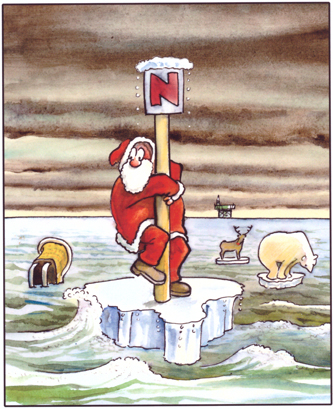
 Santa Claus could be homeless soon: the ice on the top of the world, where he lives, is melting. We are all to blame for this. Every time we turn on a light, have a warm bath, drive or fly somewhere – every time we use electricity, petrol, gas or coal – we add a little carbon dioxide to the air. Carbon dioxide is different from most other gases – it vibrates! Each molecule throbs uncontrollably, and shakes up its neighbour, which bounces into the air surrounding it … so quite soon all the air around is vibrating. That vibrating is what we call heat (rub your hands together; you’ll feel them getting warmer). And that hot air is melting the North Pole. Continue reading The North Pole is Melting
Tag Archives: Brighton Science Festival
Happy Birthday
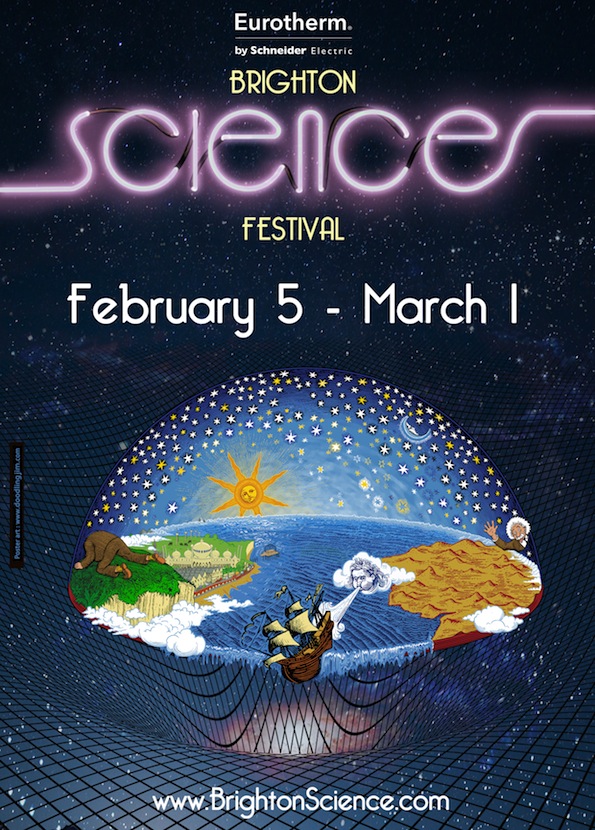 We like to celebrate anniversaries, so here’s one: 2015 is our tenth.
When the Festival started, a decade ago, Wikipedia was a pretty crazy notion, Facebook was a mild irritant among Harvard students, Twitter was not even a remote possibility, and 40% of our visitors didn’t use a computer to view the programme. The figure now is 25%, so progress has been made, though not as fast as you might think. Continue reading Happy Birthday
Brighton Science Festival Highlights
Hammer and Tongue – Science Festival Special
 Hammer and Tongue is a wild monthly poetry slam – a cross between Poetry Please and the Battle of Waterloo. This Festival special features special guests and a super science-themed slam – sign up on the door to take part. Hosted by Rosy Carrick and Mike Parker.
Thursday 2 February, 7.30pm, Komedia Studio, 44-47 Gardner Street, Brighton, BN1 1UN, 01273 647 100.
Tickets £5/£4, available on the door
Continue reading Brighton Science Festival Highlights
Brighton Science Festival 13 Feb – 6 Mar 2011
THE RHYTHM OF LIFE
 We all dance to the Circadian Rhythm. It makes us sleep. It wakes us up. It gives us jet lag and makes us have accidents when we try to disobey it. What makes us tick? Professor Russell Foster has spent sleepless nights finding the answer. The source, he finds, is our body clock, a chemical reaction which occurs deep in the heart of the brain, where molecules dance to their own rhythm: they combine, then they fall apart again, and when they have all fallen apart they begin to combine again, and so on. One cycle of the molecular dance takes exactly 24 hours.
Thursday 17 February, 8pm, Latest Music Bar, Manchester Street, Brighton
LESSONS FOR LIFE – STONE AGE STYLE
 Can’t stop eating chocolate? Too many hours on Facebook? Maybe evolution is to blame.
Dr Matt Pope reveals that Paleolithic Humans had many of the lifestyle quirks we associate with the modern life. Researching the lives of our earliest ancestors can help us understand the most remarkable, misunderstood and awkward life-form that has ever lived…you!
Food issues will be debated during the day. What do you think of the government’s idea that the best people to act as guardians of the nation’s health are the fast food giants? Come and let us know at Play with your Food
Saturday 26 February, 10am-5pm, Hove Park Upper School
WATER WAY TO LISTEN TO MUSIC
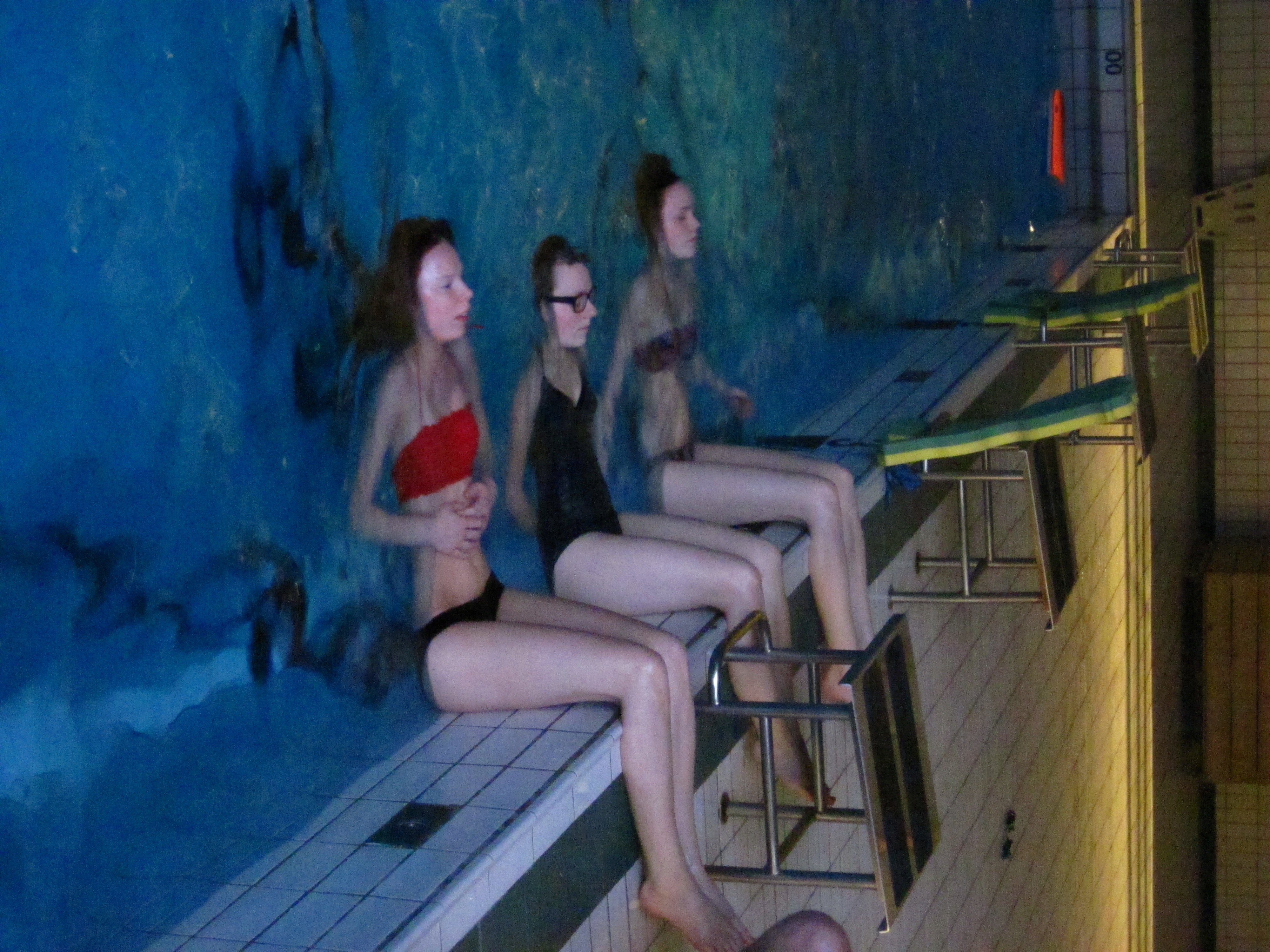 Wet Sounds – an underwater deep listening experience you can feel in your bones. Sound travels 4.5 times faster in water than air and is sensed by our bones, providing a unique immersive listening experience. As part of Wet Sounds’ third UK tour, Joel Cahen will play a live sound collage of various environments, music and sound textures. Also presented is a curated listening gallery of 2011 work for underwater listening by featured sound artist. www.wetsounds.co.uk
Wednesday 2 March, 8-10pm, King Alfred Pool, Hove
BACH-ING MAD
 What are we saying when our music is playing? How is it that human evolution brought music along with it? What does it do to us? Dr Harry Witchel uses science and anecdotes from the history of pop culture to discover why music makes us feel so good, or so bad, and how we use it to mark our patch. Like birds, gibbons, and other musical animals, we use music to establish and reinforce social territory. In this way music can influence what you think, what you buy, and even how smart you are.
Big Science Saturday 5 March, 10am-6pm, Sallis Benney Theatre, Grand Parade
The Art of Brighton Science Festival
 For an arts lover, I am always surprised just how much I love going to the Brighton Science Festival (19 Feb – 6 March 2011). There are always so many interesting things to see and hear. Symmetry will be the subject of one night, looking at symmetry in physics, music, art, maths and biochemistry.
Haydn wrote a whole movement of one his symphonies (no 47 in G) as a palindrome; the second part of the minuet is the same as the first but backwards. (Haydn didn’t confine his surprises to the Surprise Symphony!). Symmetry has been a major player in many areas of modern life.
The drug thalidomide was stigmatised as a killer in the 1970s, when its use as a pain-killer by pregnant mothers led to serious birth defects. But we now know that the thalidomide molecule comes in two symmetrical forms; the right-handed form is useful and benign, the left hand form is – in both senses – sinister. ‘Sinister’? ‘Dexterous’? Left-handedness was long considered a sign of being backward (‘cack-handed’). But it could be argued that preferential use of any hand, right or left is slightly unbalanced. Why aren’t we ambidextrous, as a perfectly symmetrical being should be?
Although, by and large, we, and most animals, do a great job of being symmetrical, it seems that nobody is perfect. Is the Universe symmetrical? Is space-time elegant, or is it cack-handed? Find out on Wed 23 Feb 2011.
 The Whistler