On Saturday 19 December West Hill Hall hosted a funky evening of fun, food, fast music and wild dancing.
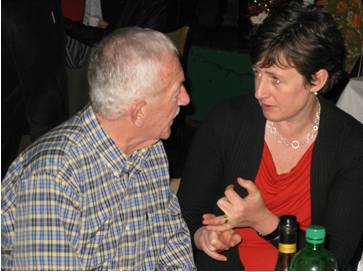
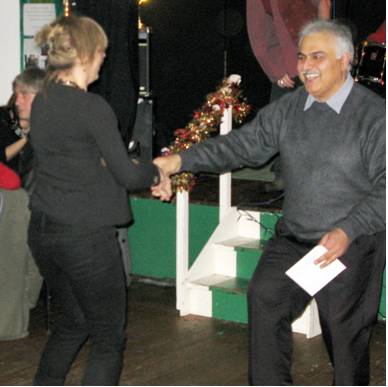
Patrick & DeniseAs ever, thanks go to Vinod and Meena for organising the event with help of Denise and Adrian Robins, Patrick, (erstwhile of Bright News) James and all the present staff. The food was fantastic, the music was provided by Stash, and talking of wild dancing, Jiving Mr Mashruhere is Vinod Mashru and willing partner demonstrating just how it’s done. Is there no end to this man’s talents?
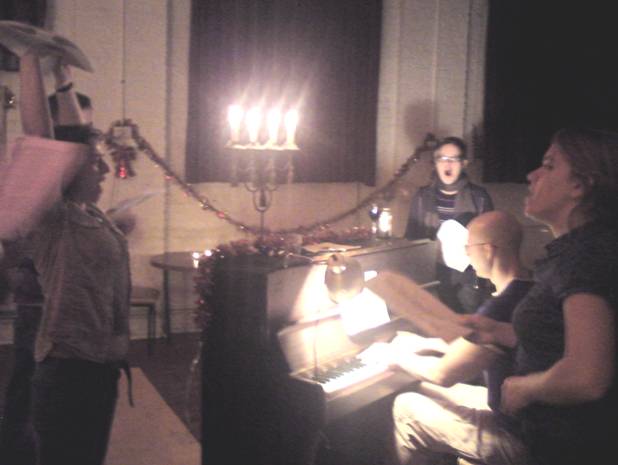
On Sunday 20 December West Hill Hall hosted a beautiful evening of midwinter candle-lit carols. Candle-lit carols
Eighty or so people of all ages from the local community, and beyond, ventured through the snow and ice to a warm, cosy and magical-looking Hall decorated with twinkling candles and fairy lights. Everyone, including babies and dogs, gathered around the piano and cello to sing carols such as Little Drummer Boy, Hark the Herald Angels Sing and Little Donkey while sharing mulled wine and mince pies.
It is one of the most favourite events that I’ve attended at the Hall. Looking around with the lights twinkling, the rosy-cheeked community gathered around the piano singing their hearts out, and the aroma of mulled wine, I imagined it could have been another era. Totally magical stuff. George Duncan
Santa ClausDepending on your age, the answer is likely to be the North Pole, Lapland or Coca Cola. None of them is right: Santa, like St George, is Turkish.
St Nicholas – the real Santa – lived and performed miracles in what is now the sun-baked town of Demre in south-western Turkey. His most famous miracles usually involved children. In one, he restored to life three children who had been chopped up by the local tavern owner and kept in a brine tub. Being kind to children explains his suitability as a Christmas saint, but St Nick is also the patron saint of judges, pawnbrokers, thieves, merchants, bakers, sea travellers, and, oddly, murderers. Italian sailors stole St Nicholas’s miraculously myrrh-exuding bones in 1087. Turkey is still demanding their return.
In the rest of Europe, the benign St Nicholas fused with older, darker mythological types – in eastern Germany he is known as Shaggy Goat, Ashman or Rider. In Holland he is Sinterklass, attended by the sinister ‘Black Peters’.
The jolly ‘Coca Cola’ Santa existed well before Haddon Sundblom’s famous advertising images of the 1930s. His illustrations, and those of Thomas Nast in the 1860s, were based on New Yorker Clement Clark Moore’s 1823 poem ‘A Visit from St Nicholas’, better known as ‘The Night before Christmas’. Moore was an unlikely author – his day-job was as a professor of Hebrew and Oriental Languages – but the poem’s importance in fuelling the Santa myth would be hard to exaggerate. It moves the legend to Christmas Eve and, instead of the dour St Nick, describes a rotund, twinkly-eyed, white-bearded elf, with fur-trimmed red clothes, reindeer with cute names, a sledge that landed on roof-tops and a sackful of toys. It became one of the most popular children’s poems of all times.
It is not clear when the North Pole and the factory of elves became attached to the story, but it was established enough by 1927 for the Finns to claim that Santa Claus lived in Finnish Lapland, as no reindeer could live at the North Pole because there was not any lichen. Santa’s official post office is in Rovaniemi, capital of Lapland. He receives 600,000 letters a year.
As if in revenge for his secular success the Vatican demoted St Nicholas’s saint’s day, 6 December, from obligatory to voluntary observance in 1969.
Everything you ever wanted to know about life in Brighton (OK, and Hove)


 The Whistler