
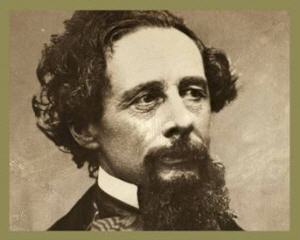
In 1822 the family returned to London, to Camden Town, still on “the outskirts of the fields”. Now aged 10, Charles would associate the house with genteel poverty. This is the residence of Mr Micawber in David Copperfield (1849-50) and Tiny Tim in A Christmas Carol (1843). From its windows the city and its spires and domes could be seen. Charles soon began to wander around London, imbibing both its magic and its darkness. In 1824, with his improvident father in financial difficulties, he went out to work pasting labels at Warren’s Blacking Factory, a rat-filled warehouse at 30 Hungerford Stairs, by the mud-filled Thames and its grimy coal barges. For young Dickens this was “grief and humiliation”, especially when his father was put in Marshalsea Debtors’ Prison in Southwark with his wife and younger children.
The variety and contrasts of London – gentility and beggary – great spaces and cramped crooked streets, leisure and brute work, families, and orphans, “strange experiences and sordid things”, would add to his humiliation. They would fill his imagination, stock his memory, shape his psychology, become his education, feed the “quite astonishing fictions” he began to tell to others. The streets he wandered between the Blacking Factory, the Marshalsea and his lodgings on Lant Street, today bear the names of the characters who sprang out of them, Pickwick Street, Little Dorrit Court. The cityscape, as Peter Ackroyd says in his biography, was still largely an eighteenth century one, and “the London of his novels always remains the London of his youth”.
When Dickens’s father was released from prison the family moved to Somers Town. After some schooling, Dickens became a lawyer’s clerk in Grays Inn. He began writing for the theatre and magazines, and became a shorthand reporter in the law courts and at the House of Commons. He produced Sketches of London for the Evening Chronicle, striking for its portraits of working people, vagrants, circus performers, poor and criminal districts, prisons like Newgate, amusement places like Vauxhall.
In the 1830s the young reporter became the wonder writer of the day. Living in Marylebone, he wrote and published his first book, Sketches by Boz (1836), a vivid collection of London scenes, accompanied by illustrations from the great caricaturist George Cruikshank. Invited to follow up its success, he developed Pickwick Papers (1836-7) in 20 monthly parts, which grew in scale as the public fell in love with each new episode. Here, with the Pickwickians and Sam and Tony Weller, was Cockney London in full voice; he had created new, deeply English comic characters who fascinated readers of every kind.
In 1836 Dickens married Catherine Hogarth and they rented lodgings at Furnival’s Inn. In 1837 they took a twelve-roomed house at 48 Doughty Street, Bloomsbury. He had signed contracts for 5 novels, produced at enormous speed, in monthly parts. First came Oliver Twist (1838) with its portrayal of London orphans, the criminal den of Fagin, the slum of the Rookery, where Bill Sykes meets his end. Then followed Nicholas Nickleby (1838-9), The Old Curiosity Shop (1840-1), where Quilp dies dramatically in the Thames, and Barnaby Rudge (1841). Finished before he was 30, these books form a great vision of the new Victorian age. With them he became a world famous writer. When, in 1842, he toured the USA, he was feted as no visiting author had been before.
In I839 the Dickens family moved to 1 Devonshire Terrace, by Regent’s Park. Dickens also acquired Fort House, Broadstairs, to take his family out of London. His comic imagination began to darken, the “giant phantom” of London taking a more complex shape. He wrote works of social and moral criticism like Martin Chuzzlewit (1843) which probed the selfishness and fraudulent corruption of his day. Half way through his career, Dickens wrote Dombey and Son (1846-48) in which the ailing Paul Dombey is sent to Brighton for the air, to be looked after by the “ogress and child queller” Mrs Pipchin and then to attend Dr Blimber’s appalling school. It is a great novel in which Dickens writes of a father who desired a son but is left with just a daughter, and turns wicked because of life’s unjust blows.
To be continued
 The Whistler