Category Archives: Features

Cor blimey, guv, strike a light

Me old China Peter Batten goes off searching for the East End he knew

Brick lane

My father’s family came from the Isle of Dogs, more politely known as Millwall. This is the area of London portrayed in the TV Soap, EastEnders. Several of my relatives were involved in amateur or professional boxing, a sport rarely mentioned in the BBC’s Albert Square.

That omission leads me to a question I am often asked, “How true to the East End is the BBC Soap. I should certainly be able to answer that question. I grew up in a house which looked out on a very substantial street market.

On the other side of the road there were market stalls and behind them a row of shops. Just at the end of the row was a pub called, The Queen Victoria. As in the soap my grandmother would meet her cronies there most evenings. Just before closing time she would toddle home clutching her nightcap, a small jug of brown ale. On our corner, two houses away, was a fish and chip shop. I can almost recapture the smell as I write these words…

Just a few yards away the market became denser, with stalls on both sides of the road and many different shops. One feature I recall immediately, which EastEnders does not recreate, is the lighting. In 1938 our road had been electrified, so the stalls had been linked to electric lighting.

One of my earliest memories (I was born in 1933) is of the warm attractive glow, in winter months, around the stalls early in the morning and again in the evening. Activity began at about 6am, when some stalls had to be brought out – lots of noise – and ended after 6pm.

There is just one problem with my description. When my mother and father married (they met in Greenwich Park) they lived in my grandmother’s flat in Southwark Park Road in Bermondsey, south of the river.

It suited my father because he worked at the Surrey Commercial Docks in Rotherhithe, just over a mile away. This is the road which I have been describing. It is certainly not in the East End.

The Street Market which I have begun to describe is typical of many throughout those inner London suburbs which grew up post 1850. They were active from Monday to Saturday. Then on Sunday huge special markets took over, like the amazing Petticoat Lane near Liverpool Street Station or the one I often visited just off the Walworth Road. One of their special attractions was the sale of animals, which took up one or two side streets.

My memories of our market are based on the years 1938-1958. I think they make an interesting contrast with the market which has been created for EastEnders, but I do not intend that as a criticism of the soap. Each of the smaller local markets had a character of its own, but they all offered a diversity of goods and characters which EastEnders cannot hope to recreate. Our market was known as “The Blue Anchor” after the pub which was at the heart of the market area.

It was older than the Queen Vic, a late Victorian pub, and an even younger pub, the Colleen Bawn. As a nosey child this name always irritated me. What did it mean? Only in the 1970s did I discover that it was the title of a very successful Victorian play by the Irish playwright Dion Boucicault.

We had a small fleapit cinema, the Rialto, a small Woolworth’s, a bank, and a Co-op supermarket, built on part of the road which had been destroyed by bombs. The variety of the stalls and shops was amazing, with all kinds of goods, groceries and foodstuffs on sale. Immediately opposite our house was a greengrocer’s stall, so it was very easy to nip across if we needed some extra veg for a meal.

Right behind him was a German bakery called Griesbach. A little further away was a German pork butcher offering some delicious specialities. Sadly, that closed in 1940.

Among the more unusual offerings was Sarsparella, a red cordial sold by the glass from a barrel. As in Ben Jonson’s Elizabethan play, “Volpone” there was usually someone offering some miracle cure for all ailments. Sometimes there would be a crockery stall where you were encouraged to make an offer for plates or a tea service, An allegedly ex-boxer stood with a set of scales offering to tell your weight. Someone called Prince Monoloulou might come by offering to sell you betting tips.

Which reminds me of something else. There is no illegal betting in EastEnders. In my childhood it was going on all around me. “Runners” as they were called were quietly taking bets and handling money in every pub and every factory. Our elderly neighbour, Mr Westcar, found a handy way to add to his pension by running a small “Book”, as it was called. Just in case the police came calling, my mother explained to me, all his betting slips were pinned to the underside of his large kitchen table.

OK EastEnders, so there’s no illegal betting these days. But what happened to our jellied eels??  

A passion for appassimento

We’re still in lockdown. It’s cold. There’s snow on the ground. Let’s go to southern Italy and talk about wine.

About two years ago, I was introduced by a friend to a wine, currently available at Waitrose for under £10 (sometimes well under £10), that has become one of our favourite weekday wines. It’s made by a firm called Terre di Faiano which is based in Chianti but they have vineyards in Southern Italy and Sicily.

The grape is Primitivo, the same grape as Zinfadel in the USA, and it’s from Puglia. It’s extraordinarily full-bodied, creamy smooth, and unlike almost any other Italian wine I’ve tasted.

For two years I’ve puzzled over how this wine comes to be so good and only discovered the answer when Waitrose put another wine on the shelf alongside it. This is also by Terre di Faiano but the grape is Nero d’Avola and it’s from Sicily. And the giveaway is that on the label it mentions appassimento. The penny dropped. Perhaps the Primitivo is made the same way, I wondered, and a look at Waitrose’ website shows that it is.

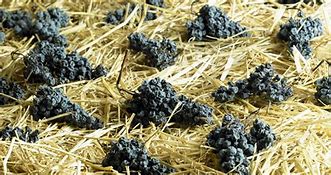
What is appassimento? It means ‘dried up’ or ‘tired out’. The basic principles of winemaking are pretty standard: once ripe, the grapes are pressed, the juice is put into some sort of container and left to ferment, then bottled, sometimes after spending some months or years in oak casks. But if the wine is made by the appassimento method the grapes are left to dry before starting the whole process. They used to be left out in the sun on a bed of straw, which is why it’s called in English ‘straw wine’. The purpose is to increase the sugar content of the grapes and reduce the water content. The resulting wines are more alcoholic or sweet or both, a deeper red and packed with flavour.

They’ve been making wine like this since the Ancient World. Hesiod (he’s the one who was roughly contemporary with Homer but less grand, more personal) described it in around 700 BCE and it’s been used in Sicily and Puglia for centuries. But the most famous wine to use it is in northern Italy, just north of Verona, where the local wines tend to be thin and bitter. Amarone della Valpolicella is made this way. It gives a red wine of extraordinary power, nearer to a port than to an ordinary Valpolicella, which can be thin and bitter. Just to complete the northern Italian story, they even keep the lees left after draining off the fermented Amarone and pour ordinary Valpolicella wine on top. There follows a second fermentation and you get another beefy wine that’s called Ripasso (‘re-passed’ in English) though less full-bodied, and much cheaper, than Amarone. Finally, the winemakers may deliberately leave enough sugar unfermented to make it sweet. It’s called Recioto and the Italians drink it at the end of the meal.

I’ve had other wines from Puglia made by the appassimento method and I’ve found them too much. The heaviness is overdone, the flavours too ‘jammy’. The Terre di Faiano from Sicily is a bit that way, to my taste, although it gets great customer reviews. It’s made with the Nero d’Avola grape which has no trouble making dark, robust wine without the need to dry the grapes. But somehow, with the Primitivo from Puglia the winemakers seem to have hit the spot. I plan to get a good supply in before this article goes to press!

Fancy a night out at The Dome?

This is what life looks like right now. Sometimes we sit at the dining table. Sometimes we sit on the sofa. Sometimes, because we’re wild and crazy guys, we go from the table to the sofa.  

Wouldn’t it be nice to go out somewhere? To do something other than say “What’s on Netflix?” Well… as chance would have it, those nice folk at The Dome are putting on a series of talks with famous people, writers and TV personalities, people like Mel Giedroyc and Stacey Dooley, Joanna Lumley and Julia Quinn, writer of Bridgerton.

OK. It’s a live stream. You’ll still be on the sofa. But if you put your coat on, it’ll feel like you’re going out – and that’s a start.

NameLive DateTicket PriceBook and Ticket Price
Jacqueline WoodsonThu 28 Jan, 6.30pm£10.00£19.00
Nikesh ShuklaWed 3 Feb, 6.30pm£10.00£15.00
Marian KeyesThu 4 Feb, 6.30pm£10.00£20.00
Julia QuinnSun 7 Feb, 6.30pm£10.00£20.00
Stacey DooleyFri 12 Feb, 6.30pm£10.00£17.00
Gyles Brandreth Meets Joanna LumleySun 14 Feb, 3pm£15.00N/A
Raven SmithWed 17 Feb, 6.30pm£10.00£15.00
Kiley Reid (pic above)Fri 26 Feb, 6.30pm  £10.00£15.00
Mel GiedroycTues 30 & Wed 31 Mar, 6.30pm£10.00£22.00

For more information… https://brightondome.org/whats_on/

Mel Giedroyc credit Laurie Fletcher

Art in public spaces. What do you think? Here’s your chance to say

Morris Singer Art Foundry Ltd|Bruce, Romany Mark; Tay (AIDS Memorial); ; http://www.artuk.org/artworks/tay-aids-memorial-245784

What do you feel when you see a statue to some historical figure you’ve kinda heard of but don’t really know anything about? Do you think… “It’s just there. It’s always been there, so let it be there”? Do you think… “Who is that? I’m going to find out about that right now. Now, where’s my Wikipedia…?” Do you think… “Whoever it is, it means nothing to me. I wish there was something there I could feel something positive about”.

Well… strangely enough now we’ve got a chance to say what we think about public art in our city. We’re not talking about private exhibitions, shows, gigs, festivals, that’s one thing, But what about the art that’s out there in the public spaces. Statues. Outdoor installations. Spaces in parks. How do we, as a city, feel about that stuff? We saw last year, particularly in Bristol, that historic statues can be… problematic. How do we deal with those subjects and feelings? Remember the Mary Wollstonecraft sculpture that was unveiled in London in November?

Brighton’s an arty city, a creative city. It’s one of the reasons we’re here. The public art should reflect that – and now’s a chance to make that happen.

The Brighton based arts charity Lighthouse has launched an online public survey and series of short films under the banner “Let’s Talk Public Art” to encourage us to say what we think about public art in the city.

“Public art can provoke intensely divided public opinion, as we have seen recently with historic statues being removed because of their connections to slavery. These short films feature discussion points such as heritage, inclusion, sustainability and wellbeing so we can delve into how people feel about public art” says Alli Beddoes, Lighthouse CEO & Artistic Director.

Films:

Places & Spaces with Matt Adams – Blast Theory and Atif Choudhury – Diversity & Ability An exploration of what and where the spaces and places can be for public art. It should be more than standalone works in the public realm, they should be integral to the ways in which we experience and understand our city.

A Green City with Ami Rae – Onca Gallery and Claire Potter – Claire Potter Design What doers it mean to be green – and can you green the city through public art. Brighton & Hove aims to be carbon neutral by 2030 – how can public art support this?

Wellbeing with Elsa Monteith – Writer & Artist and Emma Frankland – Artist What does public art mean for our sense of identity and belonging? How can it help us connect and care?

Heritage with Judith Ricketts, Artist and E J Scott, Historian & Curator What is a successful piece of artwork that celebrates heritage in our city? How can public art hold onto the past without erasing it but use it to be informed and carve out a better future for the next generation?

Connectivity & Community with Amartey Golding – Artist and Bobby Brown – Music Producer & Careworker, Hangleton & Knoll A film discussion of the ways commissioning public art can connect to community groups in the city.

There’s an event – online, natch – called Let’s Talk Public Art – Digital Campfire(10am to 12 noon, Fri 5 February) which might be interesting. To join, take part in the survey, watch the films or register for the event visit: lighthouse.org.uk/events/lets-talk-about-public-art

News: The Dome re-opens for business

Do  you remember “going out”? No, me neither. Still, the Dome is re-opening its doors for a series of seasonal events, including a production of A Christmas Carol narrated by Killing Eve and Succession actor Harriet Walter.

Live stream events also continue, with best-selling children’s author Michael Morpurgo bringing the festive spirit into people’s homes with an afternoon of Christmas storytelling.Other events feature names such as Dawn French, Benamin Zephaniah and Liza Tarbuck. 

Christmas Listings

Brighton Dome, Church Street, Brighton BN1 1UE

Ticket bookings:

W: brightondome.org

T: 01273 709709 open Tue-Fri, 10am-2pm

Ticket Office counter open Tue-Fri, 10am-2pm from Tue 8 Dec

A Night in with Alex Wheatle and Benjamin Zephaniah (livestream)

Friday 11 December, 6.30pm

£10 / £23 including copies of Cane Warriors and Windrush Child

On sale now

A Christmas Carol with Harriet Walter and Brighton Philharmonic Orchestra

Saturday 12 Dec, 2.30pm and 7.30pm

Age 12+

Tickets from £15-20 in household or bubble groups of 3 or 4 as cabaret tables, rear stalls and circle seats.

Family ticket offers for groups of 3 and 4 with under 18s.

£20 single tickets rear stalls and circle.

70 min performance, no interval

Members and Friends of BPO on sale Thurs 3 Dec at 10am

General on sale Fri 4 Dec at 10am

A Night in with Dawn French (livestream)

Sunday 13 Dec, 6.30pm

£10 / £25 including a copy of Because of You

On sale now

Christmas Storytelling with Michael Morpurgo (livestream)

Sunday 20 Dec, 3pm

£10 / £20 including a copy of Boy Giant / £45 book bundle

On sale now

Sussex Sings Christmas livestream from Brighton Dome

Wednesday 23 Dec, 6pm

£10

Book here: bfc.org.uk/sussexsingschristmas