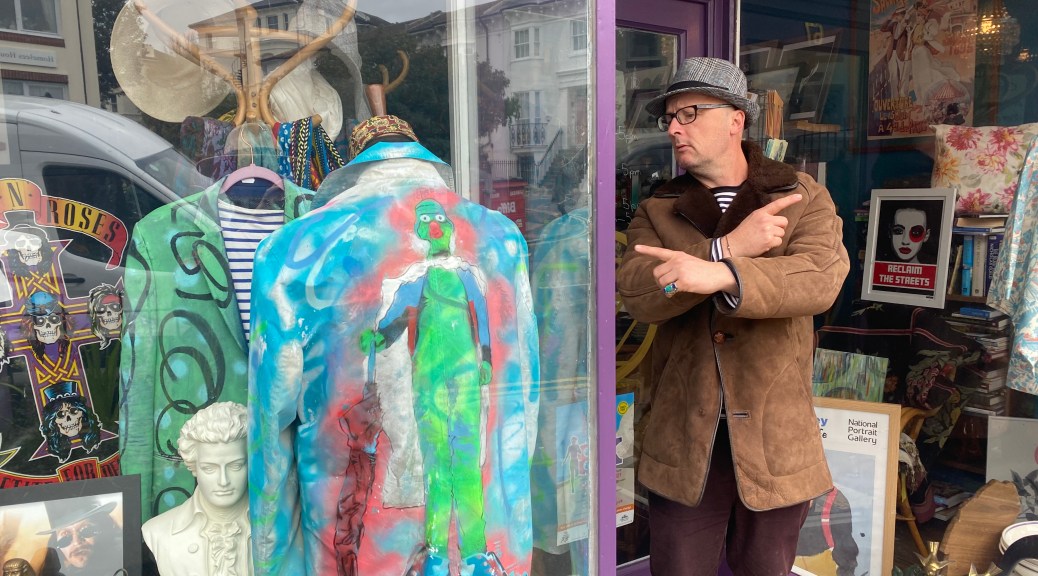
How to describe Matt Whistler? We could play it really straight and say he’s an artist. Or a performance artist. We could say he’s a comedian. When I asked him he said “Say I’m a modern day Charlie Chaplin. An eco clown. A walking artwork.” It might just be easier to say “all of the above”. A mischievious comedian with a creative free spirit. But if you scratch the surface there’s a serious message about the environment and waste.
“It pains me to walk past things that have been discarded. I just look at them and thing “What can we do with that?” (We met Matt outside Objet D’ials during the last / worst days of the bin strike and someone had left a huge pile of flattened cardboard boxes next to the throbbing pile of bin bags.
During our chat, he’d created a gallery exhibition of them, a sculpture, there was an idea to line the pavement with the cardboard and slogans and… Did any of it happen? Some of it, maybe all of it, maybe none. It doesn’t matter. There’ll be another idea along in a second. Talking to Matt is like talking to the little silver ball inside a pinball machine.
Matt’s recent projects have ranged from painting an old locomotive near Glastonbury, an exhibition of his dot-based work (“I don’t know what happened but I broke through to the other side and I haven’t stopped doing dots since”), a cafe in the Marina (“I went for a coffee there and just thought ‘Hold on a minute, there’s a canvas here. There’s a cafe in a really nice area next to the sea’…”) and a project involving painting – breathing new life into – the covers of hundreds of albums he found in a skip.
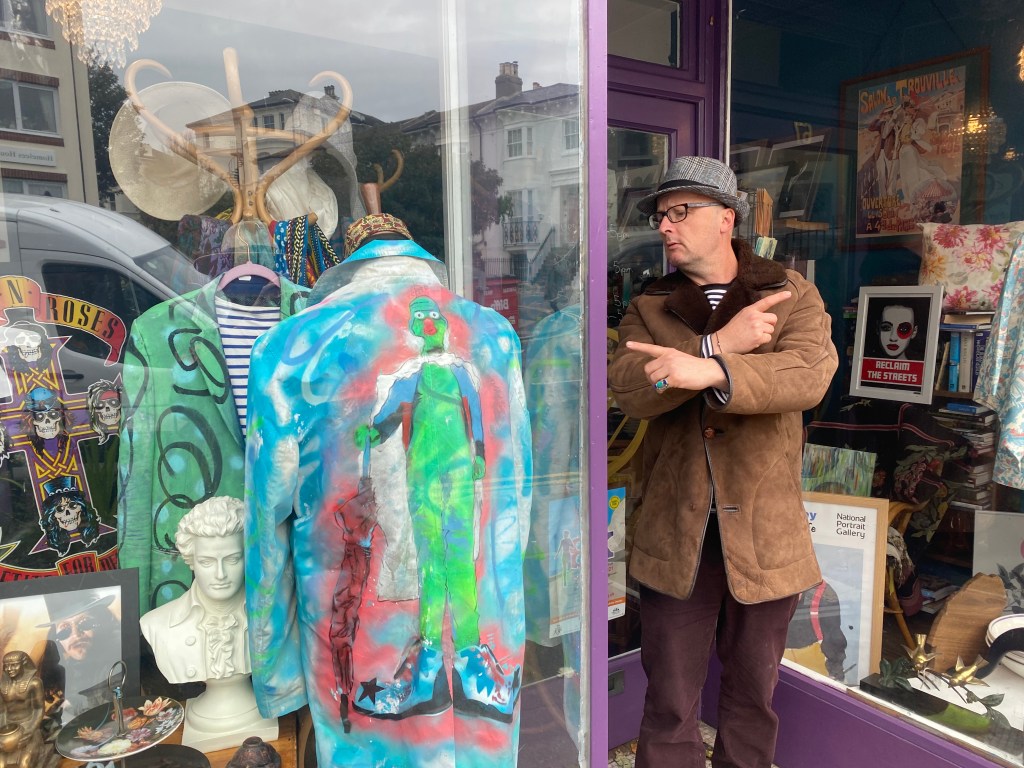
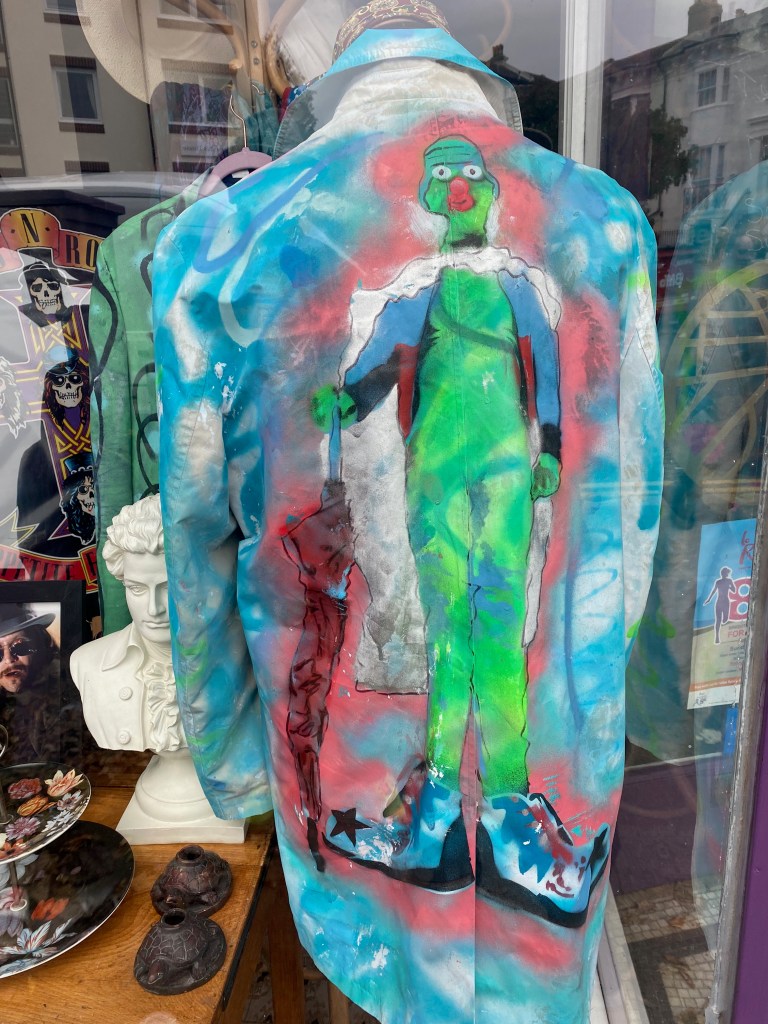
But it’s as his latest creation Artist Dotty that there’s most fun. An oversize character in a whose looks nod in the direction of Leigh Bowery but who, like so much of Matt’s work, treads the line between absurdist and message. Dotty has a habit of appearing where you least expect him. Right now you’ll find him on the back of a series of jackets in “Objet D’ials”.
Is Dotty a classic absurdist device to created to highlight the madness of our society – in this case, waste and the environment – or a very strange bloke in a green screen onesie? “Let’s say an eco clown whose job it is to make people look, laugh and maybe think.”
Rabindranath Tagore was a Bengali polymath – poet, philosopher, novelist, Nobel Prize winner… and resident of our fair city. And now there’s a plaque marking his life. Dr Jeanne Openshaw looks back at his life and times
Commemoration of Rabindranath Tagore in our city has been a long time coming. To state the obvious, a plaque needs a wall, and searches in local street directories and Indian archives for the Tagores’ precise home address have long drawn a blank. The solution was to switch focus to the school he attended, aged 17, in Ship Street (now part of the Hotel du Vin).
Rabindranath Tagore was a world-renowned polymath – poet, philosopher, novelist, visual artist, composer and activist. Born into a talented and cultured upper-class family in Calcutta (now Kolkata), India, with extensive estates in what is now Bangladesh, he came to embrace humanism and universalism.
He transformed Bengali written and visual culture, and in 1913 became the first non-Westerner to win the Nobel Prize for Literature. He was knighted by George V for his services to literature, an honour he later repudiated, in protest at the Jallianwala Bagh massacre in Amritsar.
A strong advocate of freedom from British rule in India, he nevertheless argued: ‘Patriotism cannot be our final spiritual shelter; my refuge is humanity. I will not buy glass for the price of diamonds, and I will never allow patriotism to triumph over humanity, as long as I live.’
Much later, two independent nations, India and Bangladesh, were to select Tagore’s song lyrics as their national anthems.
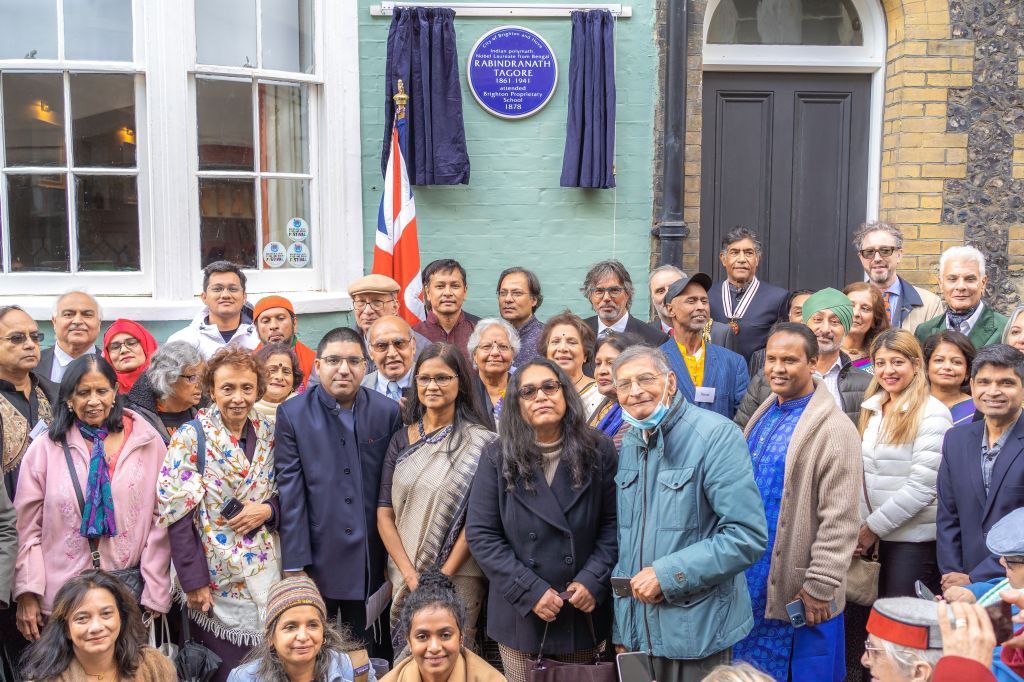
When the plaque was finally unveiled on 28th October, 7 Ship Street was accordingly festooned with three flags, and the Salvation Army played three national anthems.
Over 200 people turned up to the unveiling. But not, unfortunately, the High Commissioners of India and Bangladesh. COP 26 had claimed their presence instead. So the event was quieter than expected, although the seagulls tried to make up for that. The weather smiled on us – wind and rain held off until the following day.
Tagore was one of the most travelled persons of his time. However, the first place he lived in outside India was Brighton and Hove. He later wrote:
One thing in the Brighton school seemed very wonderful: the other boys were not at all rude to me. On the contrary they would often thrust oranges and apples into my pockets and run away. I can only ascribe this uncommon behaviour of theirs to my being a foreigner… (My reminiscences, translation from Bengali published in 1917).
On the day, Dr Kalyan Kundu, Tagore Centre UK, spoke about Tagore’s early schooling (or rather lack of it), and his first impressions of Britain.
Professor Shahaduz Zaman, University of Sussex, provided a Bangladeshi perspective. For Bangladeshis, Tagore is associated with the 1971 struggle for independence from Pakistan, and the new nation’s emphasis on Bengali language and culture.
Tagore’s descendants in India sent a touching email to all present.
A reception was held in the domed school room inside no.7 Ship Street, appropriately decorated with images of Tagore with various luminaries, as well as prints of his paintings, provided by the Tagore Centre UK. Songs by Rabindranath were performed by Mamata and Sunith Lahiri, also from the Tagore Centre.
Our neighbours, Vinod and Meena Mashru (of Bright News, Buckingham Road) provided vegetarian food and non-alcoholic champagne. Noori’s restaurant – across the road from the plaque – supplied the non-vegetarian Indian food. The Hotel du Vin provided ‘western’ food and drink (non-alcoholic on this occasion).
Credit is due to Brighton and Hove City Council, especially the Brighton and Hove Heritage Commission chair (also chair of the Brighton and Hove Commemorative Plaque Panel), Roger Amerena.
I’ve lived in Brighton for a few years now, on and off, but this is only the second year I have seen the Christmas lights in Western Road. You don’t get Christmas lights across the streets in West Hill: they’re probably considered a little garish. Especially on Dyke Road, between St Nicholas’s and Seven Dials.
But down in the big city, or the rather strange and somehow ungentrifiable Western Road, they like a display. I can’t remember what the lights spelled out last year: I think they might have said something like “BELIEVE” which I thought was a bit vague. Believe in what? Christmas? Santa? Climate change? I mean, there are all sorts of things you can believe in but not all of them are good. I think another set of lights said something uncontroversial like “PEACE” but then that’s pretty much par for the course for this time of year.
I wasn’t prepared for the slogan strung out across the road by the Sainsbury’s Local. What the pretty lights said this time was: “HERE WE GO AGAIN”.
I went into a kind of reverie. I imagined a meeting of the Christmas Decorations committee of Brighton and Hove City Council. It has been a long year: the months-long garbage strike has left everyone rattled and exhausted. And I suspect the Council has rather less money to play with than it did last year. The biscuits are not fancy. The coffee is not hand-ground Nicaraguan: it is Nescafe.
The Chair looks round the table.
“So what’s this year’s slogan going to be?”
Somewhere round the table, a spoon clinks against a coffee cup. Someone nibbles a Waitrose Essentials Garibaldi. They used to have Hobnobs. Chocolate Hobnobs.
“Anyone?”
“Nah,” says Trevor. (No council meeting in England is considered quorate unless there is someone called Trevor attending.)
“I’ve got nothing,” says Sue. She has spent the last month going over the accounts, and lost the will to live in mid-November.
A deep sense of Sisyphean ennui steals over the room. A voice pipes up from the back. It is Steve, known for his mordant wit, like Tim from The Office. “Here we go again,” he says.
There’s a long silence.
“Well,” says the Chair, “if no one’s got anything better …”
Steve is about to say that this was not meant to be a slogan, it was just a cry of despair, but then realises that if he says this, the meeting will drag on, and it is already as close to going-home time as makes no difference. He reads the room: everyone is looking at him, fiercely willing him to remain silent. So he remains silent. The Chair slaps her folder shut.
“That’s settled, then,” she says, and everyone files out. My God, they think: we got away with it.
And that’s how I like to think the meeting went. I couldn’t love this town more if I tried.
“It might sound glib, but I wrote it because I think Brighton is so special.” Daren Kay tells Katrin Johannessen why
‘The Brightonians’ is the debut novel of former advertising copywriter, Daren Kay. It tells the story of a social group in Brighton uncovering a mystery of the past, sparked by an old letter found in a hymn book at the funeral of iconic former (fictional) mayor Grace Davidson. It spans multiple decades and different generations of mostly queer people.
It was important to Kay, that the novel included different generations, as there can sometimes be a disconnect within the queer community between age groups.
“As a younger gay man, I learned a lot from older queer people and I think it’d be great to foster that intergenerational communication again, which is why in the novel I wanted to make sure there was a full spread.”
“What I really felt was important is I think a lot of queer history has been erased, it’s been forgotten, it’s been purposefully left to one side and so I wanted to do my little bit to make queer history interesting to another generation.”
Not only is there a spread over generations, but the characters also come from different parts of the UK and have different accents, Polari is also represented.
“It was largely a reflection. There isn’t anyone that is based on anyone that I know, but I would say that the characters are a mixture of a couple of people and lots of the characters have bits of me. I think Brighton is a melting pot. It might not be the most multicultural place, but I do think it is a melting pot. One thing I will say about Brighton is you very rarely meet people in Brighton from Brighton.”
Although the social scene is shown as quite competitive and perhaps even cynical at points, there is a definite sense of community throughout the book. Kay himself has experienced how the LGBT community has come together during times of struggle, such has the HIV crisis and the introduction of Clause 28.
“I was in my early twenties when that happened. My experience in Birmingham and Sheffield was that there was a separatism until that happened. I think the HIV crisis and Clause 28 brought lesbians and gay men together for the first time in a big, big way.
“I know from historian Alf Le Flohic, who is quite known in Brighton for his knowledge of queer history, he lived in Brighton in the ‘80s and he said that the lesbian community was very supportive of gay men during the crisis. So, it’s been solid for a long, long time. Particularly with older people. I think age is a great leveller.
“I’ll be really blunt, I think sometimes the different communities within our community spend too much time arguing with each-other, when we have a common enemy, which is quite obvious out there.”
Kay replaced the security of his job in advertising and started freelancing and following his passion for writing, resulting in the ‘The Brightonians’.
“I wrote it for me. As a copy writer, I went into advertising because I loved writing and as you go further up the ladder you get more and more removed from the reason you went into the job in the first place. So, when I left that job, I rediscovered my love of writing through this book.
“The other thing I wrote it for was Brighton. It might sound glib, but I wrote it because I think Brighton is so special. I just find it such an incredible place and I wanted to capture what I love about Brighton. That amazing concentration of some quite unusual people.”
In the novel one of the characters at one point ‘plays the Brighton card’, when she uses her love of Brighton to score social points.
“I’ve invented that, but I do think it exists. I think I have played the ‘Brighton card’. I’ve gone even further and played the ‘Kemptown card.”
“I think the proximity of Brighton to London is one of the things, that has made it so unique. I lived in London for 25 years and I find Brighton even more sociable than London. I think the geography of it, because it is quite small or concentrated people are much happier to do things.” Kay said.
Brighton is more than setting in the book and through a fantastical seagull it gets a chance to speak for itself.
“Brighton is so much a part of the book, I needed a way for Brighton to speak, so Charles de Gull basically became the voice. I’ve referred to seagulls in interviews as nature’s CCTV, because they’re just always there. For people who write, they are just always watching us. It seemed like the most obvious vehicle for Brighton to have a voice. What I liked about the seagull is that in my head the seagull has been there for 200 years, so it’s almost like a fantastical seagull really.
“Brighton has always been a really significant town on the south coast, because of its proximity to France and London. But Brighton in most people’s heads didn’t really become a place of any interest until the 1750s, when Dr. Russell recommended our seawater as this great sort of cure for everything, and people started to come down. So, I wanted Charles de Gull to have existed since that time. So, he allows me to set the scene and say this is a town, which has always been a centre of liberal thinking and artists.”
The people in Brighton might like to complain about the seagulls, maybe especially when having their food stolen by a shifty one, but they still have a special status in town.
“It’s weird. The book cover was designed by my friend Sarah Arnett. In her work, she has lots of birds, but she’s never done a seagull. It’s a very divisive thing in Brighton. It depends on if you’re being shat on, I suppose.”
His next novel is already in progress and it’s called ‘The Brightonians Under Siege’ and is about the last year and Covid.
“One of the things I wanted to capture and celebrate was the social scene and parties and what I sometimes call ‘competitive partying’ that I see in Brighton and now to suddenly have that stopped I think it’s really fascinating.
I do think that when people read this book still on the ends of lockdown, they will feel nostalgic for those fancy-dress parties and for being able to meet up with people and having a gin and tonic.”
The Brightonians will be released on April 23rd.
Anyone who signs up to http://www.darenkay.com before 30.04.21 will be entered into a prize draw for the chance to win a porcelain mug featuring the cover design by Sarah Arnett
The book is available to order now at Waterstones, Book Depository & Foyles:
I’ve been a big fan of this Brighton band since they started a few years ago, and we’ve done some superb gigs together at The Prince Albert, Hotel Pelirocco, two landmark gigs at the Concorde and the 100 Club in London supporting punk legends Sham 69. They also played the new band stage at Rebellion and have toured Germany.
You have just released your second album, Great Expectations. How long did it take to record, where did you record it and what’s your connection with Germany?
Char – We recorded the album in Horsham at Ignite studios it was very cold, we did nine songs there then we did three songs at Russell Church’s Sea Side Studios. The tracks were mastered at Gatehouse studios. We didn’t have time to record a song called Outsiders which is shame because it’s a rip off another song I really love.
Leon – We had plenty of time Char, me and Loz just decided it was out. Did you not get the memo?
Char – We work with Time for Action records that are based in Germany – it’s just a shame we can’t tour and get out to Germany, they treat us really well out there.
What is the main inspiration behind your songwriting?
Char – On this album lyrically I was inspired by a lot of the uncertainty and repetitiveness you start to notice in the people around you once you get past 25. I feel compared to the first album it’s a lot more pessimistic. But I’ve been told we sound a lot more vulnerable at parts.
Leon – I think with this album I wanted it to sound bigger than the rest, but when it came to the writing I wanted it to be as honest and raw as possible. The first album we wrote songs based around characters mostly with some self-reflection, but this time I wanted it to feel personal and more relatable.
When & how did the band form?
Char – I met Loz in a bar called PR6 he was playing Blink with his mate Harry. Then I met Leon at the Jurys Out open mic night – he was wearing a Libertines T shirt.
Leon – No comment. I prefer to keep this shrouded in mystery
Who’s your biggest influence & why?
Char – The Clash of course. So many reasons but for now I’ll say because they are the best band that there ever was.
Leon – Well this is a big one, what does one look for in ones influences? Raw talent, musical prowess, cutting truthful lyrics? I dunno. I like a catchy tune, I’m well into Polka at the minute – it’s the next punk take it from me.
You met Mick Jones (from the Clash) when he was in Brighton in 2015, what did he say?
Char – He said ‘Nice set boys. You’ll be hearing from my lawyers’. He was beyond cool and had a lot of time for creepy fans like me.
Leon – He didn’t speak to me. I saw Matt Cardle at Westfield once. That was pretty cool.
What’s been your favourite gig you’ve played so far?
Char – That’s really hard. Playing Concorde 2 with Sham was amazing. Our first gig in Germany was incredible, but all the gigs we played at 12 Bar in Soho hold a special place in my heart. I miss that place, but right now I’d be happy to play a gig at a bus stop.
Leon – I do love the Concorde 2 gigs, but we’ve done some great gigs at the Albert over the years, they can be very sweaty and lively. It was also the first stage we ever graced so it has a special place among the many venues we’ve played.
Where do you see live music going, post lockdown?
Char – Going to be a big hit I think which is bad because it wasn’t getting much support before, maybe people will want to go out more after being caged for a year.
Leon – I think there’s a lot of DIY stuff coming out now so I’m hoping the decline of the stadium show will give space for small grass roots venues to make a comeback. Instead of going to see old bastards headline the Brighton Centre, maybe people will watch a new band down the street.
What’s your fave film?
1.Star Wars (empire)
2.Toy Story
3.Rocky 1
4.Clockwork Orange
5.Batman 1989
6.The Fly
7.Drop Dead Fred
8.One Flew Over The Cuckoo Nest
9.On The Beat
10.Overboard
How are you keeping busy in the lockdown?
Char – Writing a lot and Leon has taught me how to record demos at home, so we’re just trying to get all the ideas down ready for when we can practice again. Got a lot of new songs between us, over 20.
Leon – I’ve been reading them books.
Any other contemporary bands you like, especially in Brighton ?
Char – Teenage Waitress I’m all over at the moment, The Lathums, Bite The Buffalo, and I’m loving the new Strokes album. And my mate I was in a band with at school recently showed me Cloud Nothings.
Leon – I’ve been getting into the new post punk thing, bands like Squids, Sports Club and Yak, there’s also some cool stuff coming out of Australia like the Chats and Viagra Boys
And what are your plans for 2021?
Char -Get the new songs together and ready to record. But also we were planning to record a new single so we will be getting that together ASAP I would like to get that out this year, all depends on when we can get back in a practice room together again.
Leon – Shake my tail feather, I just wanna go dancing.
If you could play anywhere in the world where would it be?
Char – New York!
Leon – San Francisco all the way.
Any advice for a band starting out right now?
Char – Write, rehearse, gig, record.
Leon – Don’t do it, get a trade or learn how to code or something.
Where can we buy the album?
Char – The physical copies of the album have sold out, but it’s still up on iTunes, Amazon, Spotify and a load of other streaming sites I’ve never heard of. Actually, we did a few Dirt Royal bundles with the album, t-shirts and previous singles and stuff. There might be one or two still available at www.pipandpine.com…. quick go now
Everything you ever wanted to know about life in Brighton (OK, and Hove)






 The Whistler