Raw ChocolateWhy not try a healthier type of chocolate this Easter? We all know that dark chocolate is better for us than milk chocolate, and now there is an even better alternative – raw chocolate. How does raw chocolate differ from other types of chocolate? Well, raw chocolate isn’t processed above 40 °C and this retains even more of its therapeutic antioxidant properties than other chocolate.
The chocolate has a rich and intense flavour with a naturally soft texture because it is dairy, sugar and additive free. Raw chocolate is suitable for anyone wishing to supplement their diet with a high antioxidant treat and is ideal for diabetics and vegans. If you currently eat milk chocolate then your palate may take a little time to adjust at first. The reason being that milk chocolate is loaded with sugar, milk and various vegetables fats making it very economical to produce and highly addictive. Dark chocolate and raw chocolate are an ideal ‘chocolate fix’ as a couple of squares is generally enough to cure the need for something sweet.
Here are three good health reasons to try raw chocolate:
1. Part of a healthy diet: Raw chocolate contains high antioxidant levels. It is free from milk, trans fats and additives and doesn’t contain processed sugar, therefore it won’t send your blood sugar off the scale.
2. Heart Health: Cocoa flavonoids, a group of antioxidants, have been reported to reduce the risk of coronary heart disease having a cardio protective effect.
3. Mood food: Chocolate contains the neurotransmitters anandamide and phenythylamine (PEA). These raise the levels of the neurotransmitters in the brain. Including sources of anandamide and PEA in your diet increases your ability to: focus, pay attention, stay alert and active, and relieves pain.
Graham with PAT dog Lucy and stroke patient at RSCHPets As Therapy (PAT) brings comfort and companionship to people in hospitals, hospices, residential/nursing homes, day care centres, special needs schools and many other places. PAT dogs and cats can be found on stroke rehabilitation units where they can help people to improve their mobility by interacting with them – sometimes just through gentle touch. They can often get through the invisible communication barrier put up by people suffering from clinical depression. Those who are lonely and withdrawn often respond to the selfless affection provided by a PAT dog or cat where human contact has failed. This is often the first step to recovery.
Many PAT dogs also work under the direction of clinical psychologists with children who suffer from dog-related phobias, helping them to develop the confidence to walk or play in their neighbourhoods without fear or stress. Over 4,500 PAT dogs and 108 PAT cats visit more than 7,000 sites throughout the UK, and over 130,000 patients every week benefit from the service.
All candidate PAT dogs and cats undergo a temperament test, which is carried out by a PAT-trained assessor. Neither the size nor pedigree matters – it is the animal’s temperament that is important. In small ways, PAT dogs and cats bring gentle companionship to the patients and staff alike.
Graham Bourgoing, the Area Coordinator for Brighton, has for some time been taking his PAT dog, Lucy, a 5-year-old Golden Retriever, to meet patients in the stroke unit of The Royal Sussex County Hospital, Brighton. While on the stroke unit with Lucy, one patient’s son told him it was the first time that he had seen his mother smile since she was admitted, a reward in itself. Graham says, “I sometimes think simply to see a patient smile – that is my reward as a Pets As Therapy Volunteer. I find that it is the PAT dogs that tell their own stories by their presence. I have discovered that Lucy and many other PAT dogs have an inner sense of knowing just how ill some patients are, and adapt their gentle manner accordingly. On these occasions Lucy will sit quietly next to the patient and rest her head on their hand. I remember an elderly lady who had been admitted recently who told me that she had never been in hospital before and that she was frightened, and I could see she was confused too. Just before I was leaving her ward, I noticed this lady had two visitors but she was very distressed and crying aloud. Lucy stopped in her tracks looked towards the bed, so I gently asked one of the visitors to vacate her chair next to the patient so that I could get Lucy up to the patient’s eye level. To my amazement the elderly lady stopped crying and began to stroke Lucy’s head. If I were to give Lucy’s gift a name, then I think it would be me only trying to understand something that only Lucy herself fully knows”.
Supplying this service to the local NHS Hospital and other establishments within Brighton and Hove area costs the Pets As Therapy Charity £75 for each volunteer per year. Loyal volunteers kindly contribute £19, leaving a shortfall of £56. Your sponsorship would help benefit adults and children of all ages and disabilities to receive a regular visit from a PAT dog or PAT cat. In return you will receive a certificate of recognition for your kind support. So, could you or your company help Pets As Therapy by sponsoring a volunteer with their PAT dog – a dog just like Lucy – or a PAT cat? Any donation – no matter how small – will make a difference, and will be greatly appreciated by both Pets As Therapy and the patients who benefit from this service.
Sponsorship is easy. You can send a cheque, made payable to “Pets As Therapy” to: Pets As Therapy, 3a Farm Cottages, Wycombe Road, Saunderton, Princes Risborough, Bucks HP27 9NS. Alternatively, you can pay by debit/credit card by visiting www.justgiving.com/sponsoravolunteercampaign.
If you would like more information about becoming a PAT volunteer or supporter, please check out the website at www.petsastherapy.org; you can also see a short film about the work of Pets As Therapy (just click on ‘Media’), or you can telephone 01844 345445.
Rise 2009 8k Undercliff Run for Women takes place on October 11 at 9am on the Undercliff Walkway by Asda, at the Brighton Marina. Rise helps women, children and young people affected by domestic abuse. Celebrating their 15th anniversary and aiming to raise a minimum of £15,000 towards services, Rise runs the only local telephone helpline for people suffering from the effects of domestic abuse and needs to raise money to support this vital service.
A unique run along the scenic cliff-side path from Brighton Marina to Rottingdean and back to the Marina, in total 8k (5 miles), the Undercliff Run is an exciting opportunity for new and experienced female runners to experience the buzz and camaraderie of running with 400 other women, alongside the expanse of the sea.
For more details, contact Naomi Bos, Events Officer, Naomi@womensrefuge.org.uk, 075150 27094
Sodium lauryl sulphate (SLS) is reported to be the most frequent of eye irritants in shampoos. It is a cleansing and foaming agent used in a range of personal care and household products. SLS can damage the protective outer layer of the skin and has been shown through research to penetrate the skin to depth of 5-6mm (1/4 inch) causing skin irritation with deeper transference occurring via the bodily systems. SLS is commonly used in laboratory testing on humans and animals to induce skin irritation so that the healing or modifying properties of other substances can be measured.
Skin is also sometimes irritated by SLS in tests to increase the penetration of other substances. Using SLS via cosmetics and personal hygiene products could potentially allow other toxicants to penetrate the skin more easily. Toothpastes often contain SLS in order to clean the teeth and mouth more efficiently, even though the substance has been reported to irritate mucous membranes in sensitive individuals. In the US, children’s foaming bath products carry a health warning alerting parents to this.
Formaldehyde is used as a preservative in nail polishes, soaps and other cosmetic products. It is also found in household products such as furniture polish. It is a suspected carcinogen and common skin and eye irritant. The international agency for research on cancer (IARC) says there is evidence that formaldehyde causes a form of throat cancer in humans. Although the US Food and Drug Administration (FDA) does not object to the use of formaldehyde in cosmetics, providing certain restrictions are adhered to, finished products containing it in the EU must be labelled with the warning, ‘Contains Formaldehyde’ if the concentration exceeds 0.05 per cent. It is one chemical you are well advised to avoid given its potential to cause allergies and irritation. Seek alternatives wherever possible.
If you find it difficult to get to the shops or know someone who could do with some help getting there, the Easylink shopping bus service is a door-to-door minibus service that picks shoppers up from outside their homes, takes them to a local supermarket or city centre shopping street and then returns them home when they have finished their shopping.
The service runs on Mondays to Fridays and is specially designed to meet the needs of older people and people with mobility difficulties. All the buses are wheelchair accessible. The drivers are willing to help passengers to their seats and make sure they are comfortable before driving off. Easylink buses run in all parts of Brighton and Hove, from Saltdean to Portslade and from Patcham to the Seafront. Shopping centres served include the Holmbush Centre in Shoreham, Sainsbury’s and the Co-op in Hove, ASDA at Hollingbury and the shops at Churchill Square, London Road and Brighton Marina, as well as out of town centres, such as Worthing, Eastbourne and Paradise Park, Newhaven.
Details of all the journeys that run are on the Community Transport leaflet and website www.bhct.co.uk and pre-bookings can be made on 01273 677559. The fares are reasonable, £3.50 return for most local journeys and a little more for the out of town trips. Much cheaper than a taxi and good value for the personal help that some passengers need. Supported by the B&H City Council.
Everything you ever wanted to know about life in Brighton (OK, and Hove)



 Rise 2009 8k Undercliff Run for Women takes place on October 11 at 9am on the Undercliff Walkway by Asda, at the Brighton Marina.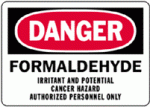
 The Whistler