

This week’s episode of The Brighton Whistler podcast

Pride In Pride. Loulou Novick on her first Pride after coming out

As a newly out person in Brighton, what does Pride mean to you?
It means a lot. I’m recently out, but also it’s now I’m a comfortable with it. I was out when I was maybe 16 or 17. I was aware I was bisexual, but I wasn’t proud and it didn’t work out for me. It felt actually quite scary, and I reverted to being straight for a really long time, until I had my first girlfriend last year. And last year I had COVID, so this is my first year feeling proud at Pride. And it just feels quite a big deal because I think I owe it to myself after growing up being so internally homophobic to myself, and just rejecting my entire identity, rejecting myself. I didn’t want to live my life that way. Now I’m so outrageously camp and queer all the time because I was afraid to express myself that way the whole of my life. So I’m excited to experience that feeling with other people and really feel the passion amongst everyone.
What bit of Pride would you feel part of? Would you feel comfortable being seen by the crowds, with the tourists coming to look at ‘the gays’? Do you want to be there being celebrated by outsiders?
It’s difficult because I’m not very queer presenting. People wouldn’t be able to tell I’m queer just by looking at me which is something I’ve struggled with in terms of finding someone to date. I’m very aware you have to fit into the stereotype to be seen. So like you can tell gay men are gay if they look gay, or butch lesbians, for example, but there’s so many other gay people who don’t fit into the stereotypes and I’m one of them. And I feel it’s difficult for me to feel seen in that sense.
I do want to take part in Pride, but I don’t think I would be able to because I don’t think people would see me. So it’s quite conflicting. But probably just being amongst the atmosphere and so many other proud people will be more than enough for me.
Physically the parade is down the middle of the street with the onlookers on the side. You don’t have to be gay to be in Pride. How do you feel about that?
I don’t like when people use it as a drunken street party, an excuse to get drunk during the day and wear glitter. OK, it’s nice, but you have to understand that queer people suffer a lot. It’s very, very new that we’ve been accepted, and can find communities with each other and go to gay bars and comfortably be safe, but even in Brighton… my friend who’s a trans woman got attacked and beaten to the ground by a bouncer of a queer bar. So even in Brighton you don’t feel safe all the time.
We really historically had to fight for acceptance by society and fight to find communities and everything and it’s just… probably straight people don’t see any struggles at all, you probably wouldn’t see those issues. But I see them all the time. But, of course, alliance is a huge contributing factor to being accepted and proud, and for those genuine people who come to cheer for us and support us, I love that!
You live Brighton, you’ve grown up in Brighton but there are plenty of very homophobic places. What does Pride say to the world?
I think it’s supposed to show solidarity and it’s supposed to show a celebration for being comfortable in who you are. That’s basically what it comes down to. Because most queer people fight with themselves for so long internally. You hide who you are for so long because you’re scared of what other people will think and you’re scared of being rejected by friends, family, society, everything. You fight with yourself for who you are.
Pride just comes down to being a celebration of people accepting themselves, of being comfortable with who you are and proud of who you are and each other. I’m proud, genuinely I’m proud. And I know that my queer friends, they’re proud and it makes a huge difference. Being in an environment that encourages feeling that sense of pride. Because your whole life you just you haven’t felt that at all. And it makes a difference knowing people care about you being OK with yourself.
But it’s also a blurred line because the city has made it a money making experience. You pay for tickets. The streets are closed off, the clubs are closed off, the parks are closed off, and it’s ticketed and the performers at the festival are straight. They’re queer icons. They’re loved by the queer community, but they’re straight people. Why wouldn’t you have queer performers?
Maybe but isn’t it about solidarity?
It is about solidarity, of course. But it’s Pride. It’s Gay Pride. Britney Spears performed.Britney’s not gay. She’s a cis straight woman. It’s Pride! Get Elton John, or anyone else who’s queer. So that’s the thing that makes me think it’s just about the money and the tickets and the people coming down.
For your first Pride, does that matter?
Yes, it does. I just want it to feel authentic and genuine. I don’t want it to feel like a commercialised business venture. I know people come to Pride and they don’t care about gay rights. They don’t care. I’ve been with people previous years who don’t care about gay rights, straight people who’ve never spoken about gay rights and they go just want to go and get drunk because everyone’s out on the streets and it’s fun. So you don’t know if it’s genuine these days. You don’t. I’m going because I am proud and I want to see other proud people. But it’s bittersweet because you know other people are coming down and they don’t give a fuck.
An extended version of this interview with Loulou Novick is available on the new Whistler podcast
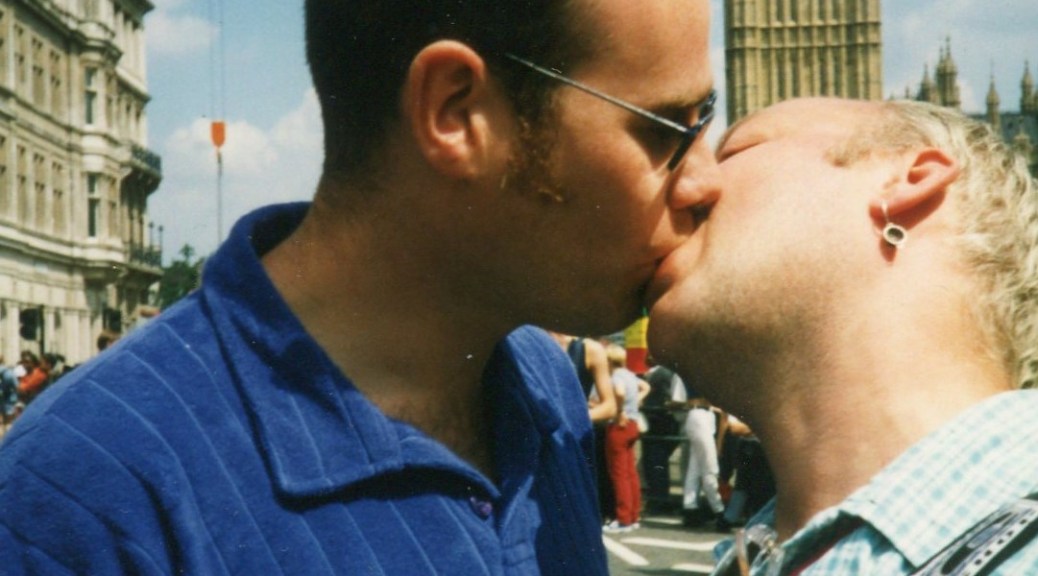
Does the increasing commercialisation of Pride make it any less meaningful?
Harry Hillery, a veteran of Prides past, on how Pride has changed, how he’s changed and why it’s still powerful

I moved to Brighton in 1988 to setup a small business and decided that setting myself free should also be part of the adventure. In London I’d lurked in the shadows, fearful of what people might think.
This might sound over the top nowadays, but it was different then. I remember testing the water with a ‘friendly’ boss once, only to be told that if my news went public, any hopes of progression would evaporate if I wasn’t sacked first. So, I came to Brighton to be reborn and vowed to never lie about myself again.
In 1991 I met Alf in the Black Horse and we soon fell very much in love. Looking back, I owe so much to his gentle nudges and knowledge of all things queer. He introduced me to new ideas, new writers and helped me navigate a new queer reality. My first Brighton Lesbian & Gay Pride with Alf was in May 1992 if memory serves.
I remember how moved I was by the spectacle and how overjoyed I was to be holding hands with my boyfriend. At the time, Brighton was gripped by the AIDS epidemic and the fallout of Section 28, which made it doubly important to shout our presence and challenge a tsunami of hate and misinformation.
As we walked along Western Road towards Churchill Square, chanting ‘we’re here, we’re queer, we’re not going shopping’ there was a tangible sense of loathing from the pavements, that sometimes turned into abuse or occasionally a missile. Although I was nervous and a little frightened, I felt a belonging that I’d never had before as a queer man – a kinship with those who’d trailblazed for me – Marsha P Johnson, Sylvia Rivera, Antony Grey, Jackie Foster, Peter Tatchell. Lesbian & Gay Pride had to be loud and angsty to be heard above the din of hatred – we were under attack and our friends were dying.
I haven’t been to a Pride event for many years now for a number of reasons. Apart from getting older and a general dislike for crowds and mess, for me that sense of kinship and a link to the past has gone. Dropping ‘gay’ and ‘lesbian’ in the title and the rebrand to Brighton Pride made me uneasy. Although queer as I prefer to call it is thankfully less siloed these days, the dropping of these words still felt like a watering down and a betrayal of sorts. A bowing down and compliance that was perhaps necessary to attract corporate sponsorship from banks and other institutions that would not have been welcome (or wanted to be associated with us) in days gone by.
The event struggled for years due to alleged financial mismanagement and in fighting, so things had to change, but I for one would be happier if the activism backbone was more prominent and given centre stage. I recognise things are better now, but gay marriage and the proliferation of rainbow flags to sell anything and everything, hasn’t made everything OK.
Our hard-won rights can be taken from us in a heartbeat, and there are many out there who still wish us harm. Queer Pride (or LGBTQ Pride if you prefer) is not just about getting horny and high or listening to Britney Spears, it’s about kinship and remembering how we got here. There’s also still so much more to do – look at all the venom around Trans rights for example – that’s surely what ‘Pride’ still needs to focus on.
On a final positive note though, it is wonderful that Pride is now so fully embraced by the city. It’s also wonderful that it raises such large amounts of money to help organisations close to my heart like Lunch Positive and Mind Out continue their amazing work. And lastly of course, whatever we call it, it continues to be the best of parties, and a great excuse to be loud and proud.

Editorial: Why Pride is like a shark

There’s a curious thing about sharks. Sharks must always move forward. Their gills – the way they breathe – are designed in such a way that if there’s no forward motion, they don’t work. So they must move forward. The only shark that doesn’t move forward is a dead shark. And who wants to be a dead shark?
Brighton Pride is something to be proud about. It’s one of those things that makes Brighton what it is, one of the reasons we live here. But everything changes, and rather like Glastonbury, the world is divided between those who say “Oh, it’s not like it used to be” and those who, for their own reasons, are happy it’s there.
Pride began here in 1972, a demonstration by The Sussex Gay Liberation Front… Don’t worry, we’re not going to go into the history of Pride – that’s what Wikipedia’s for – but suffice to say it’s very different now. A weekend wristband to the St James’s Village Party is £27.50, a ticket to “We Are Fabuloso” at Preston Park to see Christina Aguilera is £54.50 – £67.50 if you get the weekend pass. Of course, it’s not like it used to be.
Politics and commercialism are uneasy mates. They’re often suspicious of each other. Must it be that way? Must money ruin the spirit? At the first Pride here there were 2,000 people. This year there’ll maybe be half a million. Has Pride strayed too far from its roots and become another party on the calendar, next to Fatboy on the Beach and whatever else?
Should all the acts be gay? I remember how Live Aid was criticised for being too white, for having no African bands. If we were raising money for Africa, the argument went, should we not have been celebrating African music and culture instead of listening to a lot of white chart acts? But a lot of money was raised, a lot of people were helped. So should all the artists be gay? Or are we celebrating togetherness, celebrating being us?
Nothing is ever the same as it was. Life, like the shark, always moves forward. And Pride, just like Glastonbury and the others, just gets bigger, gets more popular, becomes mainstream, part of a wider culture.
None of this is to say that we should think the battle’s won, that the story is over, that that was then and this is now. The battle’s never really won. It never stops. We only have to look at the resurgence of antisemitism under the last Labour leadership to know how fragile our safety is. We’re safe now, but we should never forget that living in Brighton in 2022 is a privilege, that we’re just lucky enough to be born into a time and place where glitter’s not a crime.
Maybe we should just enjoy how great is it that half a million people can come and celebrate together, drink together, dance together. How great that the only murder is gonna be is on the dancefloor. And you’d better not kill the groove DJ, gonna burn this goddamn house right down…
View From The Hill – Nicholas Lezard

How did you spend the Great Heatwave of 2022? I spent it paddling in the sea and running contraband over the Brighton-Hove border. I’ll start with the sea. It’s slightly less traumatic.
The thing is, that although I have been coming here since 1984, in the very week the IRA blew up the Grand (golly, I thought, is Brighton always this interesting?), and living here since 2018, I have never been in the sea here. Well, maybe once. But the memory is confused and dim and I might be imagining it. This time, though, I really did.
I took off my shoes and socks, rolled my trousers above the knee, and stepped into the surf. It was about half past nine in the evening, and the breeze, such as it was, was coming from the North, that is, from the parched interior of the country.
There were still plenty of people on the beach, at least one barbecue I could see, and, of course, bongo players. Did you know that the council hands out free bongo drums to everyone who moves here? I’ve yet to claim mine, but I think that’s rather charming.
One of the reasons I have always been reluctant to swim here, apart from the fact that the sea is incredibly cold, is the beach. I have lovely, delicate feet, and their soles are sensitive, so walking barefoot on the shingle is not one of life’s great experiences.
I had been hoping that in the 38 years since I first came here, the action of the waves might have done something to turn the stones into sand, but it quite simply hasn’t happened yet. I mean, come on.
But then again … it kind of has. Go out at low tide and you’ll find that it actually is a bit sandy on the shore. (Incidentally, it took me half a century to realise that the singer Sandy Shaw’s name was a pun.) So I paddled around a bit; the water was Mediterranean-warm. That was a big surprise. But after a while there’s only so much paddling you can do before getting tired so I went back up the beach and lay down in a damp patch of stones, which was very welcome.
Isn’t it nice how the beach slopes in such a way as to make a kind of natural divan or sun lounger? I had a smoke and looked at the lights of the Rampion Array blinking on the horizon.
A dog ran around like crazy, at one point even kicking a couple of stones onto my head but he hadn’t done it on purpose so I took no offence.
I knew I had a hill to climb when I turned for home, but somehow the knowledge that it was warm enough to sleep on the beach if I wanted made it all better somehow. God, living in this town is a privilege. And my stories of smuggling bongoes into Hove will have to wait for another day.
 The Whistler