Tag Archives: poetry

Andrew Clover: Talks to the trees

The Hidden Life of Trees, Peter Wohlleben’s 2016 bestselling novel may have revealed trees talk to each other: but what would trees say to us? 

Yes… the idea seems odd – but it wouldn’t to Druids, The Sioux, or early Buddhists. It’s no surprise that the Buddha found nirvana by the Bodhi Tree, or that the Old Irish word for oak is duir: a druid is someone who connects to the oak – which brings wisdom, strength, and – even – vision.

But how does this work? How would you do that? Well…

1) Walk to your favourite oak. Already you’ll be feeling good. (Trees’ dappled light calms the mind; they emit chemicals that boost our immune systems). 

2) Greet your oak in some way. I fancy they like a hum. So I place lips and heart, and hum the question, “Can I sit, and be your sapling?” 

3) Most oaks will seem to say “Yes”. (Most yews will tell you to sod off). 

4) Sit, shut eyes, breathe slowly out. This stimulates the parasympathetic nervous system – releasing oxytocin – the body’s own version of the valium.

5) Meanwhile, mouth the seven magic words, ‘I breathe down and push down roots’. You’ll get a sense of fears and worries being drained down into the earth. 

6) Breathing up, mouth: “I breathe up and breathe up strength”. Imagine energy coming up, from the ground, filling your chest, your head, and passing up into the oak’s strong trunk. (By now you’ll be feeling way stronger).

7) Next time, breathe up to the oak’s calmly spreading boughs, mouthing, “I breathe up and breathe up calm”.

8) Next, breathe to the oak’s playfully wiggly twigs. In Latin, the oak was called quercus: and the oak is quirky. It’s the playful grandad of trees. Mouth, “I breathe up and breathe up lightness”.

9) Now, don’t hurry. If the oak might wish you to do one thing it’s that -never hurry. But when you’re feeling very calm indeed, breathe on the essential invitation the oak offers: think, “I am safe, to imagine, the future, that I need”

10) Let your imagination fly, like a bird, five years into the future. Imagine a tree, growing by the house, that you need. How big is it? What can you see in the garden?

11) Imagine entering its front door. What’s the floor like? 

12) You might see a photo of you, on the wall. What are you doing?

13) When you’ve returned home later, write down what you saw. The oak is known as The Gatway To The Mysteries. Your vision could be the start of something. 

Perhaps imagine the oak as Phil Oakey, singer of The Human League, a strange but trusted figure, inciting you to Open Your Heart. Imagine its rutted trunk is leading you into a better future. And it may.

When I first did this exercise, I saw the future I needed involved a shack, surrounded by jungle trees, that I’d helped plant, which, a year later, inspired me to sail the Atlantic, to plant 2500 trees. I lead this meditation, once, for a coaching client, who saw herself creating a company to empower female sport. Six months later, she’d raised a hundred million in investment. 

Now… hang on… I’m not saying breathing on trees makes you rich. Far more likely, you’ll embrace the lesson of the chestnut, “I want nothing… I have it all right now.” I’m just saying that there’s powerful magic, in the oak – and in all trees. 

And that connecting to them can bring a powerful, quirky magic into your life.

What’s your favourite tree? Would you like me to walk to it with you, to tell something of its magic? If so, get in touch. You’ll know what I’ll say. 

mrcloverthefamoussnail@gmail.com 

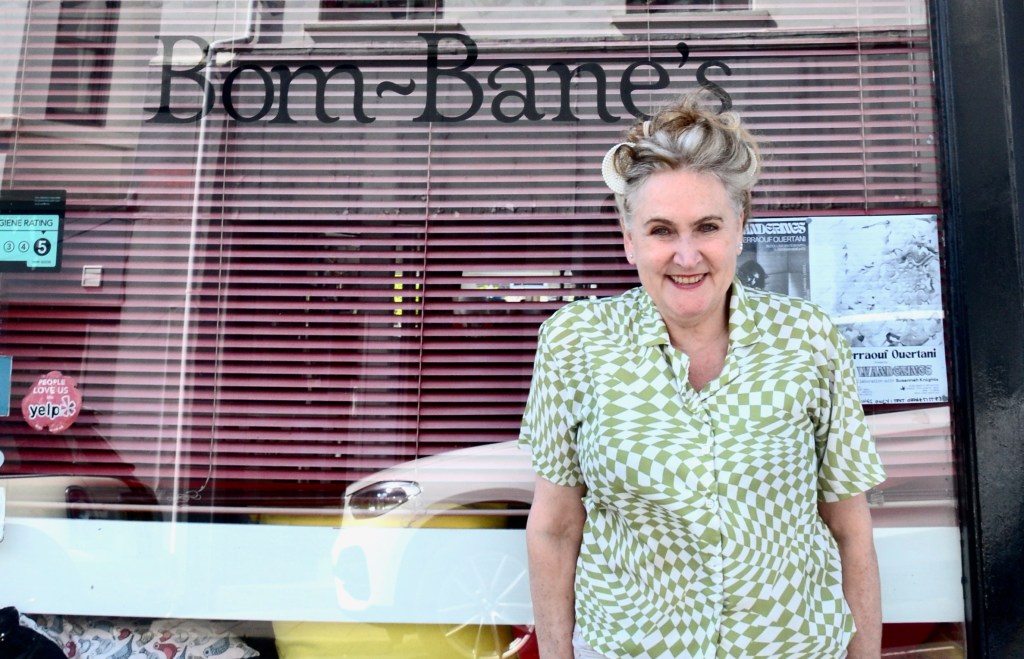
Peter Chrisp talks to Jane Bom-Bane

Jane Bom-Bane plays the harmonium while wearing beautiful mechanical hats, which illustrate her songs, such as ‘I’ve Got A Goldfish Bowl On My Head’. She had the idea to open a café while running musical evenings at the Sanctuary in Hove with her then partner, the multi-instrumentalist, Nick Pynn. After she bought 24 George Street in March 2006, they spent six months restoring the building and creating the café. 

“It was a wing and a prayer,” says Jane. “A lot we did ourselves. People who helped us were friends and gave us really good prices. For a lot of years after, we were giving people free sausage and mash.” Here she’s talking about stoemp and sausage, one of the café’s great Belgian dishes created by Andre Schmidt, the first chef. It’s still on the menu today.

Jane and Nick built seven mechanical tables inspired by table-related wordplay. These are the mirrored Tablerone, the Water Table (a model of the Palace Pier with working rides standing in a rippling sea) and two Aesop’s Tables, showing 1920s animal fable cartoons. The Uns-Table, the Turntable and the 27 Chimes Table all have delightful surprises which I leave to you to discover.

“Until the day before we opened, I still hadn’t worked out a way of putting water in the Water Table. I knew it had to be an oil because water would evaporate. I wanted a transparent oil, but the things I ordered on the net were yellow. And I was in Boots just around the corner and do you know what it was that I spotted? Baby oil! And that baby oil’s been in there for 18 years!”

The front wall of Bom-Bane’s has a bust of Jane with a revolving tray on her head with its own story to tell. Made in 2007 by her brother-in-law, Johnny Justin, it was stolen in 2012, later found in a student garden, minus its hat, and restored in 2017.

Go down the spiral stairway and you reach the basement, the main performance space, its walls covered with paintings and instruments. Although there’s only room for 25 people, it’s a room performers love. Stewart Lee, Bridget Christie, Jerry Dammers and Rich Hall are among the many who have played here.

Bom-Bane’s has a tradition of singing staff, beginning in 2008 with the waitresses Rosi Lalor and Candy Hilton, who Jane discovered were wonderful harmony singers. “I thought I’ve got to harness this, and so I wrote a musical. It was all about the café and how we cooked things, and how I got parsley and coriander mixed up.” 

This was the start of the Bom-Bane’s Family Players, who would perform a folk musical written by Jane every May fringe and at Christmas. These often used the whole building, with an audience of just five following a promenade performance from the attic to the basement.

Puppeteer Daisy Jordan, fresh from art college, joined Bom-Bane’s as a dishwasher in 2010, and soon found herself singing and performing puppetry as a member of the family players. Today she says, “I wonder if I would be a performer/puppeteer if it weren’t for Bom-Bane’s.” 

Isobel Smith, another puppeteer, had only made one puppet when Jane invited her to put on her first show here. Rosi Lalor, encouraged by Jane to write and perform her songs, has gone on to make two solo albums. 

To celebrate the centenary of the crossword in 2013, Jane turned the building into a big crossword puzzle, 5 Down and 20 Across. Her sister, the crossword setter Pegleg, wrote puzzles which were placed on the building’s 20 doors, which had all been turned into black and white paintings by different artists.

I painted one of the doors with the story of the explorer Sir John Franklin’s mysterious disappearance in the Arctic in 1845. By a curious coincidence (or Bom-Bane magic?), Sir John’s ship was discovered a year after I did the painting. This led to me hosting a series of Franklin Disaster Mystery evenings, with Arctic food, Inuit testimony, whale song and Jane as Sir John’s widow singing Franklin ballads.

The current chef is the singer-songwriter, Eliza Skelton. Unlike the waitresses who became singers, she was a singer to begin with. She performs here in the musicals, which she now co-writes, and as a member of the Silver Swans, a madrigal group with Jane and Emma Kilbey. She learned to be a great chef by working in Bom-Bane’s.

In 2008, Eliza and David Bramwell first staged Sing-a-long-a-Wickerman here. Audience members, invited to dress in character, were given a ‘Pagan Hymn Book’, which allowed them to sing along with the songs from the film. Eliza and David take this to festivals and theatres around the country, and still host Folk Horror film screenings in Bom-Bane’s. 

Today, Jane spends midweek with her mum in Coventry, and so the café is only open at weekends. It’s staffed by Jane, Eliza and recent recruit Kate Holden. Jane says, “Kate is helping me in the kitchen. She says she’s not musical, but I’m teaching her to play the guitar, and I think she can sing. Most people can sing.” That very evening Kate made her stage debut, accompanying Jane in a song.

We ended by talking about plans for the future. On the anniversary, 1 September, there’s a coming-of-age celebration, with 18 songs sung by Jane and her family of players. “There was a couple in last week who I got talking to. Somehow we got talking about when we first opened here and he said, “Was there anything that you planned to do that you didn’t do?” And I said “Yes, I wanted to make a tap with water music so that when you turned the tap on music came out with your water, but I never got around to it.” And he said, “I’ll do that for you!””

I tell Jane that I think the cultural impact of this little building has been massive. “When you look at it like that, yes, it’s been a springboard for a lot of people that normally wouldn’t do it. It’s because it’s so little and friendly, and that’s what Brighton’s like, isn’t it? It catches you if you fall.”

l Bom-Bane’s, 24 George St, Kemptown, BN2 1RH

For bookings email janebombane@yahoo.co.uk

https://janebom-bane.bandcamp.com

https://www.elizaskelton.com

https://www.daisyjordan.co.uk

https://rosilalor.bandcamp.com

Poetry Please

The fifth round of the Clore Poetry and Literature Awards is now open to applications from schools, community groups, and not-for-profit organisations to help provide poetry and literature initiatives for children and young people across the UK. The closing date is 1 May 2013.

Recent reports suggest that fewer children and young people are connected to the world of literature and that new and inspiring ways are needed to help them see its possibilities. Quality literature offers a richness of language and ideas which can excite and extend children’s and young people’s horizons and experiences. The Clore Foundation is looking for evidence of a sustained focus on published literature (contemporary or classic), enabling participants to enter a world created by or within the literature and poetry, and to appreciate its meaning.

The Awards will cover project costs ranging from £1,000 to £10,000. For more information see cloreduffield.org.uk.

Poetry for Pleasure

On Monday mornings I often find myself approaching the Cornerstone Centre, off Hove’s Palmeira Square. Just before noon I climb the stairs to a small room on the first floor. Several people are already there; soon the room is quite crowded. Now a ceremony begins. Seated at the front, a leader introduces the theme for the day. One by one, members of the group come forward to read. What are they worshipping? Poetry!

Most of the people who meet every Monday at noon at the Cornerstone are retired. Formerly, they were teachers, actors, civil servants, artists, academics – from all over the globe. They share a love of poetry, although their personal tastes may differ markedly. What they enjoy is the chance to hear some of the world’s finest poems read aloud.
Continue reading Poetry for Pleasure