

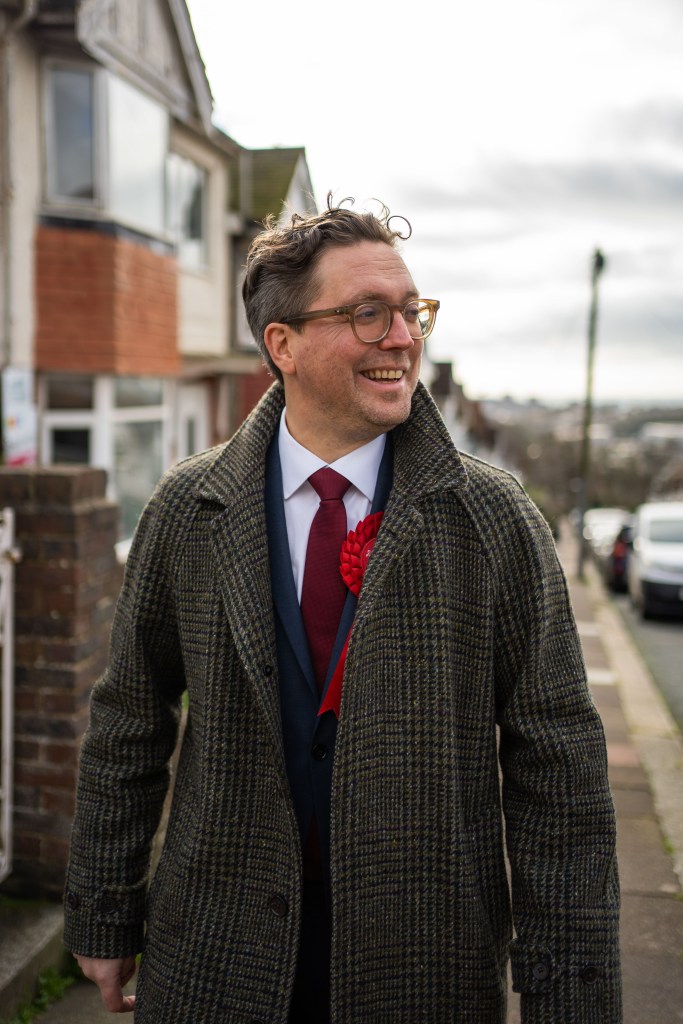
Here in Brighton Pavilion, we’ve had the same MP since 2010. Tom Gray, the new Labour Party candidate, talks to Jed Novick about changing that
Did you go full Spinal Tap? Did you throw strop about the miniature bread and get all the brown M&Ms taken out?
“No, no. I’ve always been too tethered, too down to earth.”
So OK. What was the most riderish rider you ever had?
“At one point I was struggling to keep all my socks clean, because doing your laundry on tour is an absolute ache, trying to find a launderette in Cleveland… So I added socks to the rider because I was thinking it would be nice to have some fresh, clean socks.”
Did you stipulate how many?
“Yeah, five pairs of clean socks.”
Colour?
“Whatever, just grey, blue or black.”
Clean socks. Grey, blue or black. And I was hoping for Nigel Tufnel.
I’m with Tom Gray, founding member of 1999 Mercury Prize winning band Gomez and now Labour Party candidate for Brighton Pavilion, a seat currently held by Caroline Lucas with a majority of nearly 20,000. Normally that would be considered a safe seat, but Caroline’s standing down and suddenly that 20,000 feels a bit vulnerable, a bit marginal.
“I think that’s because it’s Brighton Pavilion. It’s a unique place and has a unique standing in the electoral universe. It’s very particular and a very unusual group of people who live here. There’s an extraordinarily high level of education, of cultural engagement, of familiarity with international politics. There’s also a lot of money here, it’s actually quite a wealthy seat overall compared to most seats in the country, although there are areas of deprivation, real deprivation.
“Now, within that group, what you have is a huge number of people who’d consider themselves progressive. They wouldn’t say they’re Labour, they wouldn’t say they were Green, they might even have voted for the Lib Dems after Iraq. So you’re dealing with a huge number of people who are essentially unaffiliated floating progressive voters. And that is a fascinating group of people to aim yourself at.
“And so you say ‘What is it you actually want from your MP?’ Maybe you want somebody, as was clearly the case with Caroline, somebody who’s unique, a talented speaker, someone you felt reflected the insight and intelligence we have as a group of people in this constituency.”
But Caroline Lucas has gone – or will be soon. The question for Tom – and the other candidates is this. After 14 years of having the only Green MP in the country, what comes next? Or rather, who comes next?
“Maybe you think the natural successor is not a London councillor who’s been mired in local Green politics their entire life, but somebody who lives here, who comes from the creative industries, who’s been a musician and has been fighting all over the world for a change in the way that we perceive cultural workers, and who has a very distinctive voice of their own. Maybe that’s the natural successor.”
Sounds great but where could we find somebody like that?
“I couldn’t tell you. Where could we find someone like that?”
Labour’s slogan for the forthcoming (and frankly not forthcoming soon enough) election is “Let’s get Britain’s future back”. I’m a bit disappointed. I wanted it to be “Bring it on”, the title of Gomez’s first album.
“I keep saying ‘Bring it on. Let’s have that’, but I do understand why they’ve gone for that. It speaks to the fact that everything feels like it’s in terminal decline. Everything has been allowed to break and we’re pouring money into trying to solve the chaos they’ve created. They’re taking the investment out of people’s education, out of public health and housing and once you start to do that, everything falls apart. For example, A&E wards, on any given night, are 10 to 15% full of young people having mental health episodes. You think what’s gone wrong, where was the prevention? Where was the engagement? It’s no surprise to me that we’ve got a rise in car crime in big urban centers when we got rid of Sure Start 14 years ago. We took away the money and the support for underprivileged families, and when you do that, those communities start to disintegrate. It’s not hard this stuff, but you need time to fix it.
It’s not hard, this stuff. But no one has been able to do it.
“We can do it and we did do it. I joined the party in 1992. I joined the party of Neil Kinnock which became the party of John Smith and then became the party of Tony Blair, and the point is that even though my politics might have been some way to the left of Tony Blair, his government hauled millions of kids out of poverty, he gave us the minimum wage, gave us so many things that set us on the right track. Look back to 2010.
Whatever people thought of the country, waiting lists at the hospital were three months not three years. We really need to look at just that one fact and go, who’s better at doing this? The people who love and care for and believe in public services, or the Etonians who want to see the whole thing fall down?
Where did the passion for politics come from? Tom joined Labour when he was 15, the age when he should have been smoking behind the bike sheds and…
“Oh, I was doing that too”
“But it’s an interesting question. My family, on one side, it’s working class Roman Catholic from Salford, and on my mum’s side, my grandparents were Holocaust survivors, they were German Jews who ran from the Holocaust, so I’m a really weird mix.
“I grew up in Southport, a quiet suburban place and I suppose it’s just in the fibre of all of that, a real strong sense of duty to community.
That’s really what my politics are and that’s what has affected all the things that I’ve done along the way, outside of just making music for fun. But in terms of the other things, it’s always driven by asking how will we actually affect change? Can we really do something better for these people. I get very tired of gestures and conversation. I want people to be doing stuff. I’m like, What are we doing? What are we actually doing?
“So if people have just had enough, what I would say to people is you have to understand the scale of… look, when was the last time in British history, that we swung from a party with a working majority, to a party of a different stripe with a working majority? When was the last time that happened?”
If you read the papers and listen to the news, a Labour victory at the next election is almost inevitable. All you hear is talk of 20plus point leads in polls, but Tom’s right. It’s a major swing, a bigger swing than Tony Blair achieved in 1997. “People just seem to think it’s inevitable and I keep saying there is nothing inevitable about what we’re trying to achieve. But it really feels like the safety of the country hangs in the balance, the sanity of the country hangs in the balance. Everything hangs in the balance of this election and it’s so important that we fix this stuff.”
Labour still have, for many people, the ghost of the past hanging over them. For a long time, certainly at the time of the last election, the party was unelectable. By making Corbyn leader, they opened the door for Boris Johnson with his 80 seat majority and, arguably, for the disaster that is Brexit. The more you think about it – and incidentally, it was 1970. The last time a swing of this size happened was 54 years ago – winning the next election isn’t inevitable. Maybe right now we should look at what’s needed now rather than talk about mistakes made in the past. “If you’re not going to do something or change something, why be involved? I could be a member of the Green Party. Some of their policies are OK, but the truth is, the reason I’m in politics is not because I want to wear a badge that suits my ideology. I’m in politics, because I want to make things better. I want to do stuff. I don’t understand the politics of not doing stuff.
T
om Gray moved to Brighton in 1997 – “I came here for a gig and never left. I was sofa surfing for a year or so and had a permanent address by ‘99. I’d grown up in Merseyside and even in the creative areas, it felt you could feel physically threatened quite a lot. Whereas in Brighton it didn’t really have that. It felt safer. As soon as I came here, I felt ‘I’ve found my people’. Everyone’s cool with everyone. You can dress how you like, everyone’s comfortable with it. I couldn’t believe it existed. I was 20 years old and had spent most of my life in Liverpool and Leeds and, believe me, it’s very different.”
According to his Wikipedia page – and where else do you look to find out about people? – “Tom Gray is a Mercury Prize-winning British songwriter, composer, and activist. He is a founding member of the rock band Gomez, the founder of the Broken Record campaign, and the elected Chair of the Ivors Academy. He is an elected Council Member of PRS For Music and sits on the board of UK Music. He is a UK Labour Party activist based in Brighton & Hove, and a member of the Musicians’ Union. He was the recipient of the 2022 Unsung Hero Award presented by the Music Producer’s Guild UK”.
If that’s not enough, he’s also writing a stage musical now around “Danny, Champion of The World”, a Roald Dahl story about a boy and his dad who go nicking pheasants off the rich landowner up the road. It’s great. It’s my kind of stuff, sticking it to authority. But the main thing is it’s just a really beautiful story of a non toxic male relationship between a man and a son. You very rarely see that depicted and I think that’s why I’m really attracted to it.”
We talked long about local issues, housing, the environment – he doesn’t fly, Gomez toured carbon neutral – but what I was really interested in was this.
What was that like, winning the Mercury Prize. You were up against Massive Attack’s Mezzanine.
“I mean, they were robbed,” he laughs.
Do you still remember when the envelope was opened?
“Just. I was 20. I had no way of understanding what was happening. I was too young. I was just like, ‘Wow, we made a tape and it won the Mercury Prize’. How do you process that?
Do you remember that feeling, the night?
“Yeah, we lost the Mercury Prize that night.”
Do you remember where?
He laughs, again. Clearly it was a good night.
That whole music thing, was it great?
“Oh, come on. I loved it. I’ve had an absolutely charmed life. Honestly, I’ve been so lucky to have been able to make stuff and be involved with brilliant people. The reason I stopped touring was that my son started going to school, and I wanted to take him to school. That’s what I wanted to do. I didn’t want to travelli the world any more.
You did a lot of all that travelling the world?
“Mate, we were massive in North America. We had our biggest album in America with our fifth album, when no one was thinking about us here, that’s when we were starting to have radio hits in America. In 2007 we were in the top 30 grossing acts in America, playing 240 shows a year and playing big theatres all over North America, Australia, Asia, Japan.”
Does one moment stand out?
“There were loads of times when you’d just think ‘This is ridiculous’, but I had a moment on stage in Glastonbury in ‘99. The sun was setting behind the audience and I could see it and they couldn’t see it. So I just stopped the gig and got everyone to turn round and look at that and like 80,000 people turned round faced away from the stage and looked at the sunset. And you just heard everyone go ‘Wow’. There’s not many times in your life where you get to do that.”
 The Whistler