Category Archives: Cafe culture

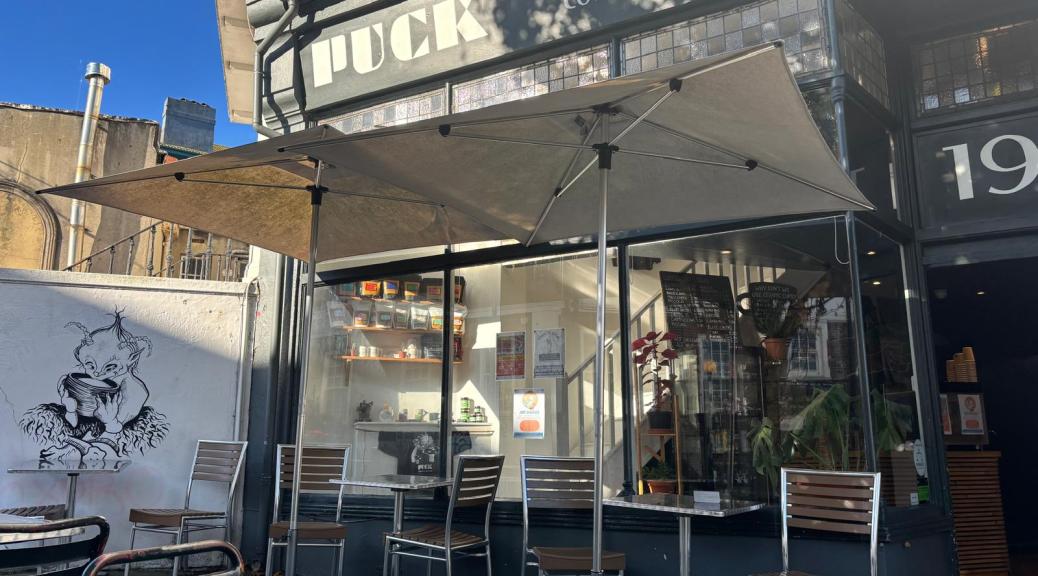
Puck Cafe – by Ceri Barnes Thompson

Having thought Puck was the sum of its tiny frontage,  I quickly found out when I went to have a chat with the owners  Ralph and Zoe, that it’s actually a warren-like oasis offering what Zoe describes as “a living breathing authentic place where people feel like it’s theirs, enriching their lives”. Ralph laughs. “Yeah, just like you discovered, you just don’t know what we are till you come in”. 

The musician and artist couple took it on just over two years ago, Ralph having worked there for the previous six years since arriving from north England to realise a dream of creating a space that brought together the things that they most care about – music and art. 

Puck is a fully and genuinely independent café/space/gathering spot. I’m nervous to just call it a café as Zoe’s very clear that she doesn’t think of it as that – it’s also a community space where artists who she feels are under-represented in Brighton can lay their hats, exhibit work, come and have creative conversations, or for customers to just be. 

Certainly it serves the most delicious cup of coffee in Brighton (so The Guardian said, and I have to agree). Having a cuppa can be an artistic act for Zoe – crucially it’s not just a transaction. Ralph agrees. They know the regulars not just by name but by their drink – think caffeinated Cheers. There’s no distinction between drink-in or take-away prices, single use paper cups are the norm there. There are porcelain cups too, but reader – this is an ‘if you know, you know’ situation – I was astonished to see hung up neatly in the kitchen the cups of around 70 local regulars who can walk in and expect to be served in their very own cup. 

So why Puck? For Zoe ‘Puck’ represents the mischief of the character from Midsummer Nights Dream. She loves the role of disruptor, messing with the routine, curating as much as she can once Ralph’s morning and afternoon residence is over, thinking of ways to offer anything from Pudding Nights to Art residences and market events for the local community. Her lovely character design graces the limited edition T shirts draped over a mushroom, for example. Indeed functional mushrooms powders to add to drinks are available from Jardin Collective and savoury and sweet snacks are locally sourced too. 

A “puck” is also that hard disc of grounds you get when you’ve pressed hot water through a coffee-machine. Ralph only uses locally sourced ‘Pharmacie’ single origin coffee. The limited batches mean the coffee will change, taste wise, over the weeks, but the brew you are served will always be good. For him the quality is measured in the sound of the drop, the colour and literally the feel of the drink in his hands. If he’s not happy, it’ll be discreetly disguarded and he’ll start again.

A “puck” is also the lump of plastic which is the starting point of every vinyl record – some of which are for sale in the shop upstairs. For Ralph, music is his life – he plays, writes and collects and curates music. From Pink Floyd’s Atom Heart Mother (which was his lullaby as a baby) to the monthly playlists he makes and describes as being “like sourdough starters”, it’s about suggesting new things to listen to. He curates the albums on offer for sale and knows that customers are very likely to come across something they didn’t know they’d like. 

The emotional connection to music is clear. They tell the stories of life in bands and venues in the north and of the past life of Puck – a TV repair shop where the back room, now a gathering place with seats and tables and board games, was then a pirate radio station, broadcasting to the Brighton area. Music is art, coffee is art, cups are art, conversation is art, everything is connected. Spend your money in Puck. Be a Puck Pal. They’re creating a scene and I want to be in it.

More than just a breadhead

The very word Gail’s got the armchair grumpies and keyboard warriors out in force, but slow down. Put away your prejudices. Just because somewhere has more than one branch doesn’t meant they’re the bad guys. Gilly Smith reports

Once upon a time in Brighton, you could gauge the feel of a neighbourhood by whether or not it had a Tin Drum. The family-run chain of bars and eateries, latterly serving charcuterie boards from the owners’ home-raised pigs, first opened on Dyke Road, home now to The Cow, and became a badge of gentrification. These days, it’s a Wolfox. Or maybe a Gail’s.

The number of Gail’s opening across the south east has long exceeded a bakers’ dozen. Our new one in the Dials will be the 130th to opens its doors since the first bakery over 30 years ago in Hampstead High Street. The new Gail’s set up shop in Night Shift, formerly the collaboration between Flour Pot, Curing Rebels, Curio Wines, and local artist, She Paints, which has camped out there since the demise of Brighton-born Small Batch. And it’s already had a pasting. It was daubed with graffiti declaring it ‘boring’ before it had even opened, a spray-painted penis summing up the outpouring of anti-establishment feelings all over social media. 

Which is odd really, as Gail herself was a bit of a radical.

Gail’s began with a mission to do things differently. Back in the early 1990s, it created a bit of a rise in the restaurant industry by taking the values of sour dough – slow, crafted, natural, like bread used to be, as bread should be. 

At its helm was artisanal baker, Gail Mejia, whose ironically named Bread Factory had been a wholesale retailer in Hampstead. She and her tiny team of bakers quickly realised that what they were making for top notch restaurants just wasn’t available in most neighbourhoods. They decided to fix that, and Gail’s Bakery was born.

Thirty years later, Gail is a biodynamic farmer in Portugal, as Tom Molnar (pictured), Gail’s CEO tells me as we chat about the new opening in The Dials. “She spent 10 really hard years before I met her, putting together the bakers, working with some top chefs, and building the thing that I fell in love with.”  A disruptor, a visionary, she was part of the Slow Food movement that has been so influential in making us rethink our relationship with food.

“She represents a whole bunch of hippies in food who changed so much,” says Tom. He means chefs like Rose Gray, Alistair Little and Sally Clarke who came back to London from America in the 80s and 90s with a dream of a simpler way of eating fresh, organic food, as  championed by restaurateur and food legend, Alice Waters. Fermented sour dough was just part of the mix. ‘When everything was becoming mass (market), they just stuck to their guns and said, ‘Look, that doesn’t make sense’. It wasn’t the engineers and the business people that got it right” says Tom, a former management consultant who recognised the potential for Gail’s back in 2005, “it was the hippies and the food pioneers.”

Now 130 Gail’s bakeries are quietly changing the food industry, not least by working with Natoora, a distribution hub on a mission to fix the food system by building direct relationships with small-scale growers and independent producers.  Gail’s distributes its surplus food through Neighbourly, a network of over 29,000 charities and community groups and an award-winning giving platform “that connects company funds, surplus and volunteer time with local causes to make a positive impact.” But does any of that matter to the customers? 

Presumably it doesn’t to Juliet who wonders on Instagram how they justify £5 for a pain au chocolat in a cost-of-living crisis. Or Laura on Seven Dials Facebook group who’s boycotted Gail’s since they stopped taking cash. “Maybe not all of them”, concedes Tom. “Maybe there’s 10-20% that do care.”  So who tells them about the spirit of Gail that’s still stirred into every loaf of bread so long after she left the building to sow her own seeds.  “Yeah, it’s tricky”, admits Tom. There’s no messaging in the shops, and you’d have to read the website to get any real sense of what Gail’s is all about. Tom says he struggles with how loud the revolution should be. “You don’t want to be the person at the party who talks all the time, and you don’t want to be that person who doesn’t say anything. You’ve got to be somewhere in between to be heard. And I don’t know if we found the right balance yet.”  

I think he’s missing a trick; give me some blackboards in a café telling the back stories of growers and carbon reducing mission statements, and I’m in. Tom doesn’t think it would have been Gail’s style. “She’s still one of my teachers’, he says. “I’m just trying to do my best to keep her view on food alive. I didn’t want to destroy what she had built. My job was to just let it flourish, I guess.”

Like a good loaf of bread, one might say.

l Gail’s in Seven Dials is opening soon 

In the meantime, you can sample their wares at: 

93 North Rd, BN1 1YE

Mon – Fri: 7.15am-5.30pm; Sat: 7.30am-6pm; Sun: 7.30am-5pm