Category Archives: Climate

Climate Cafe – Rewilding The Sea

Brighton’s seaside is a playground, a health spa and a boon to the local economy. But in our crazy industrial food culture, we’re much more likely to buy our fish already battered in a shrink-wrapped plastic package from the supermarket than one of the lovely fish stalls on the beach or the fish shops – Andrew’s in the Open Market or Brighton & Newhaven Fish Sales next to Hove Lagoon, where the fish come straight off the day boats, supporting the environment and the local fishers.

Our coastline has been through its own boom and bust, with fish stocks on the critical list and the ocean’s eco-system becoming decimated by the heavy hand of the industrial food system. But there’s good news coming in on the Sussex waves; Dolphin Head, south of Selsey Bill, was designated a Highly Protected Marine Area (HPMA) last year, after years of campaigning. Following decades of bottom-towed trawling, the site has become degraded, but these new protections will allow the area to fully recover. The area is a hotspot for bio-diversity, with several habitats found there and is used by numerous seabirds and marine mammals, including Risso’s dolphins and Harbour porpoises.

It was a lone fisherman we met on a dog walk on the beach at Shoreham who told us that Rampion wind farm has brought all sorts of fish back to its waters, that the sea bass and plaice come right up to the beach now, and there are plenty of sea bream further out. “It doesn’t just stop the trawlers. It’s created a reef which provides new habitats.” 

And that creates a whole new eco-system. 

Local campaign group, Sussex Underwater, which only this autumn won a coveted Maritime Award for their film Our Sea Forest, reports that mussel beds are returning. Like oysters, these biovalves create important habitats for other species, and provide food for rays and other fish. 

It’s an astonishing reminder of a world that turns out of our view. Charles Clover, author of Rewilding the Sea, and seasoned environmental journalist says that we need to dive deep and wake up to what’s happening in our oceans not just to save the planet but to remind ourselves of what the Channel might have been like many years ago. “The dynamism of nature is just quite fantastic” he tells me. “If you leave it alone and harvest it really sustainably, using methods that don’t damage the rest of the ecosystem, then it does you multiple favours.”

Co-founder of the campaigning Blue Marine Foundation, Clover is bringing life back to our oceans and writing about it beautifully. Margaret Atwood calls his book “a game changer”. Knepp’s Isabella Tree says it’s “desperately needed”. George Monbiot says, “What if our seas became productive again with giant sturgeon, halibut and skate? It’s closer than you think.”

 “It’s not about not eating fish”, Clover tells me. “It’s about making sure the fish are managed properly. An extremely good example of the resurgence is the Bluefin Tuna around Britain’s shores. It’s not been there for 70, 80, 90 years, but it’s back. And it’s back principally because of a fisheries management decision.”

Industrial fishing has an enormous impact upon biodiversity; trawling and dredging smashes up the seabed, destroying “the forests of the sea” where the humble seaweed draws down CO2 and locks it away forever. But as Charles explains, Sussex Kelp has turned the tide on trawling.

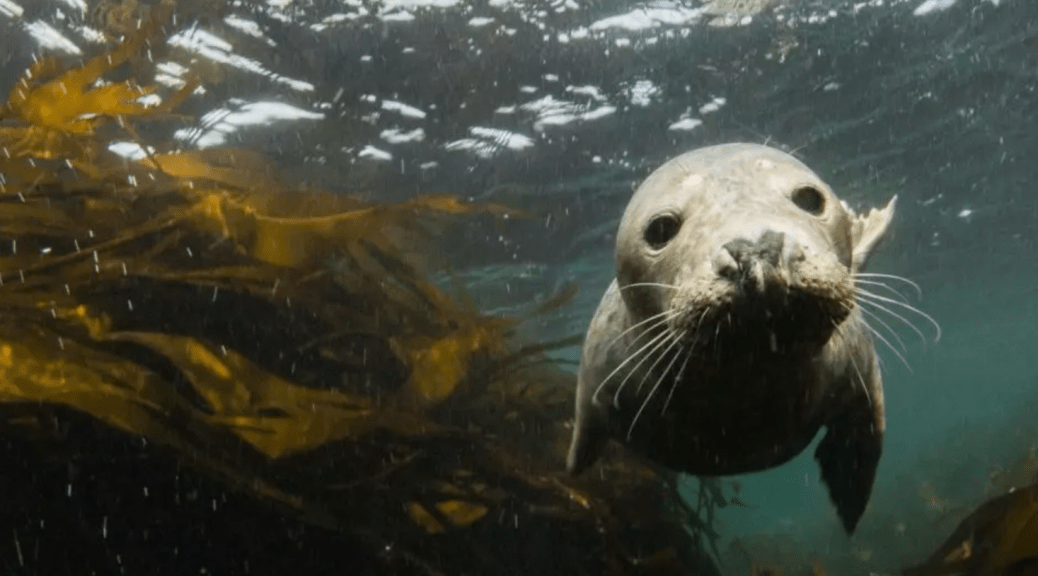
“Sussex Kelp brings together the three reasons why we must rewild the sea: for greater food security, for biodiversity and for climate,” he says. In his book, he tells the story of Eric Smith, the Shoreham free-diver with Sussex Underwater who campaigned for the protection of the kelp belt, and continues to report on the astonishing recovery of this area from trawling. As a result of his work, mussel beds are expanding, stingrays have been sighted and the kelp is returning, says Clover.

“Kelp is one of many as-yet unquantified mechanisms that can help sequester carbon from the atmosphere and lock it up in sediments, though where its leaves go to that are not washed up on the shore is complicated and hard to quantify. But in the end, it will take its place with seagrass, saltmarsh, mangrove and, I believe, other forests of the seabed, in being recognised as an important mechanism that must be protected, that makes our planet more resilient.”

With the protection of the Sussex kelp, fish have come back as well as lots of other organisms, and local fishermen are happy too. “It shows what we could do all round our shores and it shows that in some places at least, we are moving in the right direction. As Eric puts it, “we are winning.”’

l Rewilding The Sea: How To Save Our Oceans by Charles Clover (Penguin) 

l Hear more from Charles Clover on Gilly Smith’s podcast “Cooking The Books with Gilly Smith”

Climate Cafe – People, Planet, Pint

We’ve been thinking a lot about what we can do at Whistler Towers about Climate Change. And it was in the book Spinning Out by the brilliant activist, Charlie Hertzog Young that we first heard about climate cafes. These are spaces where people can talk about their eco anxiety, share ideas and feel like they’re not alone that first inspired this page. 

But mostly, they’re physical spaces; in the last issue, we read about Circles’ monthly meet-up for women involved in sustainability, either through activism or business, and in this issue, we meet Sam Zindle, managing director of Brighton B Corp certified digital marketing company, Propellernet who organises Brighton’s People, Planet, Pint monthly get togethers which have spread all over the world. Over to you, Sam.

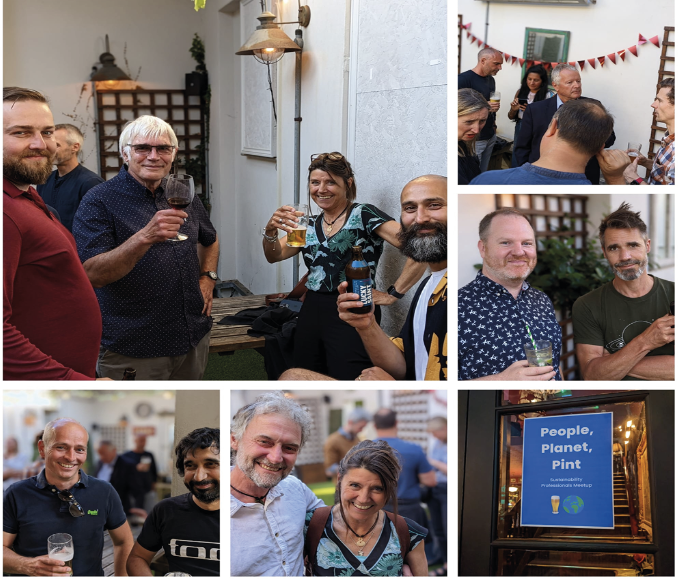
“People, Planet, Pint is an international meet-up group now. It was started by Adam Bastock, who founded Small99, which creates carbon reduction plans for small businesses. I was there when he ran the first one in 2021 at Cop 26 in Glasgow. It was essentially just a room in the back of a pub in Glasgow, and it’s grown and grown. Brighton was one of the first other cities to start running people planning meet-ups. 

We meet once a month, alternating between The Walrus – that’s the one that I’m responsible for – and at the old Albion. It’s always the third Thursday of the month from six until whenever people want to go home. It needs to be regular for people. You just sign up at Eventbrite, and it’s completely free. 

This is for anyone who’s interested in sustainability, but it’s purposefully non agenda based. We get people from all walks of life, from people in academia to startups in the kind of tech sustainability space. Or they may simply care about the environment. So, if you’re just curious people in the city who want to talk more, you can come down. There are never any speakers. There’s never a running order. It’s literally that you get your first drink bought for you, courtesy of our sponsors, Crystal Hosting and Propellernet. And then you can have your chats. It’s just a place where you’re surrounded by people who feel the same way. 

I think Brighton is awash with some brilliant independently run, volunteer-based community groups and it thrives on that. There used to be something in Brighton years ago called like, the Green Drinks, but back then sustainability wasn’t mainstream or a conscious thought for many people. I think attendance didn’t really last; it was always the same people. Every time we do People, Planet, Pint, we get about 40% of people that are new. So, it does have an amazing kind of new energy to each one. 

You do get maybe 20 people or so I’d say that are there for most of them. But you just get an array of different people coming through the door of the pub that each meetup which makes it keeps it fresh, keeps it exciting and keeps new conversations happening. We get somewhere between 50 and 100 people each month which makes it the largest sustainability meet up in the city. I guess it’s just a really vibrant and active community around sustainability and Brighton.

In the last month alone, I’ve spoken with a guy who’s pressing plant-based vinyl records who’s now done a deal with a major label, and a guy who works in agri tech and is using AI to direct plant-enhancing products onto the crops to grow them better in a really sustainable way. I speak to people who work in marketing and we talk about green washing and green hushing and how to help companies navigate that whole space. I mean, I could go on… you meet people from 101 different backgrounds. 

And my hope is that the conversations go on beyond the evening. I know for a fact there’s been some connections made and people who’ve kind of collaborated, which is a really big part of this and that everyone has there has a shared interest in doing something for the planet and environment in whatever form that may take. 

So it’s a very successful meetup and it will endure, I have no doubt, for years to come and hopefully grow in attendance. There’s no move to change how we do it. It seems to work for people 

There are People, Planet Pints all over the world now. I think it’s in 30 different cities in the UK, including Manchester, London and Bristol, and even smaller places like Cheltenham. But there’s one in California, there’s one in Berlin, there’s a couple I think in Scandinavia. You can go onto the People, Planet, Pint website to find out more about where the local events are happening all over the world. 

We don’t have big budgets to advertise. We don’t have massive sponsors. And actually, that’s part of its attraction, I think, because the minute you start kind of having to deliver a sponsored message or advertised, you know, to certain people that it becomes something different. So I’m pretty comfortable with the kind of grassroots scene in Brighton but of course, we’re always always looking for new people to find out about us and come along and spread the word. 

GILLY SMITH

https://small99.co.uk/people-planet-pint-meetup/

Climate Cafe

Changing the Game: How Brighton’s companies are leading the way to a greener future. Gilly Smith reports

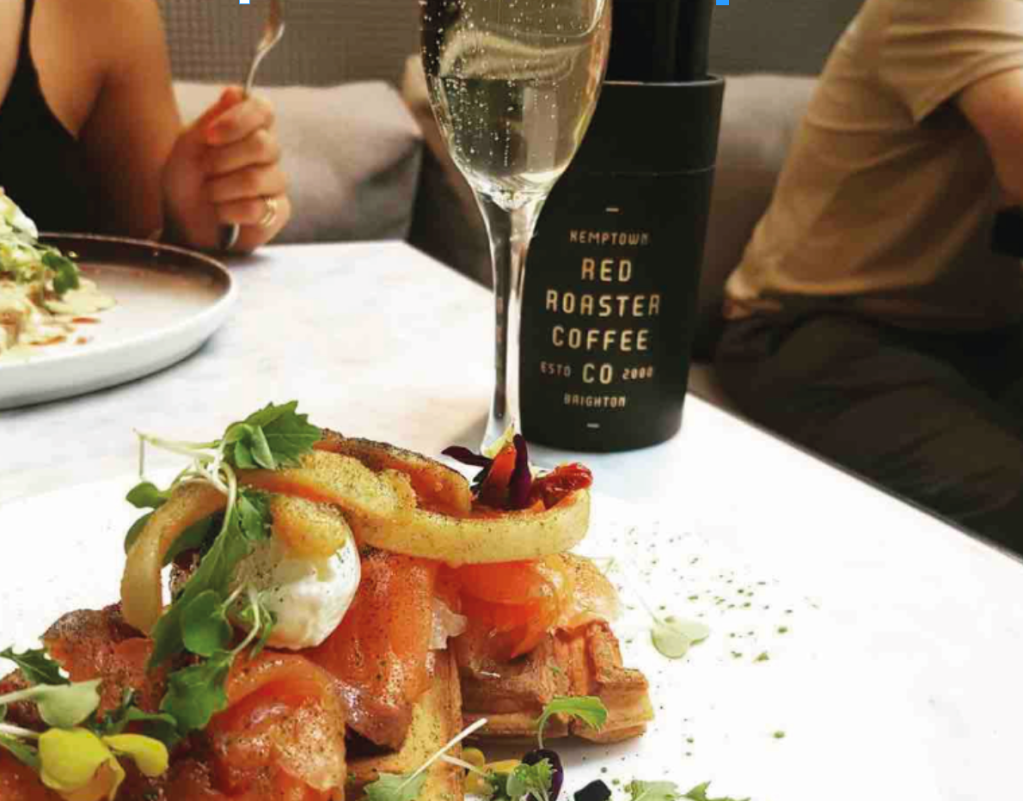
I’m waiting for Ella Byass from Marketing at the new Red Roaster restaurant in New Road on a warm afternoon in November. The nice young waiter asks me where I’d like to sit, and I choose the quieter terrace outside as I’m about to record Ella’s interview. He fiddles with a remote and pops off to get my coffee. He’s turned the heating on. Outside.

It’s not a great start to an interview about Red Roaster’s hard-won battle for B Corp, the global accreditation that aims to shift the behaviour, structure and very culture of capitalism by exacting excellence in every inch of a business. As Ella tells me that they’re one of just 7000 companies in the world to be given its stamp of approval after its rigorous three-year assessment process, I’m still trying to square the heater issue.

Red Roaster has been one of Brighton’s most sustainable companies for years; its coffee roastery in Kemp Town is the only organic coffee roastery in the South East, and its beachfront café, Lucky Beach which won the Food Made Good People’s Favourite Restaurant award in partnership with delicious. Magazine in 2017, has been collecting gongs ever since. 

Membership of the Sustainable Restaurant Association keeps the company focussed on sourcing responsibly, which includes supporting farmers who employ good animal husbandry and contribute positively to carbon capture with regenerative farming techniques to keep the soil healthy. The SRA keeps its members up to date on how best to trade, use energy and keep its carbon footprint low, but also how to interact with the community and treat its teams. 

In Brighton, they’ve switched all of their delivery vehicles to electric or bikes, and are the largest employer of learning-disabled adults in Brighton. Ella tells me that 75% of their produce for their Brighton cafes are sourced locally; its cider comes from Whistler favourite, Trenchmore Farm which operates its own micro circular economy. Its organic eggs are from Rookery Farm in West Sussex and most of its seasonal produce are from Shrub Provisions, one of the increasing numbers of sustainable food hubs working with regenerative or organic local farms for next day delivery to restaurants.  And where it can’t buy local, it supports the farmers’ own communities; Red Roaster’s coffee beans come from Brazil, Honduras and most notably from Rwanda where they run most of their social projects, including building schools and medical centres. 

Led by early sustainability adopters, Diana and Mike Palmer, Red Roaster’s B Corp badge is only the beginning.  “With B Corp, you have to constantly show how you’re improving” Ella tells me. “They’ll come back in three years’ time and say, ‘Right, this is was great three years ago, but what have you done since?’ We can’t just be like, great, we’ve got the B Corp. They’ll want to know how we’ve reduced our carbon footprint even further. They don’t allow you to use it as a green washing technique.”

As businesses try to attract and retain late millennials and Gen Z into a post Lockdown workplace where all the rules have been thrown out of the pram, sustainability is one of the most popular keywords in the search for employment. According to the Institute for Advertising Ethics, 64% of millennials will no longer work for a company that fails to show a strong corporate social responsibility. The data also shows that Gen Z are so concerned about what their peers think of their employers, that their choices are increasingly those that can prove they’re doing the right thing.

It’s an amazing story, but how will anyone know while the only connection the customer has is with a waiter who turns an outdoor heater on without even asking? Ok, so it turns out that the heaters are solar powered, but the point is how would we know?  A brunch with a mate a couple of days after our interview revealed the waitresses weren’t acquainted with the company line either, and the bacon was from Ireland.  

“Our sustainability story is on the menu”, Ella tells me.  Now, come on; who salivates over the food options, ponders over the cocktails and then scrolls through to the last page to read the diversity pledge? We’re Whistling big time for Red Roaster, but maybe by the time the B Corp team come back to check, their waiters will be wearing the t-shirt.

Of the tiny clutch of B Corp companies in the world, we’ve got quite a handful in Brighton. And if you’re thinking about booking your next holiday, you might like to know that one of them is a sustainable travel company which says that it’s not really very cool to fly at all. “There is no denying the fact that if you fly long haul, it will make up a very, very significant proportion of your year’s carbon footprint,” says Nick Pulley, founder of Selective Asia. You’re not even going to get a virtue signalling offset plan as part of the cost of your flight at Selective Asia.  “With an increasing number of reports casting doubt on the benefits of carbon mitigation, we don’t have the necessary clarity and confidence on this approach that we would ideally like,” proclaims the website. 

Instead, the travel agency works with Brighton-based carbon calculating company, C-Level which works directly with environmental scientists and communities on the front line of climate change to develop conservation projects that can provide locals with an income. This is not so much about mitigating the impact of travel, but actively supporting local economies to thrive.  Call it distribution of wealth.

“Travelling with a tour operator like us means introducing clients properly to the cultures and steering them away from the heavy footfall area”, says Nick. Encouraging them to eat on the streets and in family-run restaurants rather than in the larger hotels means shaking the hands that feeds, while keeping the tourist spend local. Travelling in-country by train not only avoids the carbon heavy short hop flights, but gives the traveller a chance to see the landscape and feel the distance.  

Eco-tourism is about understanding impact, and we’ve got to stop flying if we’re to save the planet. But if you’ve just got to make that trip of a lifetime, make sure it helps to secure the D’ering-Dibru Saikhowa Elephant Corridor in the northeast Indian states of Assam and Arunachal Pradesh or support Lone Buffalo, the Laos community project giving free English tuition, sport and creative skills tutoring to local kids.