The West Hill Community Association was one of the14 community groups which formed the coalition “AGHAST” (Action on Gasworks Housing, Safety, Affordability and Transparency) to oppose the proposed development of high-rise blocks on the former gasworks site near the Grade 1 Listed Kemp Town Estate. To the dismay of local councillors, residents and amenity associations a planning inspector representing the then secretary of state Angela Rayner (yes, she) has now overturned the decision of our City’s Planning Committee to refuse the scheme. Our councillors gave three reasons for refusal:
The scheme would represent an overdevelopment of the site with excessive scale, massing, density and heights that are not in keeping with the area, which along with the design and material palette would cumulatively harm the townscape, landscape and seascape of the area and its heritage assets. (It should be noted that the site is not in a “Tall Buildings Zone”).
The under-provision of larger units would fail to meet the identified housing need of the city. (It offers an) unacceptable standard of accommodation for future residents by reason of poor levels of amenity and light to some dwellings.
To rub salt into the wound the Inspector has directed that our City Council pay the costs of developers St William, the nom de guerre of Berkeley Homes. These costs could run into hundreds of thousands of pounds. Berkeley Homes, incidentally, last published profits of £179 million. The Inspector justified his costs decision by describing the Council’s behaviour in opposing the scheme as unreasonable!
A retired professor of architecture at Brighton University has questioned the impartiality of the Planning Inspector, citing the Inspector’s previous support for the suggestion by a “think tank” that “councillors should have no say over deciding applications for new developments”.
The professor further called the scheme a “ghastly overdevelopment”; no wonder Angela Rayner bought her £800,000 seaside flat on the other side of the city in Hove!
Brighton’s seaside is a playground, a health spa and a boon to the local economy. But in our crazy industrial food culture, we’re much more likely to buy our fish already battered in a shrink-wrapped plastic package from the supermarket than one of the lovely fish stalls on the beach or the fish shops – Andrew’s in the Open Market or Brighton & Newhaven Fish Sales next to Hove Lagoon, where the fish come straight off the day boats, supporting the environment and the local fishers.
Our coastline has been through its own boom and bust, with fish stocks on the critical list and the ocean’s eco-system becoming decimated by the heavy hand of the industrial food system. But there’s good news coming in on the Sussex waves; Dolphin Head, south of Selsey Bill, was designated a Highly Protected Marine Area (HPMA) last year, after years of campaigning. Following decades of bottom-towed trawling, the site has become degraded, but these new protections will allow the area to fully recover. The area is a hotspot for bio-diversity, with several habitats found there and is used by numerous seabirds and marine mammals, including Risso’s dolphins and Harbour porpoises.
It was a lone fisherman we met on a dog walk on the beach at Shoreham who told us that Rampion wind farm has brought all sorts of fish back to its waters, that the sea bass and plaice come right up to the beach now, and there are plenty of sea bream further out. “It doesn’t just stop the trawlers. It’s created a reef which provides new habitats.”
And that creates a whole new eco-system.
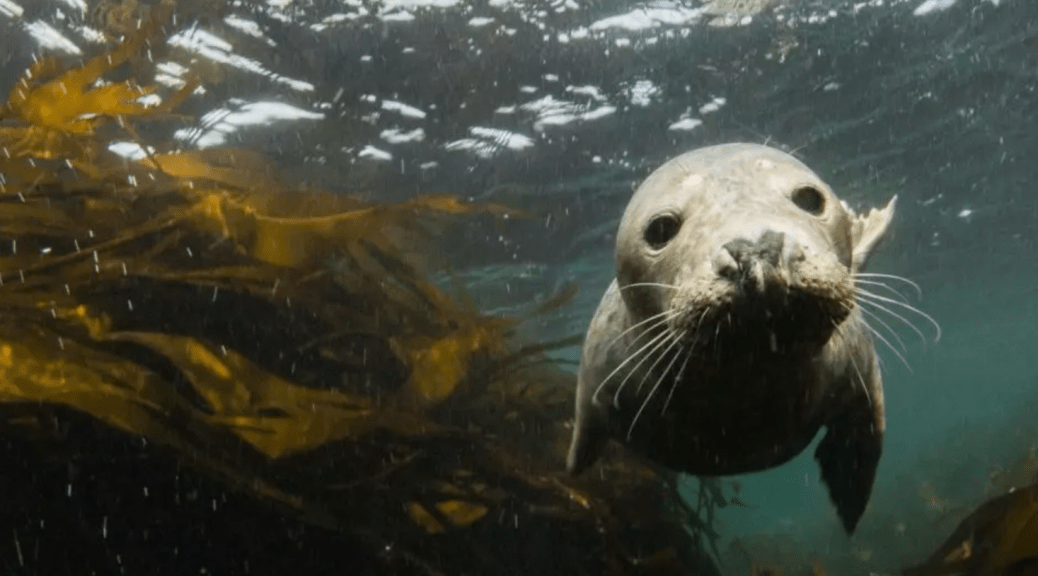
Local campaign group, Sussex Underwater, which only this autumn won a coveted Maritime Award for their film Our Sea Forest, reports that mussel beds are returning. Like oysters, these biovalves create important habitats for other species, and provide food for rays and other fish.
It’s an astonishing reminder of a world that turns out of our view. Charles Clover, author of Rewilding the Sea, and seasoned environmental journalist says that we need to dive deep and wake up to what’s happening in our oceans not just to save the planet but to remind ourselves of what the Channel might have been like many years ago. “The dynamism of nature is just quite fantastic” he tells me. “If you leave it alone and harvest it really sustainably, using methods that don’t damage the rest of the ecosystem, then it does you multiple favours.”
Co-founder of the campaigning Blue Marine Foundation, Clover is bringing life back to our oceans and writing about it beautifully. Margaret Atwood calls his book “a game changer”. Knepp’s Isabella Tree says it’s “desperately needed”. George Monbiot says, “What if our seas became productive again with giant sturgeon, halibut and skate? It’s closer than you think.”
“It’s not about not eating fish”, Clover tells me. “It’s about making sure the fish are managed properly. An extremely good example of the resurgence is the Bluefin Tuna around Britain’s shores. It’s not been there for 70, 80, 90 years, but it’s back. And it’s back principally because of a fisheries management decision.”
Industrial fishing has an enormous impact upon biodiversity; trawling and dredging smashes up the seabed, destroying “the forests of the sea” where the humble seaweed draws down CO2 and locks it away forever. But as Charles explains, Sussex Kelp has turned the tide on trawling.
“Sussex Kelp brings together the three reasons why we must rewild the sea: for greater food security, for biodiversity and for climate,” he says. In his book, he tells the story of Eric Smith, the Shoreham free-diver with Sussex Underwater who campaigned for the protection of the kelp belt, and continues to report on the astonishing recovery of this area from trawling. As a result of his work, mussel beds are expanding, stingrays have been sighted and the kelp is returning, says Clover.
“Kelp is one of many as-yet unquantified mechanisms that can help sequester carbon from the atmosphere and lock it up in sediments, though where its leaves go to that are not washed up on the shore is complicated and hard to quantify. But in the end, it will take its place with seagrass, saltmarsh, mangrove and, I believe, other forests of the seabed, in being recognised as an important mechanism that must be protected, that makes our planet more resilient.”
With the protection of the Sussex kelp, fish have come back as well as lots of other organisms, and local fishermen are happy too. “It shows what we could do all round our shores and it shows that in some places at least, we are moving in the right direction. As Eric puts it, “we are winning.”’
l Rewilding The Sea: How To Save Our Oceans by Charles Clover (Penguin)
l Hear more from Charles Clover on Gilly Smith’s podcast “Cooking The Books with Gilly Smith”
The vow always to say “Yes” started on a cliff top in Cornwall, at a retreat about Magickal Thinking, which states “If you align your desires with those of Mother Earth, she’ll help.” I was being afflicted with a wild desire to do three things, which I wrote down:
1: To find help to sail the Atlantic
2: To find ruined rainforest to rewild
3) To learn why I wanted all this.
Then I tucked the paper in the rock. A week later, someone from the retreat invited me to write five Ted-Talks on the Climate Crisis, where I learned the average Brit makes six tonnes of CO2 a year, but scientists say the sustainable amount is 2.5. Could I reduce? I wondered. How?
The day after the Ted Talks, I had a date with a professional explorer, so asked her, “Where would you find ruined rainforest?” “Minca, in Colombia,” she said. Six months later, she said she’d come with me.
I was then contacted by ex-Brighton resident, Kate McAllister, who runs The Hive, a school of self-directed learning in the Dominican Republic. Would I visit their school? I’d teach a term in spring 2023. I replied I would – if the school could help plant a thousand trees.
The explorer and I both paid a deposit to sail the Atlantic on a schooner. The next day she chucked me. Heartbroken, I sold off my possessions, rented out my house, and set off to sail the Atlantic – where I was delighted to see minke whales, sperm whales, Atlantic dolphins, gannets, cattle egrets, and – 900 miles from land – a swallow, who spurned my seeds and water. He just wanted what I wanted on that ship: a rest.
Arriving in the Dominican Republic, I sought a tree-planting project to learn what trees grow there – and the only one that replied was in Haiti. At the border to Haiti, I learned criminal gangs were kidnapping foreigners. A text arrived from my ex, telling me not to contact her. I thought I might as well proceed.
In Haiti, forbidding instructions, trying to contact the ex, I fell 10 feet to concrete – breaking ribs, and spent six days lying on a floor, where my only visitor was Patrick, who wanted £400 to train as a plumber. I gave it to him. Next day, I planted my first trees.
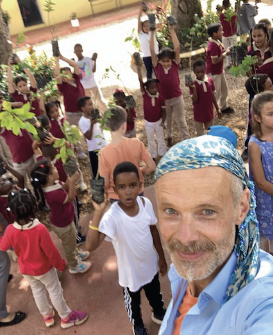
Back in the Dominican Republic, I planned to visit local schools, to persuade 1000 children to plant 1000 trees. But the project’s hardest moments (after the heartbreak) were the seven two hour visits to the bank, seeking 3000 dollars, to buy trees. Almost catatonically depressed, I applied Antony de Mello’s advice: “Don’t change yourself, observe yourself” and I saw myself objectively – still heartbroken, and desperate for encouragement.
Realising I was the witness of the thoughts, not the thinker, it engendered grace. Now magical things happened fast. Having only paid 1200 dollars, I was given 1000 trees. I was approached by a headmaster, who invited us to visit.
Still, as we started the day giving out trees, we had arranged only two school visits, reaching 140 children. Leaving the first school, the bus driver stopped at a second, where we met the mayor, and were photographed for the local paper, spreading our message further. Another school contacted… By the day’s end, we’d seen six schools, giving 840 trees.
That still left 160, but a friend from the Atlantic crossing connected me to a local organic farm. I took the 160 trees, and 20 volunteers turned up to plant them. We quickly filled the organic farm, then doubled its size, by buying a new fence…
Though proud of the project, I’ve not publicly written or spoken about it – from bashfulness, and serenity too. But…
“We’re doing a Fringe edition,” said The Whistler editor last week, “Have you a story you can make into a show?”
Well, I do, as you’ve heard, but surely I was too late to register it, wasn’t I? I dived into the Festival website, where I learned of the hundreds of venues which even include someone’s back garden, and found a spot at the Caxton Arms, at 13 45 pm, on Sunday June 2nd. I’d walked it the day before, and an instinct said, “This is your venue”.
So I’ll be there, longing to tell the tale, and to meet like-minded folks afterwards. I’ll also tell the juiciest bit of all – how I got lost in Colombian jungle, as I headed for Minca, but found my way to the Lost City of the Kogis, where I made a life-changing discovery – even more impactful than the idea “If you align your intentions with those of Mother Earth – she’ll help.”
A planning application to increase the housing stock by building a “glass box” on the roof of the existing property at the corner of Surrey Street and Upper Gloucester Road would cause considerable harm to the character of the conservation area according to the City Council’s Conservation Advisory Group. The existing building is part of a terrace of two storey houses built around 1830 which retain their attractive bow fronted bays. An application to build a much smaller dormer extension to a house directly opposite was described by officers when they refused it as “a visually intrusive, unsympathetic and dominant feature that would be harmful to the appearance of the host dwellinghouse, associated terrace and wider conservation area”, so unless the Council now casts aside all such heritage concerns, this application stands no chance of being granted.
Raising the roof (again) 40 New Dorset St
While the site at 80 Buckingham Rd (corner of Upper Gloucester Road) has been unoccupied since March 2015 while waiting for some 24 flats to be built another application claims to be improving the housing stock. The proposal is to raise the roof of the mid-19th century cottage to match the height next door (on the right in the picture). The cottage already receives a rating of 9.5 out of 10 from an online holiday letting site so it seems unnecessary to “improve” the accommodation any further.
We’ve been thinking a lot about what we can do at Whistler Towers about Climate Change. And it was in the book Spinning Out by the brilliant activist, Charlie Hertzog Young that we first heard about climate cafes. These are spaces where people can talk about their eco anxiety, share ideas and feel like they’re not alone that first inspired this page.
But mostly, they’re physical spaces; in the last issue, we read about Circles’ monthly meet-up for women involved in sustainability, either through activism or business, and in this issue, we meet Sam Zindle, managing director of Brighton B Corp certified digital marketing company, Propellernet who organises Brighton’s People, Planet, Pint monthly get togethers which have spread all over the world. Over to you, Sam.
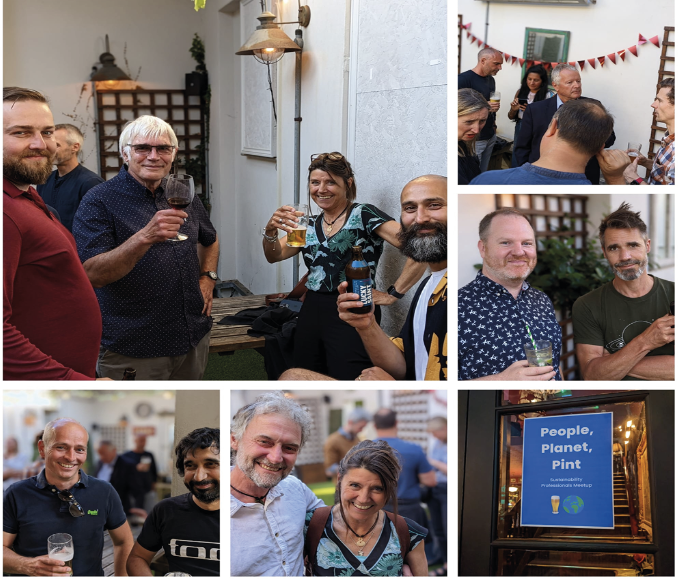
“People, Planet, Pint is an international meet-up group now. It was started by Adam Bastock, who founded Small99, which creates carbon reduction plans for small businesses. I was there when he ran the first one in 2021 at Cop 26 in Glasgow. It was essentially just a room in the back of a pub in Glasgow, and it’s grown and grown. Brighton was one of the first other cities to start running people planning meet-ups.
We meet once a month, alternating between The Walrus – that’s the one that I’m responsible for – and at the old Albion. It’s always the third Thursday of the month from six until whenever people want to go home. It needs to be regular for people. You just sign up at Eventbrite, and it’s completely free.
This is for anyone who’s interested in sustainability, but it’s purposefully non agenda based. We get people from all walks of life, from people in academia to startups in the kind of tech sustainability space. Or they may simply care about the environment. So, if you’re just curious people in the city who want to talk more, you can come down. There are never any speakers. There’s never a running order. It’s literally that you get your first drink bought for you, courtesy of our sponsors, Crystal Hosting and Propellernet. And then you can have your chats. It’s just a place where you’re surrounded by people who feel the same way.
I think Brighton is awash with some brilliant independently run, volunteer-based community groups and it thrives on that. There used to be something in Brighton years ago called like, the Green Drinks, but back then sustainability wasn’t mainstream or a conscious thought for many people. I think attendance didn’t really last; it was always the same people. Every time we do People, Planet, Pint, we get about 40% of people that are new. So, it does have an amazing kind of new energy to each one.
You do get maybe 20 people or so I’d say that are there for most of them. But you just get an array of different people coming through the door of the pub that each meetup which makes it keeps it fresh, keeps it exciting and keeps new conversations happening. We get somewhere between 50 and 100 people each month which makes it the largest sustainability meet up in the city. I guess it’s just a really vibrant and active community around sustainability and Brighton.
In the last month alone, I’ve spoken with a guy who’s pressing plant-based vinyl records who’s now done a deal with a major label, and a guy who works in agri tech and is using AI to direct plant-enhancing products onto the crops to grow them better in a really sustainable way. I speak to people who work in marketing and we talk about green washing and green hushing and how to help companies navigate that whole space. I mean, I could go on… you meet people from 101 different backgrounds.
And my hope is that the conversations go on beyond the evening. I know for a fact there’s been some connections made and people who’ve kind of collaborated, which is a really big part of this and that everyone has there has a shared interest in doing something for the planet and environment in whatever form that may take.
So it’s a very successful meetup and it will endure, I have no doubt, for years to come and hopefully grow in attendance. There’s no move to change how we do it. It seems to work for people
There are People, Planet Pints all over the world now. I think it’s in 30 different cities in the UK, including Manchester, London and Bristol, and even smaller places like Cheltenham. But there’s one in California, there’s one in Berlin, there’s a couple I think in Scandinavia. You can go onto the People, Planet, Pint website to find out more about where the local events are happening all over the world.
We don’t have big budgets to advertise. We don’t have massive sponsors. And actually, that’s part of its attraction, I think, because the minute you start kind of having to deliver a sponsored message or advertised, you know, to certain people that it becomes something different. So I’m pretty comfortable with the kind of grassroots scene in Brighton but of course, we’re always always looking for new people to find out about us and come along and spread the word.





 The Whistler