

The Ruff Guide To Eating Out – Dec 2023


Who knew there were so many dog-friendly restaurants in our city? Well, Maya the Romanian rescue for one. As we tucked into our dinner one wet and windy evening at Murmur, we were surprised to find a beautiful but rather anxious dog on the next table. “Don’t look her in the eye and she’ll be fine”, smiled Mum.
Look, we’re dog people and a nervous dog on a couchette in one of our favourite restaurants is always going to be fine with us. But while we would normally have focussed by now on the delicious fish caught only this morning by Brighton’s own day boat fishermen, we found ourselves in a curiously unBritish chat about dogs. Maya, our new friends told us, was already able to use a word board to tell her new parents how she was feeling.
“OMG,” squeaked our Gen Z daughter, ‘Do you follow Bunny on Tik Tok?” Of course they did. Bunny, it seems, is the talking dog who presses audio buttons to formulate whole sentences in order to communicate to her owners. “Maya kept us up all night last week”, said her Dad weakly, only slightly failing to follow the party line. “She was pressing ‘tummy’ ‘hurt’ ‘outside’ ‘medicine’ until I had to put a pillow over my head.” Why he didn’t just let her out, he didn’t say.
It wasn’t like this in France. For three whole weeks this summer, we feasted on dog friendly vibes. From bites in bars in balmy squares to Michelin starred 12 coursers, Pickle, our 13-year-old Collie Cross was more than welcome. Even in the brasserie at the hypermarche where we sheltered from the rain while charging the electric car (again), Pickle was invited in. “C’est normale” said the waiter, giving him a bowl of water before we could ask. Dogs in France sit under tables and are mostly seen and not heard, although the waiters Pickle met generally stopped for a little ear rub and a chat. Only once did we find a giant poodle sitting on his Dad’s lap. But they were Dutch.
And, as it turns out, it’s pretty normal in Brighton too. Maybe dogs are welcome all over the country and we’ve just never dared to ask. So, we’ve decided to send Pickle out as chief reporter for a brand-new column for the Whistler, The Ruff Guide to Brighton and Hove (see opposite page). He’ll be marking Brighton restaurants on the quality of the welcome, the offer of a water bowl and the quality of the meat. Of vegan and vegetarian fare, it’s all about the meat taste. I did tell him that that’s not always the point, but, well, you can’t teach an old dog new tricks. First up, Kusaki in Preston Circus…
Gilly Smith
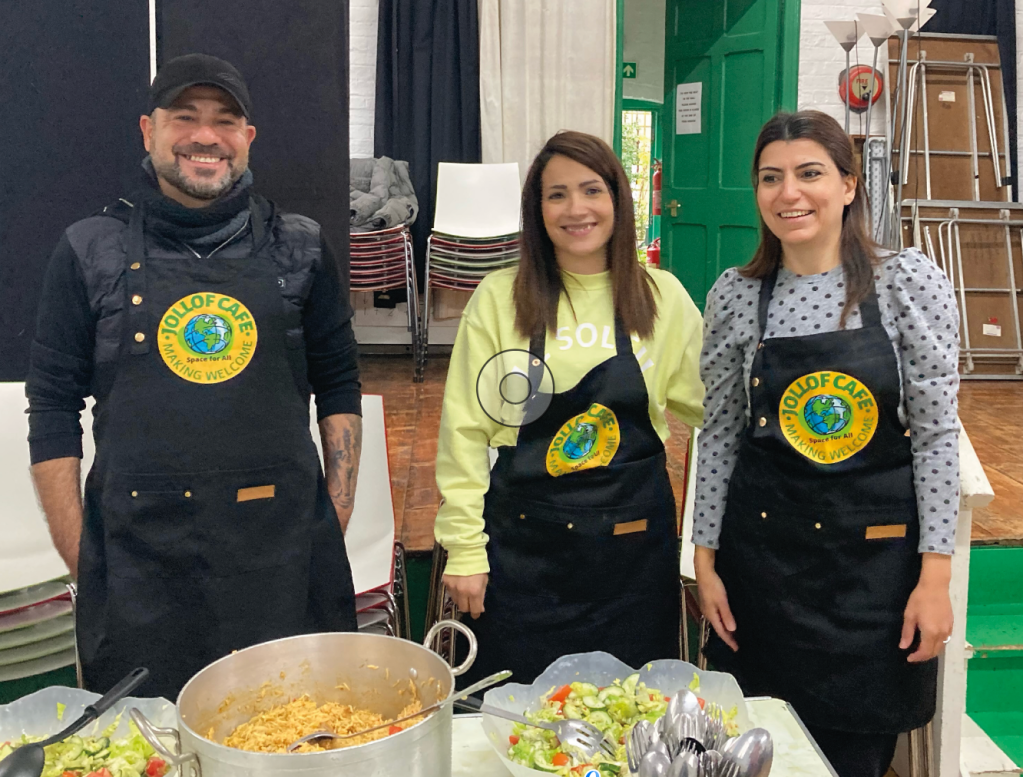
Refugees often get a bad press here. You might have noticed. Like most people, we find it really dispiriting, but there are always good people doing good things. And if good things involve hummus… what’s not to like?
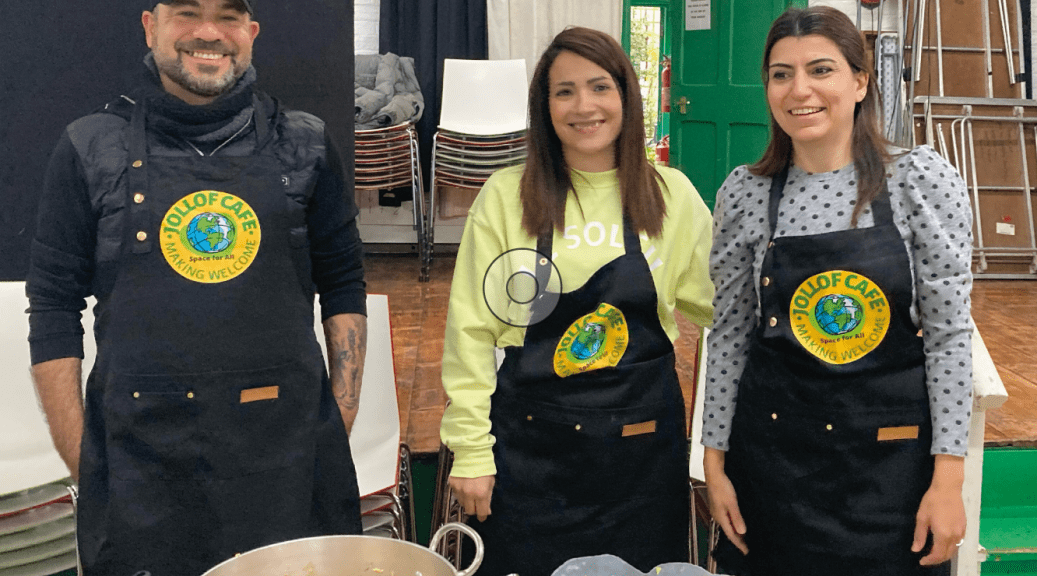
We’re lucky here in this part of the world – there are fantastic organisations such as The Launchpad Collective who are doing real things to help refugees with real tools such as work and language. And here at the West Hill Hall, the every Wednesday morning The Jollof Cafe takes over and… What’s the Jollof Cafe?
“It’s a project of the Sussex and refugee migrant self support group. It’s run for and by migrants, refugees, asylum seekers. It’s free for those who can’t afford it and £5 or whatever they feel like for those who can which enables people who can’t afford to eat there to do so. Each week we’ve got different chefs and it’s a lovely atmosphere and great food.”
I’m talking with Catherine Brown, and Catherine’s long been on the side of the good guys. “I used to work with Voices in Exile and now volunteer with Sussex refugee and migrant Self Support Group which Jollof is part of”.
“We started in 2017. We used to be at The Cowley Club in London Road, and then after Lockdown we opened up at the West Hill Hall. It’s a little treasure, a bit hard to find, but a treasure.
“The food is always vegetarian, and often vegan. It’s a welcoming, safe space where the migrant community can invite the local community in rather than the other way around. They’re always recipients of charity. Here, it’s the other way around.
And who are the biggest communities? “We used to do a lot of work with the Syrian community, and I was surprised at how many Syrian people that were here. Yes, so still Syrians but a lot less coming than about six or seven years ago. We’ve got some brilliant members of the group who cook for us when they when they’ve got time off from their English lessons. There are Kurds from Iran and Iraq. Where else? We got people from Sudan, Ethiopia, Eritrea…”
And what’s Jollof? “Jollof rice is a West African dish. When we first started, we had a lot of West Africans cooking for us and we had Jollof all the time. It’s a peanutty spicy sauce and the rice is cooked in the sauce. It’s usually with meat, but because I’ve only had it at the Hall I’ve never had it with meat”.
I’m guessing the food at your place is pretty good then. “It’s pretty damn good. Yeah, I get to eat very well. I think Syrian is probably my favorite.”
Syrian food is… I know about Syrian food. I pride myself on my hummus making abilities and, maybe foolishly once said to a Syrian guy I knew that I made good hummus. So we had a “Hummus Battle”. I told Catherine and as I told her, I heard her laugh.
“You lost, I’m guessing”.
“Lost isn’t the word. It wasn’t that close”.

They’re a smart lot over at the Flour Pot bakery in Seven Dials. Marching steadily but sassily across the city, from Sydney Street in 2014 to Elm Grove to Fiveways, zigzagging back to First Avenue, they sashayed in to Seven Dials in 2017. Bringing us unbeatable bread and a coffee culture that spread onto the pavements and into a reclaimed secret garden, wherever the Flour Pot went, we followed.
They were even among the leaders in the hospitality revolution during Lockdown, swivelling their business plan when all doors were closed to scoop up the smallest but greatest local suppliers – Gunn’s the Florist, Smors hummus, cheese from the Cheeseman and Curing Rebels charcuterie – in a genius home delivery service.
And so when Small Batch was suddenly gone, leaving landlord Pembertons a vacant space until October when they can issue a new lease, Flour Pot boss, Oli Hyde spotted an opportunity. “I decided that if we could put together a crack team of local businesses, The Flour Pot, Curing Rebels, Curio Wines, a local artist called She Paints, we could create a collaborative space here.” In partnership with Pembertons, Night Shift was born. “We asked ourselves; ‘what would the Flour Pot be if it was open at night?’” he said. “I don’t know what the future holds, but it seemed an absolute crying shame having such a site like this empty for that period of time.”
When we met, Night Shift had been open just three days, but already the locals were pouring in. Oli, who started his hospitality days at Terre a Terre in the 90s, moving to Sam’s in the heydays of the Dials, through clubs like Audio and Excape and on to the Mesmerist, knows how a thing or two about the night shift. “I think this is a lovely idea’ he says. “ It’s just early evening Wednesday to Saturday, closing at 10 or 11, depending on the numbers, and offers a local British charcuterie, a terrific wine list and local art on the walls.”
Gilly Smith
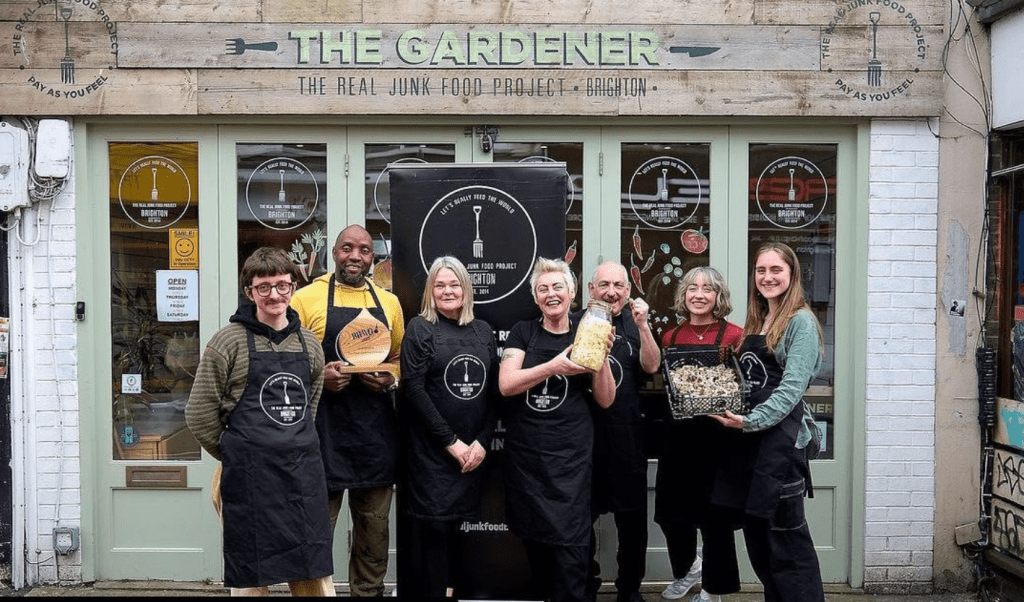
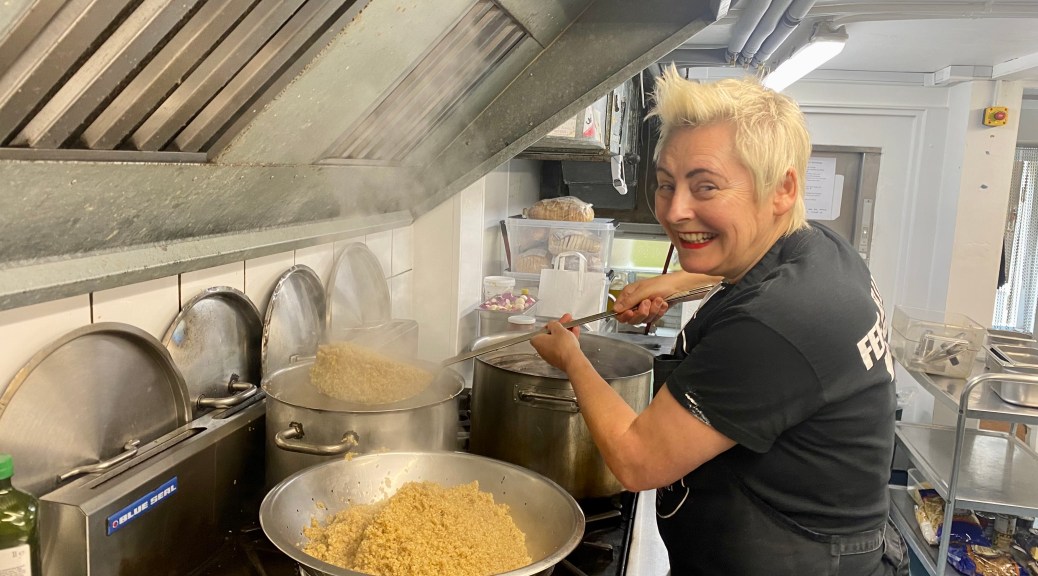
It’s 10 o’ clock on a summer Friday morning at the Gardener Café. Mick is carrying a box of red peppers down to the kitchen where vats of black beans and quinoa are bubbling. Sarah is making pastry for scones, sweet and savoury, cartons of yellow label strawberries, just on the turn, piled behind her ready for Karen Lloyd to reduce them into an accompanying jam. Elodie is chopping pretty pink radishes, and the air is fresh with camaraderie.
This is the Real Junk Food Project’s central Brighton kitchen, bang in Gardener Street in the middle of the North Laine’s most vibrant shopping and café area. Mick and Sarah are volunteers, Karen and Elodie just two of the few paid staff, and the red peppers, black beans, quinoa, flour and strawberries just part of a massive haul from the overnight supermarket waste run.
The Real Junk Food Project, whose mantra is “feed bellies not bins” was created by Adam Smith in Leeds in 2013, and has since grown into a national and international movement of cafes, projects and pop-ups with one core objective: To intercept food waste destined for land fill and use it to feed people who need it, on a ‘pay as you feel’ basis. With afterschool clubs at its sister café, The Fitzherbert Community Hub in Kemptown, and pay as you feel cafes at St Lukes Church, Hollingdean Community Centre and Bevendean Hub, it’s a busy operation.
“We have volunteers driving electric vans to supermarkets across the city picking up amazing food that would otherwise go to waste,” Karen told me. “We get cakes and breads, flour, dairy, all sorts of vegetables. A lot of it hasn’t even got the stickers on it. It’s just surplus. There’s literally nothing wrong with the food at all. But if it’s not collected that will just go into the bins and into landfill. It’s absolutely disgusting.”
Disgusting is the right word. “A quarter to a third of food produced globally, is wasted” says the RJFP website, “and yet, there’s estimated to be 795 million people who do not get enough to eat. In the UK, two million people are estimated to be malnourished, while the UK as a whole creates an estimated 15 million tonnes of food waste every year.” If waste was a country, according to the UN, it would be the third largest in the world.
But there’s not much time to chat about the politics this morning. Karen and her team are on a deadline. “Once it comes to our cafes, we chefs look at the food, decide on the menu, and get on with it”, says Karen. ‘We have three hours to get on with service.”
The black beans, which have been soaked overnight, are going to go into a chilli and the Buddha bowls. The quinoa will become a tabouleh, while the pumpkin seeds have been roasted with a little bit of tamari. The mung beans have also been soaking to encourage them to sprout and will be added to the Buddha bowls.
In the walk-in fridge, massive Kilner jars of fermented celeriac, sauerkraut, kimchis and jams line the shelves. Herbs, tomatoes, lettuces, courgettes and cucumbers – often organic and donated from personal allotments, local farmers and Infinity Foods, but most of which have come in on the supermarket run in the last 24 hours, are piled high in boxes, ready to be cooked up over the weekend.
By lunchtime, the tables outside are packed with students, families and homeless people, often sharing a long table. “It’s all pay-as-you-feel” says Karen, “so it gives everyone the chance to get a really good meal.” This is a place to have lunch with a friend, or strike up a conversation with someone with a whole new life view. You choose. “It does get people talking” says Karen, “and hopefully they talk about how good the food is. I think that’s what food does, doesn’t it?”
If people can afford it though, they try to encourage them to pay it forward. And with funding a perpetual problem on top of the cost of living crisis driving people to find food more cheaply, it’s hitting the tills at the Gardener Café hard. “We have a suggested donation of £6.50”, but most people are
giving £1 or £2 for a full meal.”
The daily lunch on Monday, Thursday, Friday and Saturday is just one part of what Karen and her team of volunteers cook up over the course of the week. “This Saturday, we’re doing a 60th birthday party for 100 people. We’re making canapes and Buddha bowls for them. When the clients come to see us, we’ll go through a basic menu and make them aware it can change. We did a canape event on Wednesday for Wired Sussex. They wanted to know what the menu was going to be, but I couldn’t give it to them until three hours before the event because the ingredients can change. But when we got there and they saw the food, they were amazed by it.”
It’s clear that this is much more than a cheffing job for Karen, whose signature red lipstick and bleach blonde quiff suggests an interesting back story. “I moved to Brighton five years ago after living in Spain for 15 years. My partner had died and I was trying to find work and get back into the catering. I did some voluntary work for Junk Food, and I found my family, basically. That’s what it felt like. So, it really helped me to find my feet again after a very sad time in my life.”
If you want to get involved with the Real Junk Food Project, go to its website for more information. Donate if you can, but the real fun is lunch in the sunshine with whoever sits next to you. Just remember to pay it forward.
http://www.realjunkfoodbrighton.co.uk
Since writing this article we’ve learned that the Gardener Street cafe is to close. The Real Junk Food Project put out this statement:
“It is with great regret that the directors of @realjunkfoodbrighton have decided to discontinue their lease for the cafe on Gardner Street and, as a consequence, the Gardener will close on 25th September 2023. When we first signed up to take on a city-centre cafe using the pay-as-you-feel model, we knew there were going to be many challenges. We could not have foreseen the imminent Covid-19 pandemic, but we managed to weather the associated lockdowns and have continued to provide much needed meals to thousands in our community over the three years since.
Sadly, the current economic crisis is putting extra strain on the food industry and this, combined with soaring energy bills and ongoing building maintenance works, mean that the costs are just too heavy for us to keep the Gardener open. The latter is also taking its toll on our staff and volunteers in a way that is simply not sustainable. Whilst the doors of the Gardener are closing, the mission of The Real Junk Food Project continues and we are optimistic for the future. Our customers in Hollingdean Community Centre, St Luke’s Prestonville and the Fitzherbert Hub in Kemptown will still be able to benefit from pay-as-you-feel lunches created by our wonderful teams.
We hope that by unburdening ourselves from the financial liabilities of the Gardener, we will be able to focus precious resources and energy into our existing venues and commitments.
A massive thank you to all staff, volunteers and everyone who has been involved in our lovely cafe. And thank you Infinity Foods Co-operative for being a supportive landlord.


 The Whistler