Category Archives: Food & Drink

Climate Cafe

Changing the Game: How Brighton’s companies are leading the way to a greener future. Gilly Smith reports

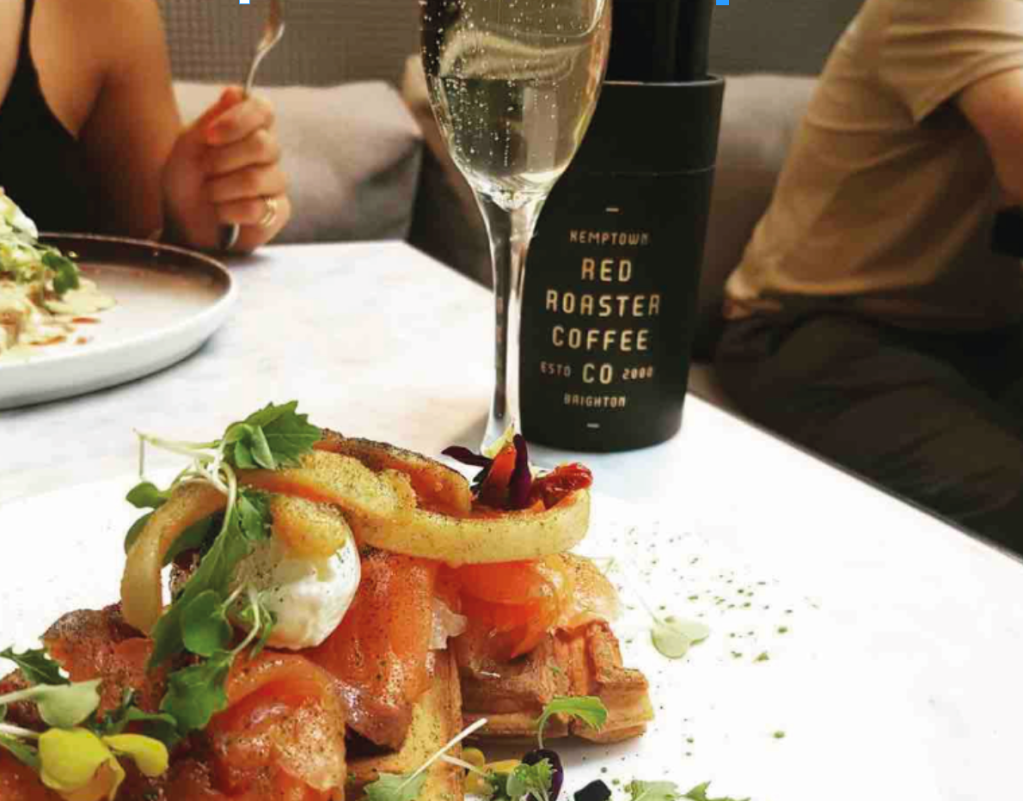
I’m waiting for Ella Byass from Marketing at the new Red Roaster restaurant in New Road on a warm afternoon in November. The nice young waiter asks me where I’d like to sit, and I choose the quieter terrace outside as I’m about to record Ella’s interview. He fiddles with a remote and pops off to get my coffee. He’s turned the heating on. Outside.

It’s not a great start to an interview about Red Roaster’s hard-won battle for B Corp, the global accreditation that aims to shift the behaviour, structure and very culture of capitalism by exacting excellence in every inch of a business. As Ella tells me that they’re one of just 7000 companies in the world to be given its stamp of approval after its rigorous three-year assessment process, I’m still trying to square the heater issue.

Red Roaster has been one of Brighton’s most sustainable companies for years; its coffee roastery in Kemp Town is the only organic coffee roastery in the South East, and its beachfront café, Lucky Beach which won the Food Made Good People’s Favourite Restaurant award in partnership with delicious. Magazine in 2017, has been collecting gongs ever since. 

Membership of the Sustainable Restaurant Association keeps the company focussed on sourcing responsibly, which includes supporting farmers who employ good animal husbandry and contribute positively to carbon capture with regenerative farming techniques to keep the soil healthy. The SRA keeps its members up to date on how best to trade, use energy and keep its carbon footprint low, but also how to interact with the community and treat its teams. 

In Brighton, they’ve switched all of their delivery vehicles to electric or bikes, and are the largest employer of learning-disabled adults in Brighton. Ella tells me that 75% of their produce for their Brighton cafes are sourced locally; its cider comes from Whistler favourite, Trenchmore Farm which operates its own micro circular economy. Its organic eggs are from Rookery Farm in West Sussex and most of its seasonal produce are from Shrub Provisions, one of the increasing numbers of sustainable food hubs working with regenerative or organic local farms for next day delivery to restaurants.  And where it can’t buy local, it supports the farmers’ own communities; Red Roaster’s coffee beans come from Brazil, Honduras and most notably from Rwanda where they run most of their social projects, including building schools and medical centres. 

Led by early sustainability adopters, Diana and Mike Palmer, Red Roaster’s B Corp badge is only the beginning.  “With B Corp, you have to constantly show how you’re improving” Ella tells me. “They’ll come back in three years’ time and say, ‘Right, this is was great three years ago, but what have you done since?’ We can’t just be like, great, we’ve got the B Corp. They’ll want to know how we’ve reduced our carbon footprint even further. They don’t allow you to use it as a green washing technique.”

As businesses try to attract and retain late millennials and Gen Z into a post Lockdown workplace where all the rules have been thrown out of the pram, sustainability is one of the most popular keywords in the search for employment. According to the Institute for Advertising Ethics, 64% of millennials will no longer work for a company that fails to show a strong corporate social responsibility. The data also shows that Gen Z are so concerned about what their peers think of their employers, that their choices are increasingly those that can prove they’re doing the right thing.

It’s an amazing story, but how will anyone know while the only connection the customer has is with a waiter who turns an outdoor heater on without even asking? Ok, so it turns out that the heaters are solar powered, but the point is how would we know?  A brunch with a mate a couple of days after our interview revealed the waitresses weren’t acquainted with the company line either, and the bacon was from Ireland.  

“Our sustainability story is on the menu”, Ella tells me.  Now, come on; who salivates over the food options, ponders over the cocktails and then scrolls through to the last page to read the diversity pledge? We’re Whistling big time for Red Roaster, but maybe by the time the B Corp team come back to check, their waiters will be wearing the t-shirt.

Of the tiny clutch of B Corp companies in the world, we’ve got quite a handful in Brighton. And if you’re thinking about booking your next holiday, you might like to know that one of them is a sustainable travel company which says that it’s not really very cool to fly at all. “There is no denying the fact that if you fly long haul, it will make up a very, very significant proportion of your year’s carbon footprint,” says Nick Pulley, founder of Selective Asia. You’re not even going to get a virtue signalling offset plan as part of the cost of your flight at Selective Asia.  “With an increasing number of reports casting doubt on the benefits of carbon mitigation, we don’t have the necessary clarity and confidence on this approach that we would ideally like,” proclaims the website. 

Instead, the travel agency works with Brighton-based carbon calculating company, C-Level which works directly with environmental scientists and communities on the front line of climate change to develop conservation projects that can provide locals with an income. This is not so much about mitigating the impact of travel, but actively supporting local economies to thrive.  Call it distribution of wealth.

“Travelling with a tour operator like us means introducing clients properly to the cultures and steering them away from the heavy footfall area”, says Nick. Encouraging them to eat on the streets and in family-run restaurants rather than in the larger hotels means shaking the hands that feeds, while keeping the tourist spend local. Travelling in-country by train not only avoids the carbon heavy short hop flights, but gives the traveller a chance to see the landscape and feel the distance.  

Eco-tourism is about understanding impact, and we’ve got to stop flying if we’re to save the planet. But if you’ve just got to make that trip of a lifetime, make sure it helps to secure the D’ering-Dibru Saikhowa Elephant Corridor in the northeast Indian states of Assam and Arunachal Pradesh or support Lone Buffalo, the Laos community project giving free English tuition, sport and creative skills tutoring to local kids. 
The Ruff Guide To Eating Out

Who knew there were so many dog-friendly restaurants in our city? Well, Maya the Romanian rescue for one. As we tucked into our dinner one wet and windy evening at Murmur, we were surprised to find a beautiful but rather anxious dog on the next table. “Don’t look her in the eye and she’ll be fine”, smiled Mum. 

Look, we’re dog people and a nervous dog on a couchette in one of our favourite restaurants is always going to be fine with us. But while we would normally have focussed by now on the delicious fish caught only this morning by Brighton’s own day boat fishermen, we found ourselves in a curiously unBritish chat about dogs. Maya, our new friends told us, was already able to use a word board to tell her new parents how she was feeling. 

“OMG,” squeaked our Gen Z daughter, ‘Do you follow Bunny on Tik Tok?” Of course they did. Bunny, it seems, is the talking dog who presses audio buttons to formulate whole sentences in order to communicate to her owners. “Maya kept us up all night last week”, said her Dad weakly, only slightly failing to follow the party line. “She was pressing ‘tummy’ ‘hurt’ ‘outside’ ‘medicine’ until I had to put a pillow over my head.” Why he didn’t just let her out, he didn’t say. 

It wasn’t like this in France. For three whole weeks this summer, we feasted on dog friendly vibes. From bites in bars in balmy squares to Michelin starred 12 coursers, Pickle, our 13-year-old Collie Cross was more than welcome. Even in the brasserie at the hypermarche where we sheltered from the rain while charging the electric car (again), Pickle was invited in. “C’est normale” said the waiter, giving him a bowl of water before we could ask. Dogs in France sit under tables and are mostly seen and not heard, although the waiters Pickle met generally stopped for a little ear rub and a chat. Only once did we find a giant poodle sitting on his Dad’s lap. But they were Dutch.

And, as it turns out, it’s pretty normal in Brighton too. Maybe dogs are welcome all over the country and we’ve just never dared to ask. So, we’ve decided to send Pickle out as chief reporter for a brand-new column for the Whistler, The Ruff Guide to Brighton and Hove (see opposite page). He’ll be marking Brighton restaurants on the quality of the welcome, the offer of a water bowl and the quality of the meat. Of vegan and vegetarian fare, it’s all about the meat taste. I did tell him that that’s not always the point, but, well, you can’t teach an old dog new tricks. First up, Kusaki in Preston Circus… 

Gilly Smith

Joloff Cafe – A refuge from the madness

Refugees often get a bad press here. You might have noticed. Like most people, we find it really dispiriting, but there are always good people doing good things. And if good things involve hummus… what’s not to like? 

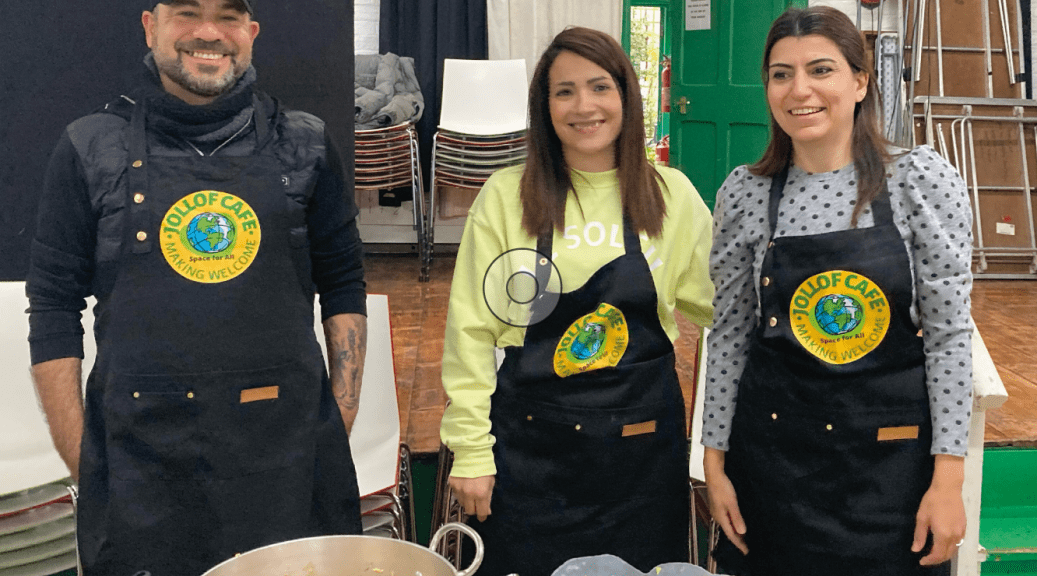
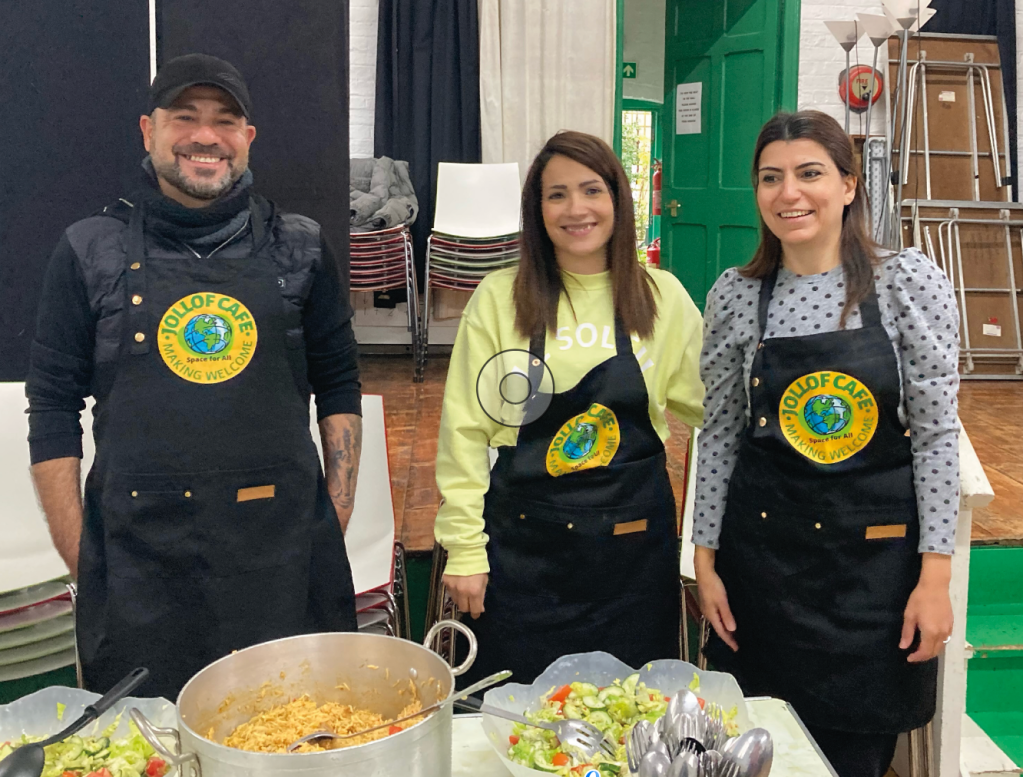
We’re lucky here in this part of  the world – there are fantastic organisations such as The Launchpad Collective who are doing real things to help refugees with real tools such as work and language. And here at the West Hill Hall, the every Wednesday morning The Jollof Cafe takes over and… What’s the Jollof Cafe? 

“It’s a project of the Sussex and refugee migrant self support group. It’s run for and by migrants, refugees, asylum seekers. It’s free for those who can’t afford it and £5 or whatever they feel like for those who can which enables people who can’t afford to eat there to do so. Each week we’ve got different chefs and it’s a lovely atmosphere and great food.” 

I’m talking with Catherine Brown, and Catherine’s long been on the side of the good guys. “I used to work with Voices in Exile and now volunteer with Sussex refugee and migrant Self Support Group which Jollof is part of”. 

“We started in 2017. We used to be at The Cowley Club in London Road, and then after Lockdown we opened up at the West Hill Hall. It’s a little treasure, a bit hard to find, but a treasure.

“The food is always vegetarian, and often vegan. It’s a welcoming, safe space where the migrant community can invite the local community in rather than the other way around. They’re always recipients of charity. Here, it’s the other way around.

And who are the biggest communities? “We used to do a lot of work with the Syrian community, and I was surprised at how many Syrian people that were here. Yes, so still Syrians but a lot less coming than about six or seven years ago. We’ve got some brilliant members of the group who cook for us when they when they’ve got time off from their English lessons. There are Kurds from Iran  and Iraq. Where else? We got people from Sudan, Ethiopia, Eritrea…”

And what’s Jollof? “Jollof rice is a West African dish. When we first started, we had a lot of West Africans cooking for us and we had Jollof  all the time. It’s a peanutty spicy sauce and the rice is cooked in the sauce. It’s usually with meat, but because I’ve only had it at the Hall I’ve never had it with meat”. 

I’m guessing the food at your place is pretty good then. “It’s pretty damn good. Yeah, I get to eat very well. I think Syrian is probably my favorite.” 

Syrian food is… I know about Syrian food. I pride myself on my hummus making abilities and, maybe foolishly once said to a Syrian guy I knew that I made good hummus. So we had a “Hummus  Battle”. I told Catherine and as I told her, I heard her laugh.  

“You lost, I’m guessing”.

“Lost isn’t the word. It wasn’t that close”.

Lost for somewhere to go?

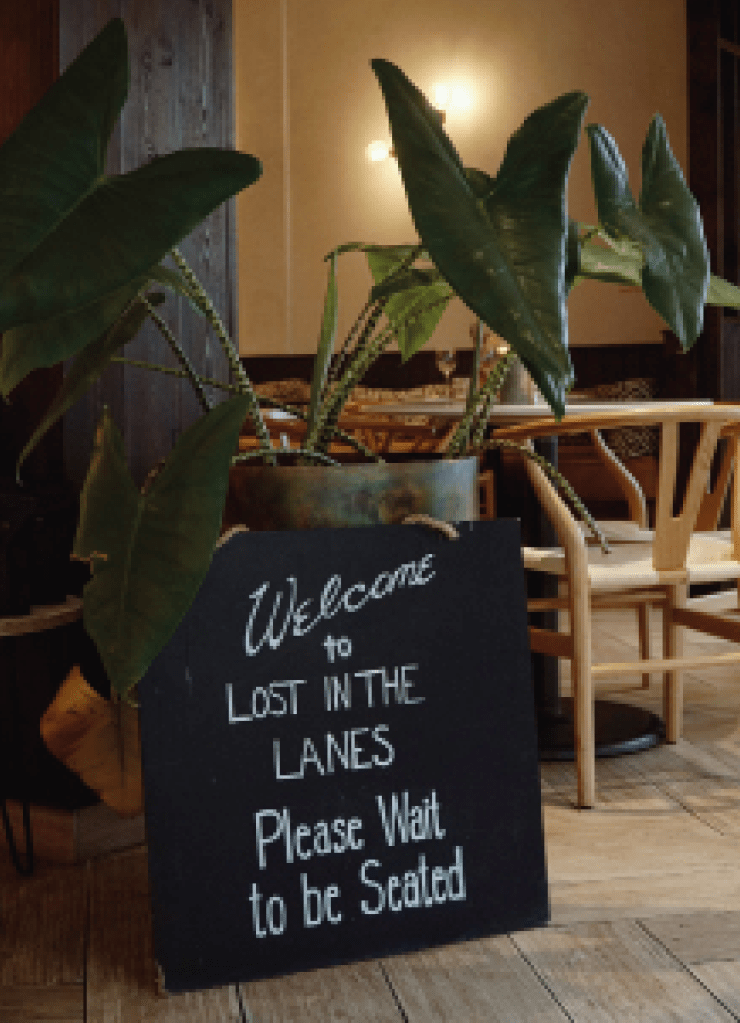
We love The Lanes with all its nooks and crannies and jewelery shops and maybe the odd tourist, but it’s easy to get Lost In The Lanes. And that’s a terrible line about a very nice place. Food editor Gilly Smith found out more

LOST in the Lanes has been a bit of a tranquil refuge in the middle of tourist Brighton, a place for a coffee and a sit down away from the buzz since it opened in 2017. But who knew that its owners were all about local produce, that it had sustainability at its core? 

Since August, its launch of LOST Nights has been showcasing an evening menu, plucked from Brighton’s natural pantry, with meat from the South Downs, fish from the day boats, dairy from our neighbours at Downsview and wines from Wiston, Stopham and Hallgarten. 

Owner Natalie Demetriou and chef Sophie Taverner are keeping it simple and slow, evolving it gently to keep its values at its heart. One day, all restaurants will be like this. I asked chef, Sophie Taverner why local sourcing is so important to her.

“The reasoning behind keeping a short and changing menu in the evenings at LOST is that it really allows us to work closely with local suppliers and make the most of produce when it is at its peak. 

“Sourcing locally isn’t just an ethical choice but also means getting the best produce at the peak of its flavour. Part of the ethos we have built is grounded in excellent relationships with suppliers who will tell us what the best catch is coming in off the fishing boats, or they’ll send us a message when new crops are being harvested. It means being able to put food on a plate that has been harvested that same day which then allows us to create menus that really showcase those ingredients”.

Tell me about your favourite local product right now and what you love to make with it.

“Right now we are coming to the end of the season for the most wonderful Culver corn from Culver Farm in Sussex. It is exactly what corn should be, so sweet and fresh with a perfect crisp to it. We have been serving it as fritters with a chilli vinaigrette, keeping it simple to allow the flavour of the corn to really shine through. It is also the most amazing time of year for fruit and we have strawberries, raspberries, redgages and damsons dotted around the menu and plans for preserving so we can also enjoy these later in the year. Part of really working with the seasons is thinking ahead to what we can make into jams or ferments so that in those months where less is growing, we have stores of things that can add some interest to our menus”. 

How do you let your customers know how much care you put into sourcing well? 

“We keep telling our story and reflecting our ethos in the menus we are creating as well as constantly highlighting our suppliers and the work they are doing. Shrub, who are our produce supplier for LOST Nights, work with small organic farms to get their produce to restaurants like LOST and that means we know exactly where our produce is coming from and who is growing it. That kind of transparency we hope will translate in what we are doing and is something that customers increasingly value. 

What’s the stand out dessert on the menu right now? 

“Like the rest of our menu, our desserts change regularly to reflect the seasons and what´s coming from the farms. This week’s standout favourite was fresh Sussex poached quince, baked cream and almonds. The quince right now is perfect and sits so well to balance out the tart sweetness of the lemon. It was so good we might keep it on for another week”.

Lost In The Lanes, 

10 Nile St, BN1 1HW

01273 525 444