Category Archives: Peter Chrisp

Jazz on a summer’s day

Is Brighton the UK’s best city for jazz? Peter Chrisp, who’s been going to jazz gigs here since the 1970s, gives his Verdict. (Verdict. It’s a jazz club. Oh, never mind) 
Ever feel like the sun is spent, and now his flasks send forth light squibs, no constant rays, the world’s whole sap is sunk; and you are every dead thing, re-begot of absence, darkness, death: things which are not? Jeez Loueeze lighten up buddy, it’s just the usual January bullshit of darkness…Get your dispirited ageing meat envelope along to JAZZ NIGHT AT THE BEE’S MOUTH and feel the surge of molten Vril coursing back to put that spring back in your step…”

That’s from bassist Eddie Myers’s ‘beat’ifully written weekly posting promoting the Monday night jazz jam he hosts at the Bee’s Mouth in Hove. Here Eddie always contrasts the misery of the season or the bleak news cycle with the life enhancing pleasures of listening to, and playing live jazz.

The Bee’s Mouth jam is just one of more than thirty regular weekly jazz gigs across our finger-popping city. On a typical Sunday, there are eleven of them. As an experiment, you could try sampling a few minutes of each Sunday gig, starting at the Walrus at 12.45 and ending at the Hand in Hand at closing time. When I posted a list of Brighton gigs online, even the musicians were surprised at how many there were. Saxophonist Arabella Sprot said, “I’ve never seen this density of jazz gigs anywhere else I’ve lived and that includes Bristol, Birmingham and Berlin.”

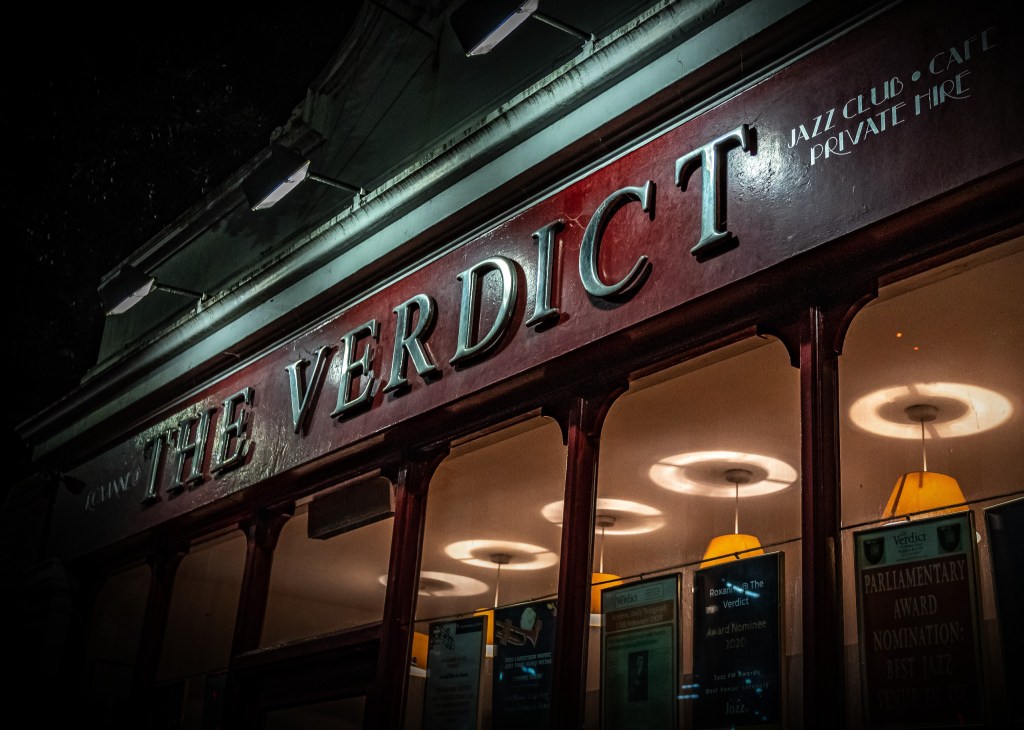
To make a jazz city, you need venues, musicians and appreciative audiences, and we have all three. A big turning point took place in March 2012, when Andy Lavender turned Drury’s tea and coffee shop in Edward Street into the Verdict, our city’s only purpose-built jazz club. Managed by the drummer Tristan Banks, the club hosts jazz jams on Thursdays and international acts on Fridays and Saturday. In 2024, the All Party Parliamentary Jazz Group gave the Verdict their Jazz Venue of the Year award.

New Generation Jazz, set up in 2015, is an Arts Council funded Brighton organisation whose aims are “to help young artists develop audiences outside the capital, and introduce young people in Brighton and the South-East to jazz and demonstrate what a vital, living tradition it is today.” Partnered with the Verdict, they run the September Brighton Jazz Festival, with sold out shows in Horatio’s Bar on the Palace Pier.

Brighton has always been a great place to hear jazz in pubs. Growing up in Essex, I thought that modern jazz was something that happened in the past, on an old Charlie Parker LP my dad bought by mistake. Soon after I moved here as a student in 1976, I came across Geoff Simkins playing lyrical alto sax in the King and Queen. Geoff is still regularly gigging, and I make it a rule never to miss him if I can help it. 

More than twenty pubs now have regular jazz, and most of them are free. The pubs pay the musicians, to bring in pubgoers. Several are organised by guitarists Jason Henson and Paul Richards, trumpeter Chris Coull, saxophone player Alex Bondonno and bass player Nigel Thomas. You can also hear jazz in churches, such as All Saints and St Andrews’ in Hove, where Chris has an early Friday evening concert. The audiences at these gigs listen attentively and applaud the solos. The jazz community is also a good place to make cross-generational friendships. I love listening to the old timers’ stories of magical nights at Ronnie Scott’s in the 1960s.

As for musicians, we have loads, the most numerous being the bass players, followed by guitarists and keyboard players. There aren’t so many drummers, so Angus Bishop, Milo Fell and Joe Edwards are kept busy. Look out for the female singers too: Sara Oschlag, Sam Carelse, Lucy Pickering, Rachel Myer, Ela Southgate and Imogen Ryall. There’s a shortage of male singers, apart from swinging crooner Dave Williams.

Once a month, on Sundays, big bands play in the back room of the Brunswick, and everybody should listen to the mighty sound of a big band playing in a small room at least once. 

Another thrilling sound to hear in a pub is that of the massive 1964 C3 Hammond organ, played by Bobby Aspey with his band the Lost Organ Unit. Their tunes sound like 1960s classics, yet they’re all Aspey originals. Check Bobby’s feet, always in red socks, bouncing over the bass pedals as he plays.

The quality of Brighton rhythm sections and the enthusiasm of audiences attracts visiting horn players. Saxophonists Alan Barnes and Simon Spillett both regularly make a 100 mile journey to Brighton to play gigs here, and Simon has been known to stay for mini tours. Following them from one pub gig to another, I like to imagine that I’m not in Brighton in the 2020s, but bouncing to bebop along 52nd Street in 1940s New York, and that the Brighton pubs are clubs like the Famous Door and Birdland.

Most locals I know don’t realise that they’re living in a jazz city. But wasn’t that probably true also of most New Yorkers in the 1940s?

https://thejamboreebag.blogspot.com/2024/12/brighton-jazz-listings.html
https://www.verdictjazz.com

https://www.newgenerationjazz.co.uk/about

Peter Chrisp on Club Silencio

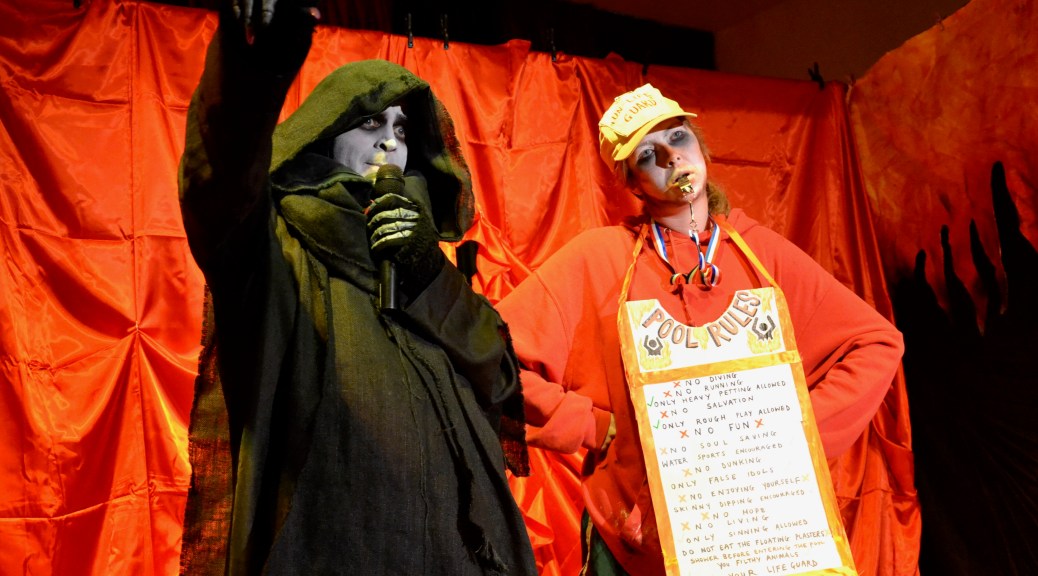
For the last nine years, Club Silencio has been staging extraordinary shows in various Brighton venues. I remember seeing my first one in a sex dungeon in Kemptown and feeling as if I had walked into one of the transgressive early films of John Waters. The next time I saw them they’d built a giant television set in the Phoenix Art Space, where they performed a surreal version of Blind Date, in which a water phobic contestant won a date with the Creature from Hove Lagoon. Then they turned the Arcobaleno bar into a pool party set in hell.

You can see Club Silencio yourself this December, in the Latest Music bar in Manchester St, performing My Bloody Pantomime (“Pantomime characters are quaking in their stilettos as a serial killer is picking them off one by one”). We are promised “gags, gore and a giant eyeball in this pantomime of epic proportions.” Stuart says this is the first Club Silencio show to feature panto characters: “However, most of them are dead!” 

I asked Stuart how it all began. “Silencio was created back in 2015. I’d been spending some nights at Subline, at the time Brighton’s only men-only sex dungeon, with my friend John Tovey. We loved it down there and saw loads of possibility for the subterranean space. The idea was to subvert the space by making it a very classy night. Dressing up in fancy clothes was encouraged, and the space was dressed with frilly lamp shades. We had a toilet attendant, who recited poetry, and a gimp in a tuxedo who walked around with doughnuts on a silver tray. I booked friends – mostly female folk singers – to play, as they brought something unique to the dank and seedy space, and I dressed up as a clown, and sang songs between the acts. For the first show I didn’t really have many acts, so I made up sketches involving puppets, and got friends to wear masks and lip-sync to weird audio clips.”

As for the Silencio name, Stuart says, “I had been to Paris that year and really wanted to go to David Lynch’s nightclub, Club Silencio, named after the club in his film Mulholland Drive. However, it was very expensive to get in and I couldn’t afford it at the time. So, irked by the exclusiveness of it, when it came to picking a name for my own club night, I chose that as a bit of a screw you to David, because Brighton’s Club Silencio was going to be a cheap and more subversive space.

John was my chief in command, and he was brilliant at dressing the room. My friend Joe worked with me in a kitchen at the time, and I persuaded him to be the gimp for the night. My friend Louis was the toilet attendant, and Juno was happy to DJ. Another friend, Ralph, ate doughnuts slowly to a weird advert for Krispy Kreme I’d made (the joke was they were our sponsors). I loved the idea that anyone who wanted to get involved could. After that lots of amazing performers, musicians, actors and creatives have come and gone over the nine years that followed, but John, Misha, Kit, Damian, Tommy, Jon, and Juno, have been at the core of Silencio.”

Alongside Stuart, the main writer is the novelist and actress Juno Dawson. Juno played Dorothy in Club Silencio’s wonderful musical, Return Again to Oz, a hit show in last year’s fringe. You can listen to the songs from the show on Bandcamp.

The regular club host is Jon Griffin, who does an uncanny impression of Death from Ingmar Bergman’s The Seventh Seal. Jon writes his own satirical monologues for the shows, and is so good at being Death that he has since taken the character into stand-up comedy clubs. He’s a composer, like Stuart, and they co-write the songs for the shows.

For Pride in 2019, to mark the 50th anniversary of the Stonewall Riots, Stuart and Juno created Equality of the Daleks. Juno, author of several Dr Who related books, got to play the doctor in a time travelling investigation of how the brick that started the riots was thrown. The brick thrower was a sexually confused dalek.

I wondered if the shows are a reaction to the way Brighton Pride has become corporate and mainstream? “Well, I thought the gay scene was crap, and Pride was just an extension of that. It had nothing to offer me and made me feel unwelcome because I didn’t conform to the idea of what a gay man should be like. I rejected it, and thus was an outsider from my tribe, so in the end I made my own tribe. Now queer outsiders are very in vogue, and there’s loads of great nights that cater to them.”

For the last nine years, Club Silencio’s magnificent sets, props and costumes have been made by Kit Yellery (Odd Fabrication on Instagram). Stuart says, “Kit is incredible and one of the things I always loved was arriving at the venue and seeing what amazing things she’d made. She really is a genius. Last year was her final show with us, and it feels very strange not to have her involved now.”

Club Silencio shows are inclusive, welcoming and immersive. Audience members are encouraged to dress up and take part in surreal games and competitions.  There’s usually an interval, when the actors pose for life drawing sessions, with prizes at the end. 

Next year will be Club Silencio’s tenth anniversary, and Stuart says he has big plans for the celebration: “I can say no more but it will be something special.” Meanwhile, we have My Bloody Pantomime to look forward too – guaranteed to be a highlight of the festive season. 

l http://www.outsavvy.com/event/22586/club-silencio-presents-my-bloody-pantomime

l http://www.instagram.com/clubsilenciobrighton

l https://iamelliotlee.wixsite.com/stuart-warwick

l https://www.jonhgriffin.com

l http://www.junodawson.com

l http://www.instagram.com/oddfabrication

l https://clubsilencio2.bandcamp.com/album/return-again-to-oz-original-cast-soundtrack

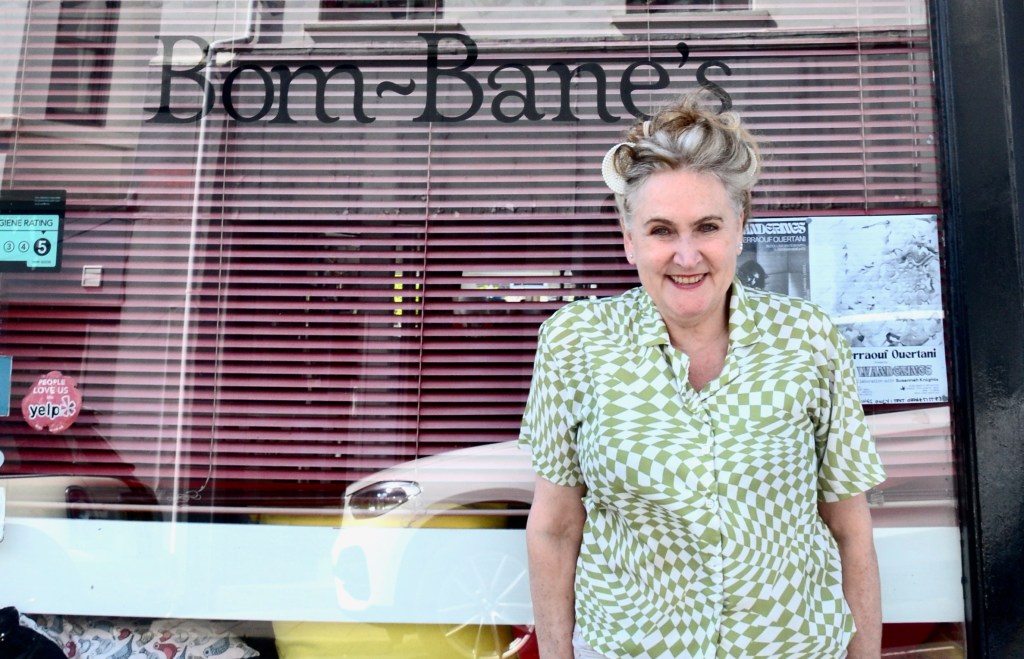
Peter Chrisp talks to Jane Bom-Bane

Jane Bom-Bane plays the harmonium while wearing beautiful mechanical hats, which illustrate her songs, such as ‘I’ve Got A Goldfish Bowl On My Head’. She had the idea to open a café while running musical evenings at the Sanctuary in Hove with her then partner, the multi-instrumentalist, Nick Pynn. After she bought 24 George Street in March 2006, they spent six months restoring the building and creating the café. 

“It was a wing and a prayer,” says Jane. “A lot we did ourselves. People who helped us were friends and gave us really good prices. For a lot of years after, we were giving people free sausage and mash.” Here she’s talking about stoemp and sausage, one of the café’s great Belgian dishes created by Andre Schmidt, the first chef. It’s still on the menu today.

Jane and Nick built seven mechanical tables inspired by table-related wordplay. These are the mirrored Tablerone, the Water Table (a model of the Palace Pier with working rides standing in a rippling sea) and two Aesop’s Tables, showing 1920s animal fable cartoons. The Uns-Table, the Turntable and the 27 Chimes Table all have delightful surprises which I leave to you to discover.

“Until the day before we opened, I still hadn’t worked out a way of putting water in the Water Table. I knew it had to be an oil because water would evaporate. I wanted a transparent oil, but the things I ordered on the net were yellow. And I was in Boots just around the corner and do you know what it was that I spotted? Baby oil! And that baby oil’s been in there for 18 years!”

The front wall of Bom-Bane’s has a bust of Jane with a revolving tray on her head with its own story to tell. Made in 2007 by her brother-in-law, Johnny Justin, it was stolen in 2012, later found in a student garden, minus its hat, and restored in 2017.

Go down the spiral stairway and you reach the basement, the main performance space, its walls covered with paintings and instruments. Although there’s only room for 25 people, it’s a room performers love. Stewart Lee, Bridget Christie, Jerry Dammers and Rich Hall are among the many who have played here.

Bom-Bane’s has a tradition of singing staff, beginning in 2008 with the waitresses Rosi Lalor and Candy Hilton, who Jane discovered were wonderful harmony singers. “I thought I’ve got to harness this, and so I wrote a musical. It was all about the café and how we cooked things, and how I got parsley and coriander mixed up.” 

This was the start of the Bom-Bane’s Family Players, who would perform a folk musical written by Jane every May fringe and at Christmas. These often used the whole building, with an audience of just five following a promenade performance from the attic to the basement.

Puppeteer Daisy Jordan, fresh from art college, joined Bom-Bane’s as a dishwasher in 2010, and soon found herself singing and performing puppetry as a member of the family players. Today she says, “I wonder if I would be a performer/puppeteer if it weren’t for Bom-Bane’s.” 

Isobel Smith, another puppeteer, had only made one puppet when Jane invited her to put on her first show here. Rosi Lalor, encouraged by Jane to write and perform her songs, has gone on to make two solo albums. 

To celebrate the centenary of the crossword in 2013, Jane turned the building into a big crossword puzzle, 5 Down and 20 Across. Her sister, the crossword setter Pegleg, wrote puzzles which were placed on the building’s 20 doors, which had all been turned into black and white paintings by different artists.

I painted one of the doors with the story of the explorer Sir John Franklin’s mysterious disappearance in the Arctic in 1845. By a curious coincidence (or Bom-Bane magic?), Sir John’s ship was discovered a year after I did the painting. This led to me hosting a series of Franklin Disaster Mystery evenings, with Arctic food, Inuit testimony, whale song and Jane as Sir John’s widow singing Franklin ballads.

The current chef is the singer-songwriter, Eliza Skelton. Unlike the waitresses who became singers, she was a singer to begin with. She performs here in the musicals, which she now co-writes, and as a member of the Silver Swans, a madrigal group with Jane and Emma Kilbey. She learned to be a great chef by working in Bom-Bane’s.

In 2008, Eliza and David Bramwell first staged Sing-a-long-a-Wickerman here. Audience members, invited to dress in character, were given a ‘Pagan Hymn Book’, which allowed them to sing along with the songs from the film. Eliza and David take this to festivals and theatres around the country, and still host Folk Horror film screenings in Bom-Bane’s. 

Today, Jane spends midweek with her mum in Coventry, and so the café is only open at weekends. It’s staffed by Jane, Eliza and recent recruit Kate Holden. Jane says, “Kate is helping me in the kitchen. She says she’s not musical, but I’m teaching her to play the guitar, and I think she can sing. Most people can sing.” That very evening Kate made her stage debut, accompanying Jane in a song.

We ended by talking about plans for the future. On the anniversary, 1 September, there’s a coming-of-age celebration, with 18 songs sung by Jane and her family of players. “There was a couple in last week who I got talking to. Somehow we got talking about when we first opened here and he said, “Was there anything that you planned to do that you didn’t do?” And I said “Yes, I wanted to make a tap with water music so that when you turned the tap on music came out with your water, but I never got around to it.” And he said, “I’ll do that for you!””

I tell Jane that I think the cultural impact of this little building has been massive. “When you look at it like that, yes, it’s been a springboard for a lot of people that normally wouldn’t do it. It’s because it’s so little and friendly, and that’s what Brighton’s like, isn’t it? It catches you if you fall.”

l Bom-Bane’s, 24 George St, Kemptown, BN2 1RH

For bookings email janebombane@yahoo.co.uk

https://janebom-bane.bandcamp.com

https://www.elizaskelton.com

https://www.daisyjordan.co.uk

https://rosilalor.bandcamp.com