Category Archives: Women’s football

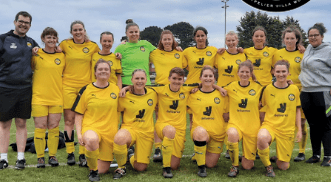
Skip Kelly on Montpelier Villas Women FC

Pre-season is my favourite time of the year. It’s all about getting players ready for the season ahead which means I can plan substitutions in advance knowing that the result has no consequence. All results are treated with a healthy dollop of skepticism because of the simple fact that it is pre-season. 

Last season, one of the earliest talks I had with a player was because they were worried about relegation. A week later I was having a conversation with another player who said their dream was to play at Wembley in an FA Cup final and waxed lyrical about how at that moment it was a possibility for us. During pre-season there are no such conversations but once league points or a place in the next round is at stake, it drives everyone mad and ultimately out of control.

‘Control the controllables’ is advice I repeatedly encounter and although it’s straightforward, I keep coming back to it. My mind is often racing with how to allocate tickets fairly if we did reach the FA Cup final or how I would keep players motivated through a relegation battle. 

 There’s a lot to worry about every season but arguably this season more than most. This will be my sixth season and I have announced to the squad it will be my last which naturally begs the question how will it all end? With silverware and plaudits like Alex Ferguson or an awkward and acrimonious like Arsene Wenger? Another one of those uncontrollables. 

This time next season, the team will be preparing for life in a new stadium with a new coach and hopefully will mark the beginning of a new successful era whereas I will be getting to grips with fatherhood. 

It’s always been a privilege to be responsible for a football team or a class in my actual job but the reality of being entirely responsible for an individual is both terrifying and exciting. 

There are countless stories of pushy parents being justified in their seemingly insane methods by the vast riches and glory that only sport offers and I can’t help but feel if we get a good start then there’s no reason that Skip Junior can’t be the person to lead Ireland to World Cup glory. 

Equally, I’m now more acutely aware of how parents can be disappointed by their offspring and I’m struck with the fear of Skip Junior being one of the greatest footballers in the world eclipsing Maradona, Messi and Ronaldo with billions of people imitating their skills on the pitch, copying their hairstyle and buying their shirt but then ruining it all in the eyes of their father by choosing to play for England. 

I have enjoyed asking current parents for advice which has ranged from ‘get sleep while you can’ to ‘don’t be afraid to say no’ but my favourite has been from the person who said people are very quick to tell you all the bad things but they never tell you how much joy they will bring you. 

Part of the reason I became the coach of Montpelier Villa was because I wanted my prospective children to have no barriers to playing football. I have never drunk alcohol because I was exposed to the effects of alcohol dependency at an impressionable age and didn’t want my prospective children to experience the same. 

Neither of these things will make me a better father and there are far more virtuous people than me out there but I share this with you to give an insight into the level of preparation I feel I have done. 

The child is due in January and by that time we are likely to know how well we have done in the FA Cup and if Wembley remains a possibility, we will know roughly where we are going to finish in the league. If the previous five seasons are anything to go by, we will win matches we shouldn’t win, lose matches we shouldn’t lose, players will get injured, and players will surprise themselves by surpassing their own expectations. 

At the moment, I feel calm and in control but my mind is racing with everything that we’re going to face in the season ahead. 

Skip Kelly – Hope Hawkins – Dec 2023

Recently at a game that had all been decided but for the final whistle, I was keen to share the knowledge I had acquired about the opposition and pointed to one of the players and revealed they had played in an FA Cup quarter-final. Hoping that this would give our team some solace in being on the receiving end of a team with some well-established pedigree, I was instead stunned into silence when one of our substitutes responded. “So what? so have I.”

This same person was responsible for ruining Christmas a few years ago when, as the opposition manager as well as their goalkeeper, they masterminded a 1-0 win over Montpelier Villa. It wasn’t a great day. I wasn’t happy. That all changed when we needed a goalkeeper. I put all that in the past, forged a new relationship and since then I’m pleased to say we’ve had some more Hope in our lives. 

“I feel special,” said Hope Hawkins when I said I wanted to interview her. Hope belongs to the generation of female footballers who’ve thrived and played at the highest level despite all the barriers and obstacles. 

“I remember playing football with my cousin who was football mad. There wasn’t a fence between his and the neighbour’s back garden so we used to use all of it as a big football pitch and breaking all my aunt’s plant pots and we also had to make sure we didn’t disturb my uncle’s pigeons. He was a couple of years older than me and he never went easy on me so he taught me a lot.”

Hope does humilty well. When I point out that she played at the Withdean Stadium in an FA Cup Quarter-Final against Arsenal, managed AFC Varndeanians there as well as hosting ourt recent FA Cup exit, she said “it’s also where I fractured my ankle,” 

Despite winning multiple leagues and cups with Brighton and sharing the pitch with a star-studded Arsenal side that included former England captain Faye White, Hope said she doesn’t get excited by winning trophies. 

“Winning leagues and cups is nice but when I think of my best memories it’s the friendships I have made that have lasted years although I remember the first team I joined was an all-boys team with my cousin, I wasn’t allowed play any matches because I was a girl even though I was one of the best players there,” she said, allowing the humility to slip for a second. “They let me play a friendly at the end of the season and I took a free-kick. It hit the crossbar. I was devastated it didn’t go in.”

Hope played for Hollingbury Hawks, Brighton, Rottingdean, and was player-coach

at AFC Varndeanians before reverting to a player once more at Montpelier Villa where she recently announced her retirement but as she points out, this will be the third time she attempts to retire. On this occasion it has come on the back of doctor’s advice but as always Hope has not taken too well to being told what she can’t do and has arguably defied expectations for longer than she should have for the benefit of her team. 

Hope made a brief cameo in the game I mentioned at the beginning of the article. The injuries sustained over a long career of always putting the team first finally catching up with her and although it wasn’t known at the time, this was the last time Hope would play football. 

Despite all, the enthusiasm and love for the game shines through. Hope struggles to contain her delight in describing the makeshift football pitch she shared with her cousin surrounded by pigeons and plant pots. For Hope, it’s never been about the trophies, the stadiums, famous players she’s played with and against. It’s been the lifelong friendships that will outlast all football careers but more importantly than that, it’s been about proving people wrong. 

Hear the Lioness roar

Skip Kelly, coach of Montpelier Villa Women, explains
why women’s football has transcended nationalism

It’s hard to predict the future, and what I’m about to write could come back to haunt me. For a man with a name like mine and a background like mine and a cultural upbringing like mine… Are these the words I’m commiting to print in the finest local magazine to be read by millions? The words that will finally see me charged and convicted? 

I like the English football team. No, not that one. Let’s not get carried away. The English football  team that puts a smile on your face. It’s been another incredible summer for The Lionesses and many of you will wonder if I am referring to the Lionesses of Singapore or the indomitable Lionesses of Cameroon or the humble, but local English Lionesses. 

This summer was spent reacquainting ourselves with women’s football teams from around the world such as the Super Falcons (Nigeria), The Reggae Girlz (Jamaica) and, of course, The Girls in Green (Ireland).

Nationalism is one of those concepts like organised religion or low emission zones that emits a guttural reaction ignoring the sometime possible benefits. Such as laughing at your neighbours when they are knocked out of international football tournaments. 

Like all those concepts, it’s often the subtlety that provokes shock – and Irish nationalism is no different. After sitting through a school curriculum that had the Gaelic language as a compulsory subject until the age of 18, a history syllabus that taught the wrongs of imperial nations in far flung places like India and Congo, the litany of English football failures serves as a small serving of revenge every couple of years. International football doesn’t allow for nuance and it was always a joy to watch England lose at anything. 

It was suggested that the Australian team – the Matildas – success in the World Cup was the culmination of a co-ordinated online media campaign that itself was a response to the traditional media that supposedly reflects what middle Australia think and espouse good old-fashioned traditional Australian values had for a long time taken a dim view of women’s football. The Matildas were successful because they weren’t seen as representing good old-fashioned Australian values and good old-fashioned Australian morality – they were just seen as Australians. 

I heard this argument and thought it reflected precisely why I found the Lionesses easy to like. The Lionesses had names like Niamh and Mary. Surnames like Daly, Walsh and even Kelly. My initial resentment was at their refusal to declare for Ireland but that has slowly but surely subsided when I realised that these surnames are no longer considered de facto Irish names. 

The Lionesses and The Matildas have somehow transcended nationalism in favour of a more inclusive world for all of us. One that seeks to include rather than exclude. And it’s really hard to root against that, especially when you see first-hand the impact it has on people who’ve previously felt uncomfortable in their own sexuality. Those who felt they had to be in a metaphorical closet now get to see openly gay athletes being celebrated for their athleticism. 

I’m fortunate enough to have a front row seat to this at Montpelier Villa. Our players have always been footballers first, and yet I see how much it means to players when they wear rainbow laces or put up Pride flags at our matches. Our little football team is one of many  that has subverted what’s expected of a ‘traditional’ football team. 

The only court I will be convicted in for liking another football team is the one of public opinion. In the most extraordinary act of self-sabotage ever seen before this court, I would like to present the footage captured by the BBC immediately after Chloe Kelly’s winning goal last summer. Although it’s not clear initially, I am featured in the crowd shot, and I can be seen celebrating wildly with 90,000 others . . . And, yes. I’m wearing my emerald green cap.