

https://viewer.joomag.com/the-whistler-september-october-2024-take-two/0353422001723803989


Edibles for the back of the border.
Surely not, I hear you say. Who grows edibles at the back of their borders? Often forgotten, some edibles provide the perfect backdrop to our borders.
For beauty I am going to surprise you with my all time favourite edible within the herbaceous border; asparagus. Most of us are put off by the years of waiting prior to a crop, or the fact you assume they will take up lots of space. Scrub all your preconceptions away and consider this plant as a beautiful screening device for an ugly bit of fence or garden wall – the foliage is delicate, wispy and detracts the eye nicely from a potential eyesore.
Many years ago in late summer I was fruit picking with my daughter and we passed fields of glorious foliage and I felt compelled to investigate what crop this could be, my delight at finding it was a mere asparagus solved my conundrum of trying to locate a screening plant for an ugly repair to my garden wall, and at just about 5 foot tall, this seemed perfect.
After a while I started incorporating asparagus into my client’s gardens. Perfect for that smaller, not so deep border in a town garden. I often paired it with verbena, oregano and sage for a maintenance free border.
While we’re talking about the rear of the border, have you ever considered growing the humble fennel? There are delicious bronze varieties that don’t grow as high as their green cousins, but both can be shoe horned inbetween shrubs to provide a nice texture contrast. I rarely harvest the bulbs but the seeds are glorious addition to my kitchen cupboards.
One year, while waiting for a potato vine to find its feet I planted some spotty bolotto beans to romp up the trellising. Not only were the scarlet flowers plentiful, but the bean pods were a speckled red, adding to flash of colour after the annuals had done their stuff. Then I dried the beans and stored them in my kitchen to pop into stews throughout the winter; I suspect this was my family’s favourite crop.
Living at the top of a hill provides us with some pretty windy sites, so screening with tall plants that don’t take up the whole garden with their width is a tricky ask. Bamboo just invades everywhere and trees shade our small town gardens too much. Also you want light during the winter months when the sun is low in the sky, so how about trying Jerusalem artichokes? They grow up to 10 foot high plus they don’t mind at all if you chop them down a few feet during the growing season. They produce cheerful bright yellow sun flower type blooms and their sturdy stems withstand the windy battering West Hill experiences. They are easy to grow in our soil and have the all time advantage of needing very little attention.
So now you can plan those gaps lurking by your fences and walls with something that is not only pretty but can be consumed as well.
l Nancy Kirk is a retired gardener who provides bespoke gardening lessons in your own garden. Packages start at £250.
westhillgardenoracle@gmail.com

Pre-season is my favourite time of the year. It’s all about getting players ready for the season ahead which means I can plan substitutions in advance knowing that the result has no consequence. All results are treated with a healthy dollop of skepticism because of the simple fact that it is pre-season.
Last season, one of the earliest talks I had with a player was because they were worried about relegation. A week later I was having a conversation with another player who said their dream was to play at Wembley in an FA Cup final and waxed lyrical about how at that moment it was a possibility for us. During pre-season there are no such conversations but once league points or a place in the next round is at stake, it drives everyone mad and ultimately out of control.
‘Control the controllables’ is advice I repeatedly encounter and although it’s straightforward, I keep coming back to it. My mind is often racing with how to allocate tickets fairly if we did reach the FA Cup final or how I would keep players motivated through a relegation battle.
There’s a lot to worry about every season but arguably this season more than most. This will be my sixth season and I have announced to the squad it will be my last which naturally begs the question how will it all end? With silverware and plaudits like Alex Ferguson or an awkward and acrimonious like Arsene Wenger? Another one of those uncontrollables.
This time next season, the team will be preparing for life in a new stadium with a new coach and hopefully will mark the beginning of a new successful era whereas I will be getting to grips with fatherhood.
It’s always been a privilege to be responsible for a football team or a class in my actual job but the reality of being entirely responsible for an individual is both terrifying and exciting.
There are countless stories of pushy parents being justified in their seemingly insane methods by the vast riches and glory that only sport offers and I can’t help but feel if we get a good start then there’s no reason that Skip Junior can’t be the person to lead Ireland to World Cup glory.
Equally, I’m now more acutely aware of how parents can be disappointed by their offspring and I’m struck with the fear of Skip Junior being one of the greatest footballers in the world eclipsing Maradona, Messi and Ronaldo with billions of people imitating their skills on the pitch, copying their hairstyle and buying their shirt but then ruining it all in the eyes of their father by choosing to play for England.
I have enjoyed asking current parents for advice which has ranged from ‘get sleep while you can’ to ‘don’t be afraid to say no’ but my favourite has been from the person who said people are very quick to tell you all the bad things but they never tell you how much joy they will bring you.
Part of the reason I became the coach of Montpelier Villa was because I wanted my prospective children to have no barriers to playing football. I have never drunk alcohol because I was exposed to the effects of alcohol dependency at an impressionable age and didn’t want my prospective children to experience the same.
Neither of these things will make me a better father and there are far more virtuous people than me out there but I share this with you to give an insight into the level of preparation I feel I have done.
The child is due in January and by that time we are likely to know how well we have done in the FA Cup and if Wembley remains a possibility, we will know roughly where we are going to finish in the league. If the previous five seasons are anything to go by, we will win matches we shouldn’t win, lose matches we shouldn’t lose, players will get injured, and players will surprise themselves by surpassing their own expectations.
At the moment, I feel calm and in control but my mind is racing with everything that we’re going to face in the season ahead.

Brighton in the summer is a time of plenty for your favourite scavengers. Tourists, blinded by the city’s light, can barely keep a grip on their picnics and barbecues as they stagger to the beach, and we see it as our job to help out. While the cafes spill onto the streets and fairy-lit restaurants stay up late, we provide a round the clock rubbish collection service. You’re most welcome.
But for a discerning bird like Yours Truly, it’s a time to sort the good from the bad, tapping on the windows of our favourite kitchens to check in on where they get their fish, meat and dairy. Regular readers of The Gull About Town will know that if there’s a sniff of a factory about the chicken or a heavy carbon hoofprint attached to the beef, she’ll turn her beak in horror. But her bird’s eye view over the city can reveal enough good news food stories to smooth even the most ruffled of feathers.
Swooping first to Time Out favourite, Halisco your gull spots an interesting exchange over the back fence between owner Ali and his next-door neighbour chef at Kanok Thai.
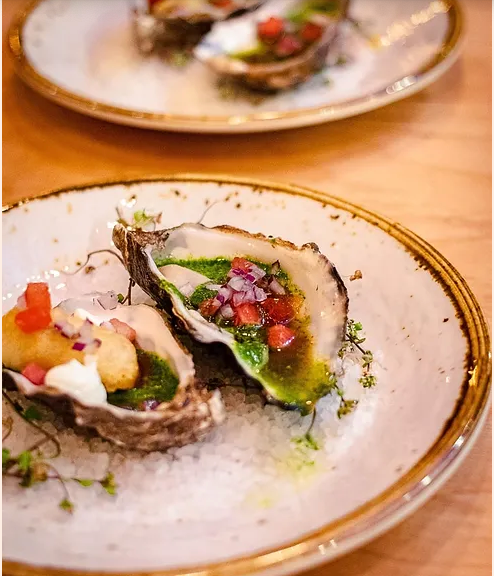
One of the bird-loving brothers who have made this little Mexican one of the grooviest eateries in Preston Street, Ali always saves a delicious bite at the end of the evening at both this and his global fusion restaurant, Anakuma opposite. It seems that his Thai neighbours regularly go fishing off Brighton and happily share their freshly caught mackerel, bass and bream with him. The sea bream and grapefruit ceviche is as a fresh as a gull could wish for.
#Bemoregull is a mantra worth squawking when eyeing the menus at Brighton’s more exciting restaurants. Just as we catch local, seasonal fish from plentiful stocks, so do the best chefs in town. The word on the wing that you’re looking for when asking your waiter in better restaurants such as Petit Pois on Ship Street where their fish comes from, is BNFS – Brighton and Newhaven Fish Sales. Only the fisherchefs at Kanok Thai can compete.
You only need to look at the gang of gulls hanging around Barfields butchers on Ditchling Road on a Saturday morning to see where Brighton foodies choose to buy their meat. And it’s a feather in the cap of any good chef in town to get their meat here. A good butcher, as any gull will tell you, is the gatekeeper to quality meat, and if your chef doesn’t know who he is, that’s worth a proper peck.
Palmito is at the head of the queue in brownie points on this one; hop over to the Climate Café column to find out more on this fine little diner which made it, along with small plates favourite, Med and Hove’s Fourth and Church to The Good Food Guide’s 100 Best Local Restaurants in the UK.

Climate change can feel like an overwhelmingly difficult issue, something just too big for people like you and me to do anything meaningful about. But Global CEO of Compassion in World Farming, Philip Lymbery reminds us that we have an opportunity three times every single day to make a real difference. And that’s about what we eat.
Eating locally, seasonally, supporting the farmers who grow and the chefs who source responsibly, eating less but better meat – if eating meat at all – eating real food not ultra-processed and adding more plants to your plate not only reduces the carbon footprint of your food bill but makes us healthier too. And that takes the weight off the NHS, which is already buckling under the burden of diet-related diseases.
And where we eat makes a difference too. Diego Alejandro Ricuarte is the founder of Palmito, the Brighton favourite where classic street food dishes from Colombia, Mexico and Ecuador come with an affordable price tag and an ethical halo.
“Our butcher is Will Pountney at Barfields who mostly deals with local sourced meat. We know the farmers he works with, but we also buy from our own favourites; we get whole lambs from Rosie Martin at Nuthurst Farm, and goats from Ed Brown at Clapham Farm whose whole family believes in creating more sustainable local food systems.
“Rare breed Middle White Pigs are always on the menu at Palmito and I’ve been getting them from Richard Vaughan at Hunstham Farm in the Wye Valley. The farm has been in the family for 400 years and they have a small team devoted to the pigs to make sure that they are reared and fattened really slowly.
“We have been working directly with Sophie Bullacher who has her own market garden – you can follow her on Instagram @pitfield.veg. She delivers some of our vegetables directly from her land every Wednesday, and we really love the way she thinks about the food she grows. She studied craft and design at Brighton University, but she quickly realised how wasteful the big budget jobs she was getting were. She leads a really sustainable low impact way of life herself, and so she decided to start growing vegetables for cool restaurants like Palmito! It’s a lovely story.
“The other vegetables and dairy we source from
Shrub.London (www.shrub.london) which is a brilliant hub for over 45 ethical farms, but gives restaurants next day delivery, which is important. Our mushrooms and wild food come from Chris Amys the forager who has a workshop at Stammer Park.
“It is still a work in progress. To be able to work directly with the growers and producers has been a challenge, but we want our diners to see how hard we try to source well, support good farming, and still be able to be competitive. We want our cooks to be directly involved with the food they cook and to know where things come from.
“What I eat at home is what I cook at the venue. Like today, it is my day off and I just go visit growers and get to know them more. Just like other people care about a brand of shoes and know everything about them, I like to know what I put in my mouth. I am in awe with people who grow food, and by using local producers I have been welcomed into their land. I win from that on a personal level because I realise that we share the same values and we choose those values over profit.
“What really makes me happy is that all my suppliers come to Palmito every week. They know my staff by name and vice versa. They have a chat and they get excited about the produce. Therein lies our philosophy. Grow food, know food, grow community. When the young cooks I employ know what it takes to grow those products and they can put a face to them, then they are more careful about food in general. It works for us.”
l Palmito: 16 Western Rd, Hove BN3 1AE
01273 777588


 The Whistler