The Coast is Queer – the UK’s biggest festival of LGBTQ+ literature

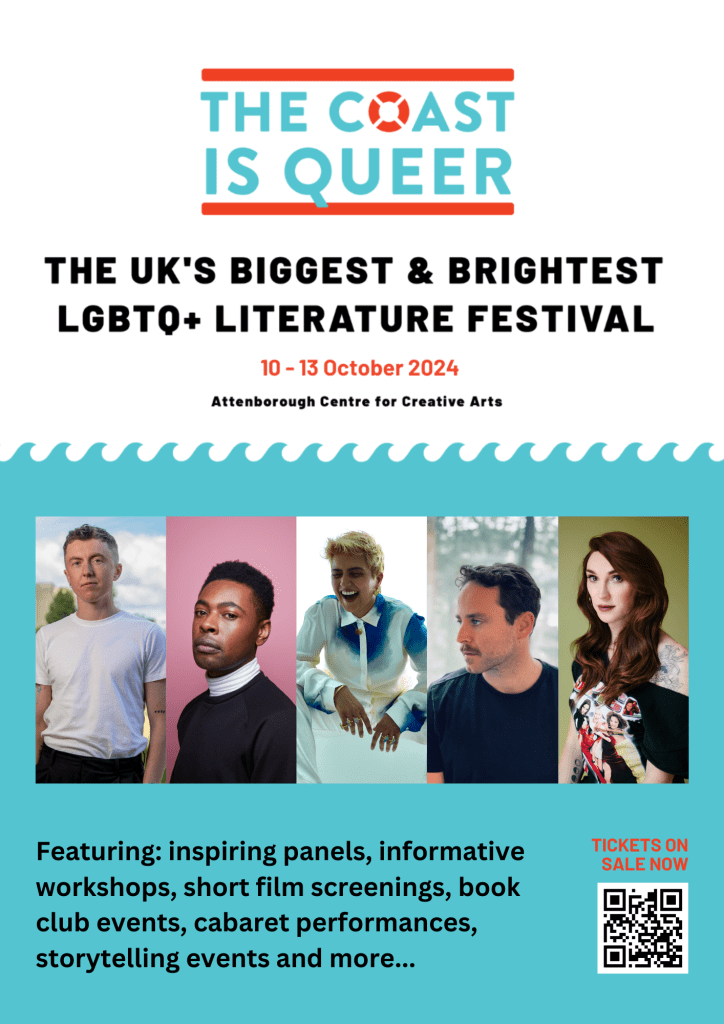
It’s three days of lively conversations, panels, workshops, performances and films celebrating some of the best and brightest LGBTQ+ writers. The first festival of its kind in the UK, The Coast is Queer aims to create a space for queer readers, writers and allies to come together in a grassroots celebration of the written word and its ability to illuminate and enrich the life of the queer community.

The Coast is Queer Festival is a collaboration between New Writing South and Marlborough Productions, and is funded by Arts Council England. The line-up includes a opening event on Thursday 10 October celebrating 30 years of DIVA Magazine – Telling Our Stories – Then & Now – with DIVA’s Roxy Bourdillon, Gay Times’ Reeta Loi, and Attitude’s Matthew Todd, chaired by Paula Akpan.

Friday’s events – partly curated by students from Sussex and Brighton Universities – feature panels exploring Queer Fantasy Writing and Writing Queer Stories for Multiple Generations. 

Also on Friday, there’s Politics and Hope with Leah Cowan, Amelia Abraham and Sharan Dhaliwal, and a dive into Queer Nightlife with historians, DJs and authors Daren Kay & Alf Le Flohic, Dan Glass, and DJ Paulette chaired by Kathy Caton. Rounding off Friday’s festivities, the artist in residence AFLO the Poet hosts an Poetry Open Mic event featuring some of the most exciting queer poets writing today. Workshops on Friday cover: Pitching to Agents, Self-Publishing, and Reading and Performing for Live Audiences.

Saturday is full, packed with panels, in-conversations and workshops including Liberating the Queer Canon with H Gareth Gavin, Adam Macqueen and Julia Armfield; Writing for Performance with Matilda Feyisayo Ibini, Charlie Josephine and Alexis Gregory, chaired by Debbie Hanna. Later, there’s wild intrigue with Environmental Writers Roma Wells, Mike Parker and Natasha Carthew. Lotte Jeffs, Stu Oakley and Ben Fergusson will talk Queer Parenting.  Sex, Lust and Romance is the distinctly queer theme of a Polari Prize legacy panel featuring Paul Burtson, Jon Ransom, Nicola Dinan and Viola Di Grado and Saleem Haddad’s stunning film, Marco will be screened with a director’s Q&A.

Novelist, screenwriter and Sunday Times Number 1 Bestseller Juno Dawson returns with another edition of her Lovely Trans Literary Salon, this time featuring Kuchenga Shenjé, whose debut novel The Library Thief has taken the publishing world by storm and the day will culminate with the David Hoyle Does The Classics Cabaret and three new young-artist commissions.

Workshops and additional events on Saturday include a Print Workshop, a Work in Progress Breakfast, a Private Rites Book Club event in collaboration with Brighton’s Real Writer’s Circle and Julia Armfield and a buzzing book launch for Lea Anderson’s exquisite Cholmondeleys & Featherstonehaughs.

The Festival rounds off with a fascinating line-up of events including a Queer Memoir panel featuring Dean Atta, Karen McLeod and Juano Diaz, chaired by literary agent Abi Fellows; a Celebration of James Baldwin’s Life and Work with Mendez and Douglas Field chaired by Campbell X; an inspiring poetry workshop and a joyful closing event celebrating Radical Hope – a smorgasbord of spoken word, performance, films, activities and keynotes designed to excite, inspire and make you feel  connected to the queer literary community.

Short films featuring the best new queer film makers will be programmed throughout the weekend and Queer Heritage South will be running ingenious pop-up history club activities. 

The Coast is Queer is a significant event for LGBTQ+ literature. Over 5,000 people have enjoyed and been inspired by moving and exhilarating events from over 150 writers since 2019. Past speakers include Douglas Stuart, Sarah Winman, Juno Roche, Leone Ross, Alan Hollinghurst, Okechukwu Nzelu and Travis Alabanza.

Lesley Wood, CEO of New Writing South said: “We’re delighted to bring some of our most thrilling LGBTQ+ writers to Brighton again for The Coast is Queer. Now in its fifth year, the 2024 festival promises an abundance of big ideas, lively discussions, challenging debate… and above all else, radical hope… with a good dose of queer joy. Spread across three days in the perfect festival setting of ACCA, there will be something for everyone – book events and literary talks, cabaret performances, storytelling events, short films, extraordinary workshops, a wonderful book group and much more. All designed to celebrate and find joy in LGBTQ+ writing.”

Buy tickets at http://www.coastisqueer.com and follow on Instagram at @coastisqueerfest
http://www.attenboroughcentre.com/

Corinne Sweet – Growing Old(er) Disgracefully – Sept 2024

“Oooh, look at those amazing blue eyes”.

My dear friend Suzi has come to see me ensconsed in my new West Hill abode and we are sitting side-by-side over tea on my sofa, swiping left and right.

“I like his coat”, she says breathlessly, “There’s definitely something about him”.

Gingerly she swipes right. We move on to the next pic.

Suzi lost her husband a couple of years ago and is desperately trying to get ‘out there’ again. However, lonely nights, no cuddles, and no welcome home, are weighing heavily on her.

So here we are on social media trying to find a mate. Not unusual, you think? Well, no. Except this is no ordinary ‘Tinder’ – it’s what I call ‘Cat Tinder’.

We are deep in Worthing’s Cat Welfare Trust’s website, desperately seeking a furry companion for my bereaved friend. We are amazed – and somewhat bemused – by the Tinder-like menu for choosing a homeless puss.

‘Oh, he’s gorgeous”, purrs my friend over a fluffy mog, “I’d definitely like him to cuddle up to me on my bed.”

As a shameless cat lover myself, I know, first-hand, the benefits of being owned by a gorgeous furry monster. When I moved south in darkest December my dear boy, Woolf, plonked himself on me, rubbed noses and reassured me all would be well.

When I return late at night after my weekly work commute to London he deftly drops off the garden wall with a loud, ‘Meow, where have you been? I want my supper, and a cuddle, you’re late!’ We slink in together, and I’m home.

Indeed, the research in the 2022 Cat Protection League survey of 10,000 cat owners (“Cats & Their Stats) found positive psychological and physical benefits from cat ownership.

67% of people interviewed said their cats gave them something to get up for in the morning and 21% said their cats helped them feel less stressed. 

WAY (Widowed and Young) for people whose partners have died aerly agree cats can help mental health, particularly when we’re grieving.

Stroking cats is well-known for lowering blood-pressure in owners. Plus, there is benefit in talking to your cat about your own woes. Play makes everyone smile.

I remember being sad myself and when I cried prone on the sofa, Woolf would jump on my chest and purr nose-to-nose to me with cat empathy.

Cat vocalisations (mews, purrs, chirps, in differing tones) are how cats bond with their owners. They only ‘meow’ to those they care about (although it’s more likely they’re demanding food, attention, play, in that order).

Suzi is teetering on the brink. ‘I don’t know if I could bear to lose him’, she says wistfully. ‘What if something happened to me?’

‘Well,’ I say, looking around for an alert lurking Woolf, hoping he’s out of ear shot, ‘I could always have him.’ Woolf had had a little sister, Frida, who’d died too soon and broke my heart. “There’s always room for two…”

“Hmm”, Suzi ponders, glancing at her phone. ‘Oooh, he’s nice’. I watch her peruse fabulously tiger markings and emerald eyes. I sense another solo soul is becoming a lost cause. “I might just give them a ring..I’ve got all the cat stuff in the loft”. 

I know when best to keep quiet. I stroke a prone Woolfy stretched on my lap, purring like a well-oiled motor, and just smile.

Growing Old(er) Disgracefully by 

Corinne Sweet

Psychotherapist, writer, broadcaster 

http://www.corinnesweet.com

The secret diary of a microdoser #2

My psychiatrist looks straight at me. His body completely still, his eyes piercing with total concentration. I précis the last hour, “So, basically, I’ve given up drinking and taken up mushrooms and DMT…” And his answer?… “Great!”… Seriously. Hand on heart. I shit you not. He closes his notebook, wrapping up the session and repeats, “Great.”… If ever I needed validation, that was the moment. I could have kissed him.

I float out to his reception desk and am less bothered by his astronomical fees than usual. I wave a plastic card over a plastic box to make a plastic sound. I ponder whether that “friendly” beep has been acoustically engineered to hide the laugh of bankers. But I shrug it off. Sometimes you get fleeced. Sometimes it’s worth it.

I didn’t get the chance for him to expand on why he thought psychedelics were better for me than alcohol. But do I need to? Who am I kidding? How many trippers do you meet in A&E on a Saturday night, nursing their smashed up heads or broken arms? Zero. Zip. Nadda.

Booze was just the best thing we could come up with at the time. Liquid bread. Goes well with a fag. Something to throw in the air when England score a goal… The thing is that the world isn’t that simple anymore. The world has changed, and our needs have changed with it. And it’s not going back because reversing isn’t an option offered by its gear box. It can only travel in one direction. 

Evolution is a journey towards complexity. It is inexorable. Relentless. It started with simple cell division and it ends with?… Well, I guess that’s the million dollar question… Telepathy? Teleporting? Inter-dimensional travel? Perhaps we become the gods. Wherever we’re going, whether you lubricate the wheels with psychedelics or not, it will undoubtedly blow our minds.

Often when I dose on psilocybin, I think of a coral reef in The Red Sea called Ras Mohammed. The metaphor is as simple as it is beautiful. A giant figure of Mohammed is standing with his feet planted on the Earth’s core, and the top of his head (specifically his scalp or “Ras”, the most spiritual part of the brain according to Islamic scriptures, being “closest to God”) is a huge coral reef, bursting with life and exploding with colour. 

But you don’t need to have scuba-dived off the Sinai Peninsula and witnessed the intricacy and symbiosis of a coral reef to bathe in the beauty of natural psychedelia. You can experience the same complexity and harmony by walking through the stunning woods and countryside that surround our city. You only need to open your eyes a little wider and study a leaf whose veins divide and divide again until you enter the mesh of its photosynthesising cells. Follow the light that refracts through a droplet of dew on a bed of moss; marvel at its suspension in space and time by the perfection of surface tension; allow your mind to bend with its lens. Enable your senses to reach into the roots of a vine winding round its host with will and intent, and grasp its strength, yoke its power. 

What I’m trying to say is that, if you dive into the detail and increase your true connection with nature, you will find your nirvana. In a world where our food is sterilised in cylinders of tin, wrapped in plastic or presented in polystyrene, (none of which exist in the natural world), we are often barred from quenching our thirst for spiritual grounding. Earthing is not a paradox, it is a human requirement. Whether you believe in the ionic exchange between your body and the Earth’s magnetism, whether you consciously bridge that gap with psychedelics or you’ve developed your own method, modern society’s hellbent determination to contain us with concrete, cover us with plastic and encase us with metal, leads to a schism with the natural environment and that … makes … you … sad… Why? Well, this is the hilarious secret. Hilarious, because it’s so obvious: You Are Nature

Nature is not something separate to you. You are not simply the Observer. Nature is not something you only watch on TV. Yes, it is out there, sure, but it is also within. It is You. It is Me. It exists in each and every exchange of our breath. In our beauty. In our faults and mistakes. In our skills and talents. In our empathy. In our senses, our thoughts, our beliefs and our emotions. In our smiles. In our tears. Even in our dreams… If you can’t see that, at our finest, we are the coral reef, then maybe it’s time to take off your mask. 

With love. 

Ray, Brighton, 2024

Editor’s note: The Whistler does not condone Ray’s opinions. We chose to publish this as we know there are many microdosers in the city. But remember, what works for Ray may not work for anyone else. 

Benita Matofska looks at Sussex Bay

I’ve long been fascinated by the wonders of our waterscapes and how vital ocean conservation is to our very existence. 70% of our planet is covered in water – from seas and salt marshes, to rivers and inland coastal waterways, these shape the land, the way we live, eat and breathe – they’re vital to our health, wealth and happiness and we need them to survive. When they thrive collectively, this is Blue Magic.

I grew up in land-locked Leeds and the first time I saw the sea, I was 18 months old and stood and stared and was silent for the first time. It was my first encounter and it would come to shape my life. 

Fast forward to when I was 10. Riddled with eczema, my parents took me to the Dead Sea. They’d heard about its healing powers and had been told that if you submerge yourself in the water for seven minutes, it can heal even the most damaged skin. Willing to give it a go I gripped his hands tightly and in we walked. The pain in my open sores was terrible, but I persevered and managed to stay submerged. Within three weeks, my eczema had cleared. It felt like a miracle. Nature’s minerals in the Dead Sea – magnesium, calcium and potassium – had worked their Blue Magic. 

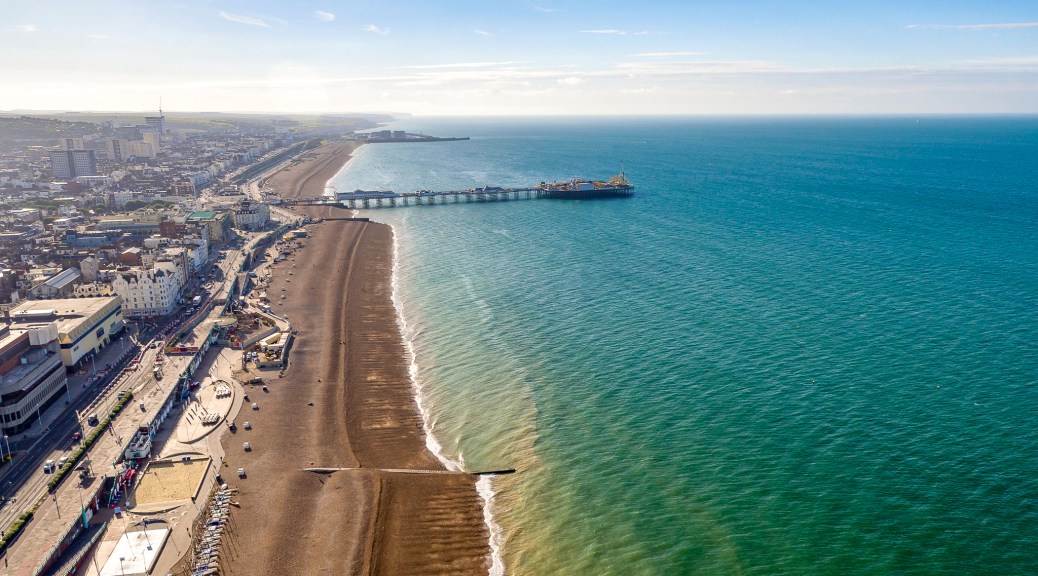
So what does all this have to do with us Brightonians? Well a new initiative called Sussex Bay is set to bring Blue Magic to our very own shores, so we can reap the benefits. Sussex Bay is a mission to regenerate, restore and revive 100 miles of our Sussex coastline. Paul Brewer, the Director for Sustainability and Resources at Adur and Worthing Council and Dean Aragon-Spears, Head of Blue Natural Capital are spearheading this incredible project. 

Dean describes Sussex Bay as ‘a movement initiated by Adur & Worthing Councils, powered by civic organisations, local businesses, communities and people.’ 

Through what they describe as ‘bold collaboration’ they aim to generate £50 million by 2050 to accelerate local seascape recovery along this incredible coastline – from Selsey in the west to Camber
Sands in the east including its river systems, coastline and marine area out to 12 nautical miles.

Sussex Bay came about after Adur & Worthing Council declared a climate emergency in 2019. Two  local projects inspired the next step: the Knepp Estate which has rewilded 951 hectares of farmland and seen massive increases in wildlife and biodiversity, and secondly the work of the Sussex Inshore Fisheries Association to introduce a 300 km2 trawler exclusion zone off West Sussex to restore the decimated historic kelp forest. If yoiu could rewild the land, why couldn’t you rewild the sea?

“There’s an urgent need to reverse the catastrophic decline in marine biodiversity.  Sea-based rewilding projects are far less common than those on land. The Blue Marine Foundation defines rewilding the sea as ​‘any effort to improve the health of the ocean by actively restoring habitats and species, or by leaving it alone to recover’. Healthy seabed drive a richer marine ecology, so when habitats recover so does everything that relies upon it. 

“Now more than ever we must bring nature back to our seabed, reefs and rivers. Restoring these ecosystems and their blue natural capital helps protect our coasts from storms, clean our waters, store carbon and support biodiversity.

And as nature recovers, people and the coastal economy will benefit too; from sustainable fisheries to enhanced health and wellbeing, and new commercial opportunities in ecotourism and leisure.” And that is magic. 

https://www.sussexbay.org.uk/

Benita Matofska is a speaker and author of Generation Share, a collection of 200 stories of changemakers.

benita@benitamatofska.com


Reasons to believe in the power of the seas

1.Globally, the Blue Economy is worth $1.5 trillion, provides over 30 million jobs and food for three billion people. And that’s predicted to double by 2030. A similar initiative to Sussex Bay is The Great Blue Wall, an African initiative to secure livelihoods for 70 million people, restoring two million hectares of ocean, capturing 100 million tonnes of CO2. The network of seascapes will be connected by a living blue wall that act as regional ecological corridor created by conserved and restored blue ecosystems such as mangroves, seagrass and corals.

2.Another initiative is Ireland’s Eco Showboat, the brainchild of Anne Cleary and Denis Connolly who travelled the coast of Ireland by solar powered electric boat on a zero carbon journey to connect scientists, artists, communities to spark climate action.

3.We’ve lost half of our coral reefs in the last 30 years and are estimated to lose 90% by 2050 because of climate change, pollution and over fishing. The better news is that scientists have found that marine ecosystems recover very fast and we can restore marine life by 2050 if we act now. 

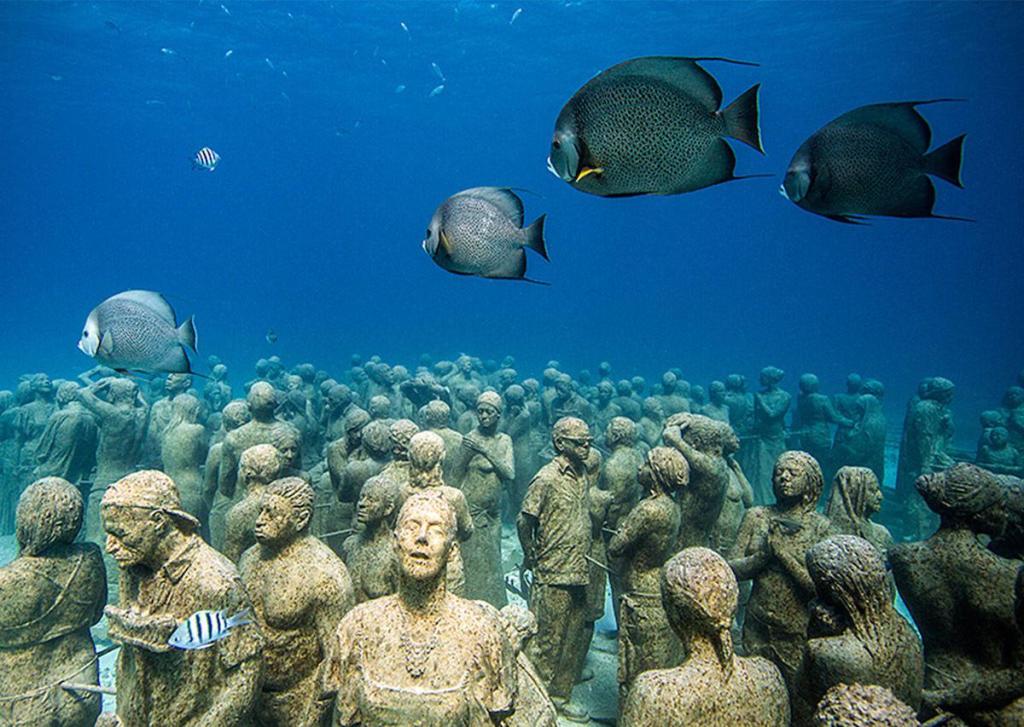
At the Museum of Underwater Art in Australia, underwater sculpture artist Jason DeCaires Taylor has created installations and beautiful artificial environments installations also lure divers and visitors away from the Great Barrier Reef, helping to protect it. 

4.Wetlands are biological super systems that store up to 50 times more carbon than rainforests. 40% of all plants & animals live and breed in wetlands and over a billion people depend on them for their living. We need to preserve our wetlands and our waterways to survive. The floating gardens is a project in Bangladesh to bring wetlands back to life using ancient Aztec traditions providing food, livelihoods and flood defences, combating impacts of climate change. 

5.The South African charity Waves for Change is a project offering surf therapy to children. By making the ocean accessible, children are learning new skills, and having a magical, life changing experience. 

6.Alejandro Duran, a Mexican environmentalist and artist, has created The Museum of Garbage and Washed Up, an installation and photography project using rubbish that washes up on Mexico’s Caribbean coast, a UNESCO world heritage site. His mission is to wake us up to the impacts of plastic pollution and consumerism. Alejandro and a team of volunteers found trash washed up from 58 countries and 6 continents.

How You Can Get Involved

1.Help to regenerate Sussex Bay by donating to the crowdfunding campaign. 

2.Volunteer with one of the Sussex Bay projects such as Sussex Underwater, the Sussex Kelp Project or the Sussex Dolphin Project.

3.Document wildlife sightings at the coast and get involved in citizen science. For more information, visit sussexbay.org.uk

4.Submit your idea. What’s your vision for Sussex Bay? Be part of the region’s biggest, boldest coastal collaboration ever. 

Contact hello@sussexbay.org.uk

Peter Chrisp talks to Jane Bom-Bane

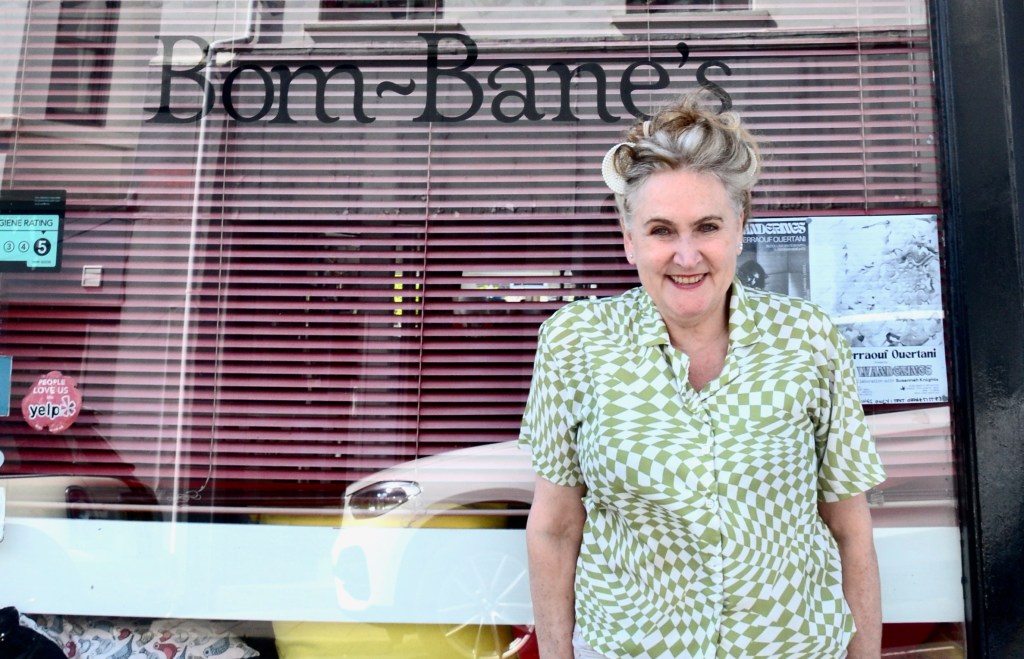
Jane Bom-Bane plays the harmonium while wearing beautiful mechanical hats, which illustrate her songs, such as ‘I’ve Got A Goldfish Bowl On My Head’. She had the idea to open a café while running musical evenings at the Sanctuary in Hove with her then partner, the multi-instrumentalist, Nick Pynn. After she bought 24 George Street in March 2006, they spent six months restoring the building and creating the café. 

“It was a wing and a prayer,” says Jane. “A lot we did ourselves. People who helped us were friends and gave us really good prices. For a lot of years after, we were giving people free sausage and mash.” Here she’s talking about stoemp and sausage, one of the café’s great Belgian dishes created by Andre Schmidt, the first chef. It’s still on the menu today.

Jane and Nick built seven mechanical tables inspired by table-related wordplay. These are the mirrored Tablerone, the Water Table (a model of the Palace Pier with working rides standing in a rippling sea) and two Aesop’s Tables, showing 1920s animal fable cartoons. The Uns-Table, the Turntable and the 27 Chimes Table all have delightful surprises which I leave to you to discover.

“Until the day before we opened, I still hadn’t worked out a way of putting water in the Water Table. I knew it had to be an oil because water would evaporate. I wanted a transparent oil, but the things I ordered on the net were yellow. And I was in Boots just around the corner and do you know what it was that I spotted? Baby oil! And that baby oil’s been in there for 18 years!”

The front wall of Bom-Bane’s has a bust of Jane with a revolving tray on her head with its own story to tell. Made in 2007 by her brother-in-law, Johnny Justin, it was stolen in 2012, later found in a student garden, minus its hat, and restored in 2017.

Go down the spiral stairway and you reach the basement, the main performance space, its walls covered with paintings and instruments. Although there’s only room for 25 people, it’s a room performers love. Stewart Lee, Bridget Christie, Jerry Dammers and Rich Hall are among the many who have played here.

Bom-Bane’s has a tradition of singing staff, beginning in 2008 with the waitresses Rosi Lalor and Candy Hilton, who Jane discovered were wonderful harmony singers. “I thought I’ve got to harness this, and so I wrote a musical. It was all about the café and how we cooked things, and how I got parsley and coriander mixed up.” 

This was the start of the Bom-Bane’s Family Players, who would perform a folk musical written by Jane every May fringe and at Christmas. These often used the whole building, with an audience of just five following a promenade performance from the attic to the basement.

Puppeteer Daisy Jordan, fresh from art college, joined Bom-Bane’s as a dishwasher in 2010, and soon found herself singing and performing puppetry as a member of the family players. Today she says, “I wonder if I would be a performer/puppeteer if it weren’t for Bom-Bane’s.” 

Isobel Smith, another puppeteer, had only made one puppet when Jane invited her to put on her first show here. Rosi Lalor, encouraged by Jane to write and perform her songs, has gone on to make two solo albums. 

To celebrate the centenary of the crossword in 2013, Jane turned the building into a big crossword puzzle, 5 Down and 20 Across. Her sister, the crossword setter Pegleg, wrote puzzles which were placed on the building’s 20 doors, which had all been turned into black and white paintings by different artists.

I painted one of the doors with the story of the explorer Sir John Franklin’s mysterious disappearance in the Arctic in 1845. By a curious coincidence (or Bom-Bane magic?), Sir John’s ship was discovered a year after I did the painting. This led to me hosting a series of Franklin Disaster Mystery evenings, with Arctic food, Inuit testimony, whale song and Jane as Sir John’s widow singing Franklin ballads.

The current chef is the singer-songwriter, Eliza Skelton. Unlike the waitresses who became singers, she was a singer to begin with. She performs here in the musicals, which she now co-writes, and as a member of the Silver Swans, a madrigal group with Jane and Emma Kilbey. She learned to be a great chef by working in Bom-Bane’s.

In 2008, Eliza and David Bramwell first staged Sing-a-long-a-Wickerman here. Audience members, invited to dress in character, were given a ‘Pagan Hymn Book’, which allowed them to sing along with the songs from the film. Eliza and David take this to festivals and theatres around the country, and still host Folk Horror film screenings in Bom-Bane’s. 

Today, Jane spends midweek with her mum in Coventry, and so the café is only open at weekends. It’s staffed by Jane, Eliza and recent recruit Kate Holden. Jane says, “Kate is helping me in the kitchen. She says she’s not musical, but I’m teaching her to play the guitar, and I think she can sing. Most people can sing.” That very evening Kate made her stage debut, accompanying Jane in a song.

We ended by talking about plans for the future. On the anniversary, 1 September, there’s a coming-of-age celebration, with 18 songs sung by Jane and her family of players. “There was a couple in last week who I got talking to. Somehow we got talking about when we first opened here and he said, “Was there anything that you planned to do that you didn’t do?” And I said “Yes, I wanted to make a tap with water music so that when you turned the tap on music came out with your water, but I never got around to it.” And he said, “I’ll do that for you!””

I tell Jane that I think the cultural impact of this little building has been massive. “When you look at it like that, yes, it’s been a springboard for a lot of people that normally wouldn’t do it. It’s because it’s so little and friendly, and that’s what Brighton’s like, isn’t it? It catches you if you fall.”

l Bom-Bane’s, 24 George St, Kemptown, BN2 1RH

For bookings email janebombane@yahoo.co.uk

https://janebom-bane.bandcamp.com

https://www.elizaskelton.com

https://www.daisyjordan.co.uk

https://rosilalor.bandcamp.com

Everything you ever wanted to know about life in Brighton (OK, and Hove)