Climate Cafe – People, Planet, Pint

We’ve been thinking a lot about what we can do at Whistler Towers about Climate Change. And it was in the book Spinning Out by the brilliant activist, Charlie Hertzog Young that we first heard about climate cafes. These are spaces where people can talk about their eco anxiety, share ideas and feel like they’re not alone that first inspired this page. 

But mostly, they’re physical spaces; in the last issue, we read about Circles’ monthly meet-up for women involved in sustainability, either through activism or business, and in this issue, we meet Sam Zindle, managing director of Brighton B Corp certified digital marketing company, Propellernet who organises Brighton’s People, Planet, Pint monthly get togethers which have spread all over the world. Over to you, Sam.

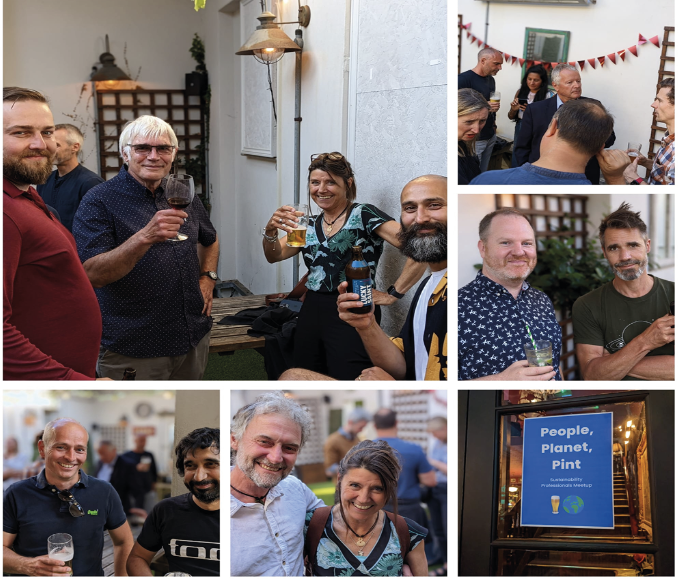
“People, Planet, Pint is an international meet-up group now. It was started by Adam Bastock, who founded Small99, which creates carbon reduction plans for small businesses. I was there when he ran the first one in 2021 at Cop 26 in Glasgow. It was essentially just a room in the back of a pub in Glasgow, and it’s grown and grown. Brighton was one of the first other cities to start running people planning meet-ups. 

We meet once a month, alternating between The Walrus – that’s the one that I’m responsible for – and at the old Albion. It’s always the third Thursday of the month from six until whenever people want to go home. It needs to be regular for people. You just sign up at Eventbrite, and it’s completely free. 

This is for anyone who’s interested in sustainability, but it’s purposefully non agenda based. We get people from all walks of life, from people in academia to startups in the kind of tech sustainability space. Or they may simply care about the environment. So, if you’re just curious people in the city who want to talk more, you can come down. There are never any speakers. There’s never a running order. It’s literally that you get your first drink bought for you, courtesy of our sponsors, Crystal Hosting and Propellernet. And then you can have your chats. It’s just a place where you’re surrounded by people who feel the same way. 

I think Brighton is awash with some brilliant independently run, volunteer-based community groups and it thrives on that. There used to be something in Brighton years ago called like, the Green Drinks, but back then sustainability wasn’t mainstream or a conscious thought for many people. I think attendance didn’t really last; it was always the same people. Every time we do People, Planet, Pint, we get about 40% of people that are new. So, it does have an amazing kind of new energy to each one. 

You do get maybe 20 people or so I’d say that are there for most of them. But you just get an array of different people coming through the door of the pub that each meetup which makes it keeps it fresh, keeps it exciting and keeps new conversations happening. We get somewhere between 50 and 100 people each month which makes it the largest sustainability meet up in the city. I guess it’s just a really vibrant and active community around sustainability and Brighton.

In the last month alone, I’ve spoken with a guy who’s pressing plant-based vinyl records who’s now done a deal with a major label, and a guy who works in agri tech and is using AI to direct plant-enhancing products onto the crops to grow them better in a really sustainable way. I speak to people who work in marketing and we talk about green washing and green hushing and how to help companies navigate that whole space. I mean, I could go on… you meet people from 101 different backgrounds. 

And my hope is that the conversations go on beyond the evening. I know for a fact there’s been some connections made and people who’ve kind of collaborated, which is a really big part of this and that everyone has there has a shared interest in doing something for the planet and environment in whatever form that may take. 

So it’s a very successful meetup and it will endure, I have no doubt, for years to come and hopefully grow in attendance. There’s no move to change how we do it. It seems to work for people 

There are People, Planet Pints all over the world now. I think it’s in 30 different cities in the UK, including Manchester, London and Bristol, and even smaller places like Cheltenham. But there’s one in California, there’s one in Berlin, there’s a couple I think in Scandinavia. You can go onto the People, Planet, Pint website to find out more about where the local events are happening all over the world. 

We don’t have big budgets to advertise. We don’t have massive sponsors. And actually, that’s part of its attraction, I think, because the minute you start kind of having to deliver a sponsored message or advertised, you know, to certain people that it becomes something different. So I’m pretty comfortable with the kind of grassroots scene in Brighton but of course, we’re always always looking for new people to find out about us and come along and spread the word. 

GILLY SMITH

https://small99.co.uk/people-planet-pint-meetup/

Nicholas Lezard – View From The Hill July 2024

“I must go down to the sea again, to the sea and the lonely sky …”

The opening line of John Masefield’s poem “Sea Fever” often occurs to me as I look out of my window, for from it, I can see the sea. When I lived in a basement flat in Dyke Road I couldn’t see the sea at all; in fact, I couldn’t even see the street. There is a part of Dyke Road by St Nicholas’s where you do get to se the sea, and something about the geography and the layout of the street means that it looks as though the sea is gigher up than you, which much impressed my children when they first came to visit. But now I have moved to the lower slopes of West Hill I have a view of a patch of sea every time I sit at my desk, and this pleases me, although it sometimes acts as a rebuke. Because what I am doing is looking at it, and not walking by it.

I wonder if this is means I have turned into a true Brightonian. When I lived on Dyke Road I only rarely went to the sea, because I lived at the very summit of West Hill and walking down to the shore meant a long uphill climb back home, and hills and I don’t get on very well. So now I live much nearer the Channel, do I go down to visit it every day? After all, living by the sea is a privilege. People go daffy trying to buy properties near the sea. (Well, ok, maybe not all places by the sea are desirable. I have a friend who lives in Southend and, believe me, you don’t even want to go there, let alone buy somewhere there.) But I don’t go down to the sea, to the lonely sea and the sky. I just look at it and admire its changing moods from afar. It’s never dull, even when it’s flat, as it is now (and blue: it’s a sunny day).

It makes me think of the place I lived in in London for ten years: because my flat, and the house it was in, was a shambles, it was the last affordable place in Central London. And all of London’s galleries and museums were within walking distance. Did I walk to them? No? Did I even take public transport to them? Also no. Because I knew I could walk there whenever I wanted, I felt no pressure to go there. And so it is with the seaside: it’s for visitors. And I wonder also if the view I have of a patch of sea, and only that, rem,inds me of my childhood, when we knew that the real holiday was beginning: when we could see, through a gap in the trees, the twinkling blue of the Cornish Atlantic. And on blustery, bright sunny days the sea, from my window, looks just the same as it did from my dad’s Vauxhall when I was 10. It’s close enough. 

Besides, it’s full of poo these days.

Sam Harrington-Lowe July 2024

I’m writing this in June and you’re reading this in July. And the General Election may very well be over by now. I really hope it’s gone the right way – if I had to predict the outcome, my money would be on a Labour victory, or possibly a Lab/Lib coalition. 

When talking to my venerable editor about this month’s magazine, I asked if he had any theme, and he said (obviously) that politics seemed likely to feature. I generally don’t write about politics, mostly because I don’t have a thick enough skin to deal with rabid disagreement, and I hate the immoveable and binary right/wrong arguments. When did the elegant skill of discussion and discourse disappear? I blame algorithms, and bubbles, and particularly Twitter. But I digress. 

Growing up, I was led to believe that discussing your political leaning was bad manners. I’m going to guess that this is a painfully middle class thing, saved mostly for the mish-mash of the middle orders where people might vote any which way, but you might not want the Joneses to know your bent. Whereas perhaps in the olden days you could reasonably rely on the working class to vote left, and the poshos to vote right, in the centre it was all to play for, and very much an indicator of your social ambition. 

As social mobility took hold in the 70s, I think perhaps this nouveau bourgeoise practice of not talking about politics was executed by the middle classes to avoid having to stick their flag in the sand. One might want to be upwardly mobile, but not be seen to be abandoning one’s lower-class roots. Or, in a fit of reverse snobbery, have your brats at private school and live in a big house but pretend to be working class, and support the lefties.

Things these days are a lot more fluid. I’m not sure how the class system works in Britain anymore, but it’s not as clear-cut politically. The advent of UKIP, The Reform Party, Brexit, the Greens etc has meant that there’s a lot more choice now. Which is a good thing. A tri-party state is an insane idea anyway, when you think about it. Even more so when you consider it’s mostly whittled down to just two. 

We take a lot of our political cues from our parents. My father, having studied theology as a young man, voted Labour. When he decided the cloth wasn’t for him, and became a business owner, he voted Conservative. Later in life, he voted Green, having become appalled at the state of not just the planet, but also politicians’ behaviour. Politically, I personally feel quite homeless. You’ve seen that meme of a little girl wailing “I don’t want to vote for any of these people.” I feel like that.

If I have to stick my flag in the sand, I think what I’d like is a Lab/Lib coalition, with a good handful of independents in the mix, to represent all interests. Lots of Greens would be nice, with some Monster Raving Loonies, and obviously Lord Buckethead. 

For those of you interested, I’ve just had a look at Ladbrokes, and it’s giving Labour ridic odds. 1/50 Most Seats, and 1/20 Overall Maj, whereas the Conservatives are 25/1 and 40/1 respectively. Interestingly they’ve got Lib Dems to win over 25 seats at 1/8, but no odds for a coalition. 

I’m off down the betting shop to haggle out a bet with them for that right now…

Cooking The Books with Gilly Smith

“What podcasts are you listening to?” Have you noticed we seem to be saying this more and more. It’s the new box set conversation. I love the excellent journalism and shared stories I hear on my dog walks and right now the top of my ‘Spotify’s most listened to’ list is “Cooking the Books with Gilly Smith”. It’s been my companion every Thursday morning for the past two years and not only has it changed the way I shop, cook, eat and understand the world of food production, it’s ignited my connection to the taste memories that have been part of my life. No other podcast has had such a profound effect on me as this. 

This summer “Cooking The Books” comes to Rockwater in Hove as Gilly will be hosting Yasmin Fahr, Rachel Roddy and Melissa Hemsley, three of the most exciting food writers around throughout July who’ll all talk about life, food and their latest books.

Gilly is a Sussex based writer and journalist, but her reputation in the food world is international. Immersed in a lifetime of food journalism she started podcasting at Delicious magazine before striking out on her own. 

“Podcasting is the ultimate in democratising women, people of colour, gender, sexuality and age. We take our subjects and we prise them open to find so much more than the traditional media would ever commission. It’s powered by passion rather than sales meetings. We do what we love and it’s catching!” So powerful is her belief in the format that she has also written a book “How To Start And Grow A Successful Podcast” and has made online courses on the subject too.

“Cooking the Books” won The Guild of Food Writers Award for best pod last year and this year only missed out to the BBC production team at the Food Programme at The Fortum and Mason Awards. Not bad for someone who’s the  consummate solo producer – every episode of “Cooking The Books” she researches, books, records and edits herself. There are no adverts, no sponsors. 

Melissa Hemsley describes Gilly as “hugely respected by the old guard of the food world, but also massively loved by the up-and-coming due to her boundless energy for encouragement, mentoring and change-bringing”. Hemsley says that “Cooking the Books” is the podcast she’d choose first out of any list to appear on. She calls it “genius” because it honours the author by taking the listener on a deep dive into the stories, recipes and writing often reading segments back the authors they’d almost forgotten, the refreshing excitement of hearing your own words being read out loud for listeners to enjoy. 

Along with Hemsley on the roster will be the Guardian food journalist and author Rachel Roddy and New York Times food writer Yasmin Fahr, who recently relocated from New York to Menorca, attracted by the slower pace of life.

Yasmin thinks it’s Gilly’s authenticity and insight that make the podcast is so enjoyable. “These conversations can give people a ‘head start’, bringing people into their confidence around food and cooking. Gilly uses stories of personal experience because she knows that the most effective way to get people to change is through stories.”

And that’s very much Gilly’s mission – to change the world. She’s concerned about climate change, the food industry’s broken industrial systems, child food poverty and our lack of connection to the soil and to each other. A good cook book will always be the antidote to ultra processed food. A good recipe will always have you handling the ingredients rather than popping a silver processed tray in the oven. And that’s what she wants us to do as a result of listening to the podcast. Shop locally, think about how the animals have been treated, share a meal and a story with family and friends as often as possible. 

Away from “Cooking The Books” Gilly works with the Food Foundation to help bring awareness of food poverty especially of our children living in scarcity. Melissa Hemsley is one of the voices that Gilly’s encouraged to come on board and Melissa credits Gilly with encouraging her to flex her energy in the more important parts of the food world like being part of this kind of campaigning work.

I asked Yasmin what she is hoping for from the live shows. “Food people tend to be good-hearted people and I’m really looking forward to hearing what questions come up. If there’s a chance of one thing landing that gives someone the ability to try something new, it’s all worthwhile”. 

“I hope there’ll be a real hobby club atmosphere” says Gilly, “people coming with all kinds of different takes on a subject, it always surprises and delights me”. 

l Rockwater, Western Esplanade, BN3 4FA 01273 091166

Tuesday July 2 6.30-8pm Yasmin Fahr 

Tuesday July 16 6.30-8pm: Rachel Roddy

Tuesday July 23 6.30-8pm: Melissa Hemsley

Tickets £15 from CookBookBake, Hove’s indie specialist cookbook shop and include £5 off the author’s book.

Tickets from https://www.gillysmith.com/event-list

Everything you ever wanted to know about life in Brighton (OK, and Hove)