

Summer wouldn’t be summer without a night in Dyke Road Park, watching a play at the Brighton Open Air Theatre, glass in one hand, blanket in the other. Peter Chrisp looks back at what’s happened to Adrian Bunting’s dream
This summer, we’re celebrating the tenth season of Brighton Open Air Theatre in Dyke Road Park. It’s the legacy of Adrian Bunting (1966-2013), theatre maker and construction manager.
Adrian had been thinking about building a permanent open-air theatre in Brighton for years. He knew what the theatre should look like, and had even picked the perfect location, the bowling club in his local park. Yet it seemed unlikely that it could ever be done.
In April 2013, when Adrian was diagnosed with incurable cancer, the council announced it was looking for a new use for the bowling club. Adrian spent his last weeks initiating plans to build his theatre there, and asked five close friends to help create it.
Interviewed in the week before he died, Adrian said, “I lived in Seven Dials for nearly 22 years and I had this idea for building an open-air theatre for Brighton, and because my favourite park is Dyke Road Park, I would constantly go up there and imagine putting it there. And the bowling lawn was always the place that I dreamed of – it’s a magical place, with its own copse, hidden from the world…But of course it was a bowling lawn. You’ve heard about my unfortunate illness. That, combining with the fact that the bowling green is no longer needed, was almost too big a coincidence to think about. I really think that Brighton deserves an open-air theatre…that one of the most artistic towns in England can have a theatre that it can be proud of, alongside all the big, beautiful theatres inside…And this is a chance for us to make one, and enjoy it for the whole of the summer.”
Adrian left his savings of £18,000 for the project, and £100,000 more was raised by benefits, art auctions and donations. It took just two years to create the theatre, which was opened by Adrian’s mother Isabelle on 9 May 2015. Adrian used to say, “I want the audience to be part of the show.” As a theatre maker, he always wanted to break the fourth wall, the imaginary barrier between audience and performance. He did this on an intimate scale with his World’s Smallest Theatre, which he took to Edinburgh fringe in 1996. This was a box, with just enough space for the heads of three people – one audience member and two actors, Adrian and Clea Smith.
He broke the fourth wall on a big scale with his play Kemble’s Riot, which won best theatre award at Brighton Fringe in 2011. Here the audience takes sides in the 1809 riots at Covent Garden Theatre, sparked when actor-manager John Kemble raised the ticket prices to cover the costs of rebuilding the theatre.
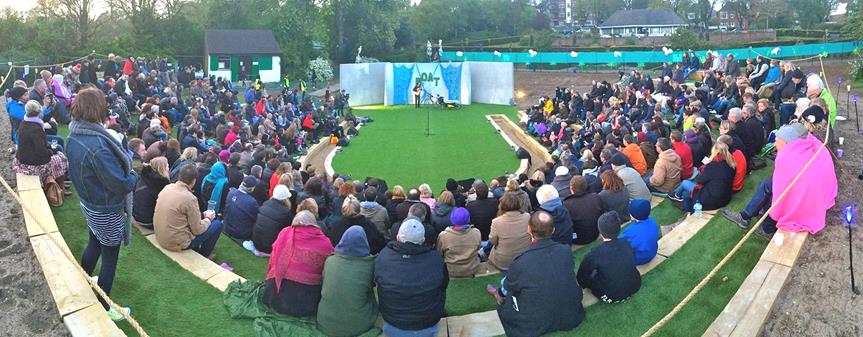
The most striking feature of Adrian’s plan for BOAT is its long-thrust stage, which brings the performers out among the audience – another way of getting rid of the fourth wall. You can see how radical this is if you compare it with earlier open-air theatres, such as Regents Park and the Minack in Cornwall, where audience and stage are separated.
Claire Raftery, one of the founding Trustees, recalls, “Ross Gurney-Randall and I measured out the planned dimensions for the BOAT stage – with 30 metal pins and a rope on a sunny afternoon in Victoria Gardens – adjusting dimensions to make sure it would work, and trying out different types of performance in relationship to audience proximity. The stage needed to be large enough for larger casts and ensemble shows, for movement and dance, whilst making sure it had enough intimacy and connection for solo performer….”
BOAT’s tenth season began with a revival of Kemble’s Riot, staged by Brighton Little Theatre. This was the first performance of the full-length version, as written by Adrian. Audience members sang songs and made their own banners, writing slogans such as “No to Kembleflation!” or “We love you Kemble!”
I went to the show with three of the founding Trustees, James Payne, Steve Turner and Donna Close. After, we talked about Adrian’s stage design, and how this was the perfect meeting place of a play and a space. James said, “He was rightly proud of this innovative design. I can’t help feeling that it has inspired other open-air theatres. Take the Thorington woodland theatre for example, not to mention the Downlands theatre in Hassocks.”
In Brighton, we didn’t realise just how much we needed a purpose-built open-air theatre until we saw what the space could do. Alongside drama, BOAT has hosted wrestling, opera, rock concerts, circus, contemporary dance, poetry slams, live art, drag in the park, Glen Richardson’s epic one-man recreation of the Live Aid concert, and stand-up comedy for dogs. In 2020, we had a midwinter pantomime – Hansel and Gretel.
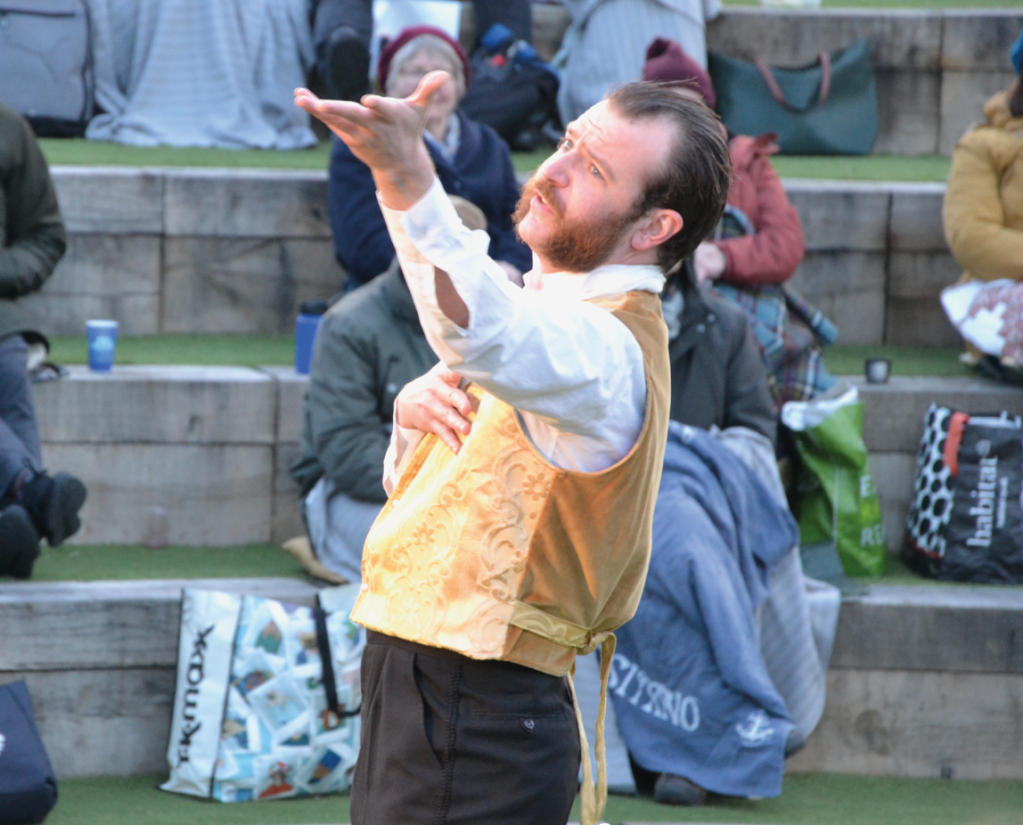
Many companies make use of the whole space. Wrestlers enter through the audience, with the heroic blue-eyes high-fiving, and the heels getting whacked by children with inflated clubs. Suspiciously Elvis will do walkabouts, even sitting on people’s laps mid song. By the end of one of his magnificent shows, half the audience has joined him dancing on the thrust stage.
It’s lovely to watch the sky above change as the sun goes down, and listen to the birds singing in the trees. Even rain can bring extra drama, such as the time during Mark Brailsford’s production of Julius Caesar when real thunder and lightning accompanied the storm in Shakespeare’s play.
What a remarkable journey. BOAT now runs for a six-month season, staffed by a small expert team, its Trustees and upwards of 80 committed volunteers. Without public subsidy, BOAT is kept afloat through income from ticket sales and from donations, with any profits invested into making the venue even more accessible, green and welcoming.
Take a look at this year’s programme on the BOAT website; there are lots of great shows to see until the end of September. If you’ve not yet been, you’re in for a treat.
Brighton Open Air Theatre, Dyke Rd, Brighton and Hove, Hove BN3 6EH
http://www. brightonopenairtheatre.co.uk/
07391 357542 (Mon-Fri, 1pm-6pm)
 The Whistler