It can be said that Brighton is a hub for cinema. There are a wide variety of cinemas in the area, ranging from multiplexes to independents, with someone to offer for anyone somewhat interested in film. But what if cinemas don’t offer a specific niche that you happen to be craving? That is where film clubs come into play.
Brighton itself has a few film clubs to go around, ranging a variety of genres and niches. One of these clubs is the Toad Lickers Collective (TLC), although it is not strictly a film club. Founded last year by Keziah Keeler and Liz Rose, TLC’s wider programme includes free exhibitions and workshops alongside film screenings once a month at the Rose Hill, an independent music venue.
Regarding why they wanted to do more than just film screenings, Kez said, “There’s a lot of things you can express through film that can reach a wider audience, and we’re quite interested in the idea of film as the eye of the workers. We thought it was a cool way to get a lot of people in a room talking about the same subject which feels a bit missing in this era.”
TLC themselves don’t make much of a profit, due to being a Community Interest Company, so any profit made from screenings goes towards running free workshops and exhibitions, due to their desire to make themselves as accessible as possible.
The choice of The Rose Hill as their venue for film screenings was one that TLC are happy with, as Rose points out the difficulty of finding places to host events. Rose said, “The Rose Hill are really welcoming and really care about the community, and I think you feel that in the atmosphere they create, it’s all very casual and we really like how comfortable it is as well, it’s cosy and intimate.”
TLC’s most recent exhibition was Folklore, which set out to explore why folklore is having a revival and how contemporary artists are using its legends, techniques and aesthetics to describe their experiences. This fits in with what Kez describes as the core of the club, “this idea that storytelling is really important, and there are all these different ways of storytelling that we can use the rules and the methods to help us describe social issues and real problems.”
Whilst they’ll be looking at other interests when their film screenings return after the summer in September, Liz wishes to explore working class culture in a potential future film season, looking at joyful working-class films such as Billy Elliot and The Full Monty. Their reasoning is because, to them, “Folklore has a history that belongs to people and has the potential to be much more linked to working class cultures. As funding disappears, it’s becoming increasingly hard to see diverse voices, and if you’re working class or from an underrepresented background, those stories don’t get told in a genuine way by people telling them.”
Similarly to TLC’s recent folk-based exhibition, Bom-Bane’s Folk Horror Film and Ice Cream Club may be of interest as well, a film club that explores the many films belonging to the folk horror genre. Hosted by David Bramwell at Bom-Bane’s in Kemptown, each film screening features an intermission, a discussion halfway through the screening, a food break, and what David describes as ‘an avant-garde unsettling performance from a group calling themselves the Bewilderkin’
David himself is no stranger to folk horror, having been performing a Wicker-Man singalong for 16 years. To him, the club is a chance for him to ‘explore the genre and see how far we can stretch the boundaries of the definition of folk horror, and not present the obvious choices like The Wicker Man. We try and delve into weirder fringes of Folk Horror, including folk horror films from around the world, not just Anglo-centric, and presenting films from parts of the world that wouldn’t necessarily be associated with the genre.’
The difficulty of running any film club largely revolves around the financial aspects. Despite most screenings at Bom-Banes selling out tickets-wise, thanks in part to the venue capacity being just 25, David notes there is difficulty in spreading the word about his folk horror film club. He said, ‘It’s too expensive to put posters up around town, and I’d be making a loss on the night if I paid for 50 posters to go up for a week or two.’
Regardless of the financial aspect of keeping the film club going, David is still optimistic for the club’s future. Whilst there is no showing at Bom-Bane’s in May due to David’s work during Brighton Fringe, his next screening will be the film ‘Wake in Fright’ from 1971. As David describes it, ‘It’s one of Nick Cave’s favourite films, it’s similarly themed to ‘Straw Dogs’, about the breakdown of civilisation in remote places and about the schoolteacher through unfortunate circumstances finds himself trapped in this town and how he descends into this toxic-machismo culture.’
While these two clubs are just two examples of film clubs across Brighton, there are undoubtedly more than these two, and if your interest is not in folk horror or folk in general, there will likely be other film clubs that will satisfy any cravings for film clubs of a certain genre.
THERE ARE FEW THINGS in life truly worth loathing, but received wisdom is undeniably this column’s noirest bête noir. Take “The Best Concert Movies of All Time” (Rolling Stone and Rotten Tomatoes) or variations such as “20 Greatest Concert Films” (The Guardian).
For one thing, the words “Pop” and/or “Rock” so implicit in those titles are missing, never mind “Soul”, “Jazz” and “Reggae”, much less any other musical genre. To these eyes and sensibilities, the two most uplifting concert scenes on screen could hardly offer a starker sonic or visual contrast: Bruce Springsteen and The E St Band’s 20-minute re-bonding on Tenth Avenue Freeze-Out from their 2000 NYC reunion (a gift from HBO that never stops giving) and, in Maestro, Bradley Cooper’s imperious impersonation of Lenny Bernstein electrifying Ely Cathedral in 1973, wringing out every ounce of his vast if not always pious passions conducting Mahler’s 2nd.
It feels safe to presume, nonetheless, that a classical music gig will never be a) called a gig, or b) qualify for one of the aforementioned Guardian or Rotten Tomatoes charts. The sticking-point, box-office-wise, is that orchestras are essentially dress-alike covers acts whose idea of stagecraft is leaning forward. So why not clarify matters? Why not bill the ones that do dominate said charts as “Gig Movies”? If nothing else, Mahler fans won’t get miffed.
For another thing, even now, in what may turn out to be their heyday, gig movies are far from 10 a penny. As a genre, unlike musicals, westerns, horror and noir, they’ve barely reached middle-age. Commemorating the inaugural pop/rock festival, Monterey Pop (1968) was the first member of the litter, though aside from Jimi Hendrix setting his guitar alight and Pete Townshend bashing his to bits, its impact was but a pinprick next to Woodstock (1970), the three-hour, multiscreen epic on which Martin Scorsese cut his teeth.
And because gig movies were only ever intended to be a secondhand experience, at best, and thus lacked box-office appeal, it has taken this century’s documentary boom, and the recent advent of simultaneous live Odeon transmissions, to thicken the best-of-breed contenders to any significant degree.
The latest nauseating spot of consensus has it that the best gig movie is Stop Making Sense. David Byrne’s baggy suit, an irresistible electro-funk stew and Jonathan Demme’s imaginative staging are all tremendous fun, granted, but ambition was limited. As Geoffrey Cheshire’s stirring essay for The Criterion Collection put it, this column’s choice, Gimme Shelter (1970), gave the Rolling Stones “what no one had bargained for: a terrifying snapshot of the sudden collapse of the sixties”.
Having only just seen the latter on a big screen for the first time, as part of a European re-release (you can stream it on Amazon), I can only concur wholesouledly with the view that, when it comes to cinema verité, the Maysles brothers’ sickening documentary of the anti-Woodstock, held on the West Coast at Altamont, struck the motherlode.
Sure, the cameras miss Marty Balin, the Jefferson Airplane vocalist, being knocked out by Hell’s Angels, foolishly hired as security (in exchange for a barrel of beer) and brandishing pool cues in a way even Ronnie O’Sullivan might never have countenanced. As it is, we get more than enough of the prelude (Balin mouthing off at the abusive leatherjackets) and the aftermath (Balin’s battered face). And those peace and love vibes at Hyde Park just a few months earlier, where Mick Jagger bid farewell to Brian Jones by releasing a fleet of doves and reading a poem by Shelley? Gone for good.
No scene in the annals of gig movies, nevertheless, is more chilling than when those beer-pumped Angels seize the mile-high, gun-toting Meredith Hunter as he advances towards the stage, then knife and bludgeon him to death.
There had been good reason to fear such a grisly outcome. Not only had Jagger been subjected to death threats, hence the insistence that no audience member be allowed to invade the stage; as he stepped off the helicopter on arrival, he was punched by someone he might reasonably have assumed to be a fan.
Watching him watch Hunter’s murder unfold on a monitor backstage is like surfing an emotional pendulum. No matter how you feel about rock’s first and foremost frontman, it would take an act of astonishing anatomic control not to gulp or shudder at the way his face slides from preening pride – in a terrific band performance, in the way the filming was going – to grim, guilty stupefaction. And the song he happened to be singing as Hunter was savaged? Sympathy for the Devil, what else?
In The New Yorker, Pauline Kael, by no means a rock chick, derided it all as wish-fulfilment and a sham, alleging – wrongly, according to the Mayleses – that the show was designed and lit for the cameras. The ingredients, though, were all in place: a free festival headlined by their satanic majesties for 300,000 drugged-up if not loved-up fans at a San Francisco speedway track in the final month of the most radical yet delusional of decades.
“I think it affected all of us very profoundly,” guitarist Mick Taylor reflected on recordings released only last year. “The only thing we were very upset about was being accused and held responsible for what happened. You can’t really blame anybody in that kind of mass hysteria.”
Nonetheless, Don McLean’s dream that drums and wires could “save your mortal soul” was in tatters. On American Pie, there was nothing ambivalent about his allusions to Jagger (“Jack Flash”): “I saw Satan dancing with delight the day the music died.”
Well, it didn’t die, did it? And Jagger, who has done more than most to keep it alive and rocking, certainly didn’t deserve crucifixion. Understandably, forgivably, he still shies clear of the topic with religious fervour. Even so, one can only imagine how many times his nights have been ruptured by those visual scars.
On the infinitely brighter side, the Stones were in marvellous nick for the Maylses, majestic as well as satanic. MC Mick struts like a coked-up peacock, the consummate rabble-rouser; Bill Wyman cuddles his bass and plucks it with infinitely more dexterity than you ever remembered; from the opening chords of Jumpin’ Jack Flash, Richards and Taylor’s complementary twin guitars – so much more diverse and fascinating than the riff-heavy Keef-Ronnie combo – lock into a funky fusion of flying fingers. Needless to add, Charlie was bloody good that night too.
And, as you watch them, you can’t help but be reminded why the other act you’ve known for all these years has now been going more than half a century longer than Sgt Pepper’s squabbling slackers. Love ’em or merely tolerate them (how can you possibly loathe an octogenarian-led band that can still persuade tens of thousands of Brazilians to stump up a week’s wages to see them?), the Stones remain England’s hardiest Sixties tribute act.
Within five years of Altamont, they would be in freefall recording-wise, yet even now, the sellouts (literal, never spiritual) persist. Mick and Keef have pretty much always known that sticking to the same seat in the same carriage on the same track could pay considerable dividends. Happily, Gimme Shelter, which showcases the chemistry responsible, works as celebration as well as damnation.
Top 10 Gig Movies
Gimme Shelter (Rolling Stones)
Live In New York City (Bruce Springsteen & The E St Band)
The Last Waltz (The Band, Joni Mitchell, Bob Dylan, Muddy Waters et al)
Summer of Soul (Stevie Wonder, Sly & The Family Stone, Nina Simone, Staple Singers et al)
Stop Making Sense (Talking Heads)
Get Back (The Beatles)
Sign O’ The Times (Prince)
Monterey Pop (Jimi Hendrix, Mamas & Papas, Otis Redding, Ravi Shankar et al)
Live At Pompeii (Pink Floyd)
Woodstock (Janis Joplin, The Who, Santana, Crosby, Stills & Nash, Joan Baez et al)
The satanic majesty of Gimme Shelter
By Ruby Ephstein
THERE ARE FEW THINGS in life truly worth loathing, but received wisdom is undeniably this column’s noirest bête noir. Take “The Best Concert Movies of All Time” (Rolling Stone and Rotten Tomatoes) or variations such as “20 Greatest Concert Films” (The Guardian).
For one thing, the words “Pop” and/or “Rock” so implicit in those titles are missing, never mind “Soul”, “Jazz” and “Reggae”, much less any other musical genre. To these eyes and sensibilities, the two most uplifting concert scenes on screen could hardly offer a starker sonic or visual contrast: Bruce Springsteen and The E St Band’s 20-minute re-bonding on Tenth Avenue Freeze-Out from their 2000 NYC reunion (a gift from HBO that never stops giving) and, in Maestro, Bradley Cooper’s imperious impersonation of Lenny Bernstein electrifying Ely Cathedral in 1973, wringing out every ounce of his vast if not always pious passions conducting Mahler’s 2nd.
It feels safe to presume, nonetheless, that a classical music gig will never be a) called a gig, or b) qualify for one of the aforementioned Guardian or Rotten Tomatoes charts. The sticking-point, box-office-wise, is that orchestras are essentially dress-alike covers acts whose idea of stagecraft is leaning forward. So why not clarify matters? Why not bill the ones that do dominate said charts as “Gig Movies”? If nothing else, Mahler fans won’t get miffed.
For another thing, even now, in what may turn out to be their heyday, gig movies are far from 10 a penny. As a genre, unlike musicals, westerns, horror and noir, they’ve barely reached middle-age. Commemorating the inaugural pop/rock festival, Monterey Pop (1968) was the first member of the litter, though aside from Jimi Hendrix setting his guitar alight and Pete Townshend bashing his to bits, its impact was but a pinprick next to Woodstock (1970), the three-hour, multiscreen epic on which Martin Scorsese cut his teeth.
And because gig movies were only ever intended to be a secondhand experience, at best, and thus lacked box-office appeal, it has taken this century’s documentary boom, and the recent advent of simultaneous live Odeon transmissions, to thicken the best-of-breed contenders to any significant degree.
The latest nauseating spot of consensus has it that the best gig movie is Stop Making Sense. David Byrne’s baggy suit, an irresistible electro-funk stew and Jonathan Demme’s imaginative staging are all tremendous fun, granted, but ambition was limited. As Geoffrey Cheshire’s stirring essay for The Criterion Collection put it, this column’s choice, Gimme Shelter (1970), gave the Rolling Stones “what no one had bargained for: a terrifying snapshot of the sudden collapse of the sixties”.
Having only just seen the latter on a big screen for the first time, as part of a European re-release (you can stream it on Amazon), I can only concur wholesouledly with the view that, when it comes to cinema verité, the Maysles brothers’ sickening documentary of the anti-Woodstock, held on the West Coast at Altamont, struck the motherlode.
Sure, the cameras miss Marty Balin, the Jefferson Airplane vocalist, being knocked out by Hell’s Angels, foolishly hired as security (in exchange for a barrel of beer) and brandishing pool cues in a way even Ronnie O’Sullivan might never have countenanced. As it is, we get more than enough of the prelude (Balin mouthing off at the abusive leatherjackets) and the aftermath (Balin’s battered face). And those peace and love vibes at Hyde Park just a few months earlier, where Mick Jagger bid farewell to Brian Jones by releasing a fleet of doves and reading a poem by Shelley? Gone for good.
No scene in the annals of gig movies, nevertheless, is more chilling than when those beer-pumped Angels seize the mile-high, gun-toting Meredith Hunter as he advances towards the stage, then knife and bludgeon him to death.
There had been good reason to fear such a grisly outcome. Not only had Jagger been subjected to death threats, hence the insistence that no audience member be allowed to invade the stage; as he stepped off the helicopter on arrival, he was punched by someone he might reasonably have assumed to be a fan.
Watching him watch Hunter’s murder unfold on a monitor backstage is like surfing an emotional pendulum. No matter how you feel about rock’s first and foremost frontman, it would take an act of astonishing anatomic control not to gulp or shudder at the way his face slides from preening pride – in a terrific band performance, in the way the filming was going – to grim, guilty stupefaction. And the song he happened to be singing as Hunter was savaged? Sympathy for the Devil, what else?
In The New Yorker, Pauline Kael, by no means a rock chick, derided it all as wish-fulfilment and a sham, alleging – wrongly, according to the Mayleses – that the show was designed and lit for the cameras. The ingredients, though, were all in place: a free festival headlined by their satanic majesties for 300,000 drugged-up if not loved-up fans at a San Francisco speedway track in the final month of the most radical yet delusional of decades.
“I think it affected all of us very profoundly,” guitarist Mick Taylor reflected on recordings released only last year. “The only thing we were very upset about was being accused and held responsible for what happened. You can’t really blame anybody in that kind of mass hysteria.”
Nonetheless, Don McLean’s dream that drums and wires could “save your mortal soul” was in tatters. On American Pie, there was nothing ambivalent about his allusions to Jagger (“Jack Flash”): “I saw Satan dancing with delight the day the music died.”
Well, it didn’t die, did it? And Jagger, who has done more than most to keep it alive and rocking, certainly didn’t deserve crucifixion. Understandably, forgivably, he still shies clear of the topic with religious fervour. Even so, one can only imagine how many times his nights have been ruptured by those visual scars.
On the infinitely brighter side, the Stones were in marvellous nick for the Maylses, majestic as well as satanic. MC Mick struts like a coked-up peacock, the consummate rabble-rouser; Bill Wyman cuddles his bass and plucks it with infinitely more dexterity than you ever remembered; from the opening chords of Jumpin’ Jack Flash, Richards and Taylor’s complementary twin guitars – so much more diverse and fascinating than the riff-heavy Keef-Ronnie combo – lock into a funky fusion of flying fingers. Needless to add, Charlie was bloody good that night too.
And, as you watch them, you can’t help but be reminded why the other act you’ve known for all these years has now been going more than half a century longer than Sgt Pepper’s squabbling slackers. Love ’em or merely tolerate them (how can you possibly loathe an octogenarian-led band that can still persuade tens of thousands of Brazilians to stump up a week’s wages to see them?), the Stones remain England’s hardiest Sixties tribute act.
Within five years of Altamont, they would be in freefall recording-wise, yet even now, the sellouts (literal, never spiritual) persist. Mick and Keef have pretty much always known that sticking to the same seat in the same carriage on the same track could pay considerable dividends. Happily, Gimme Shelter, which showcases the chemistry responsible, works as celebration as well as damnation.
Top 10 Gig Movies
Gimme Shelter (Rolling Stones)
Live In New York City (Bruce Springsteen & The E St Band)
The Last Waltz (The Band, Joni Mitchell, Bob Dylan, Muddy Waters et al)
Summer of Soul (Stevie Wonder, Sly & The Family Stone, Nina Simone, Staple Singers et al)
Stop Making Sense (Talking Heads)
Get Back (The Beatles)
Sign O’ The Times (Prince)
Monterey Pop (Jimi Hendrix, Mamas & Papas, Otis Redding, Ravi Shankar et al)
Live At Pompeii (Pink Floyd)
Woodstock (Janis Joplin, The Who, Santana, Crosby, Stills & Nash, Joan Baez et al)
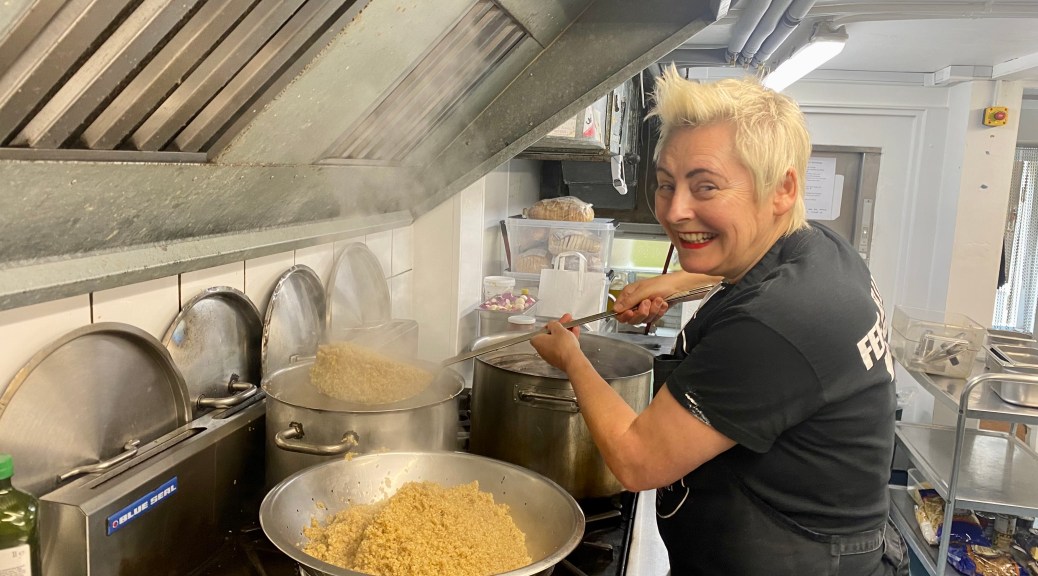
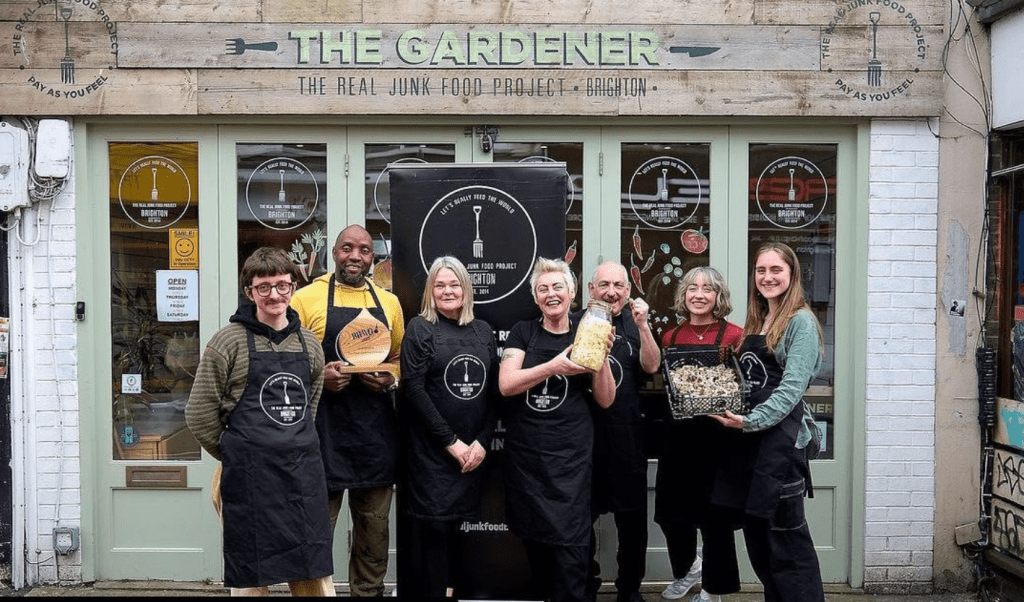
It’s 10 o’ clock on a summer Friday morning at the Gardener Café. Mick is carrying a box of red peppers down to the kitchen where vats of black beans and quinoa are bubbling. Sarah is making pastry for scones, sweet and savoury, cartons of yellow label strawberries, just on the turn, piled behind her ready for Karen Lloyd to reduce them into an accompanying jam. Elodie is chopping pretty pink radishes, and the air is fresh with camaraderie.
This is the Real Junk Food Project’s central Brighton kitchen, bang in Gardener Street in the middle of the North Laine’s most vibrant shopping and café area. Mick and Sarah are volunteers, Karen and Elodie just two of the few paid staff, and the red peppers, black beans, quinoa, flour and strawberries just part of a massive haul from the overnight supermarket waste run.
The Real Junk Food Project, whose mantra is “feed bellies not bins” was created by Adam Smith in Leeds in 2013, and has since grown into a national and international movement of cafes, projects and pop-ups with one core objective: To intercept food waste destined for land fill and use it to feed people who need it, on a ‘pay as you feel’ basis. With afterschool clubs at its sister café, The Fitzherbert Community Hub in Kemptown, and pay as you feel cafes at St Lukes Church, Hollingdean Community Centre and Bevendean Hub, it’s a busy operation.
“We have volunteers driving electric vans to supermarkets across the city picking up amazing food that would otherwise go to waste,” Karen told me. “We get cakes and breads, flour, dairy, all sorts of vegetables. A lot of it hasn’t even got the stickers on it. It’s just surplus. There’s literally nothing wrong with the food at all. But if it’s not collected that will just go into the bins and into landfill. It’s absolutely disgusting.”
Disgusting is the right word. “A quarter to a third of food produced globally, is wasted” says the RJFP website, “and yet, there’s estimated to be 795 million people who do not get enough to eat. In the UK, two million people are estimated to be malnourished, while the UK as a whole creates an estimated 15 million tonnes of food waste every year.” If waste was a country, according to the UN, it would be the third largest in the world.
But there’s not much time to chat about the politics this morning. Karen and her team are on a deadline. “Once it comes to our cafes, we chefs look at the food, decide on the menu, and get on with it”, says Karen. ‘We have three hours to get on with service.”
The black beans, which have been soaked overnight, are going to go into a chilli and the Buddha bowls. The quinoa will become a tabouleh, while the pumpkin seeds have been roasted with a little bit of tamari. The mung beans have also been soaking to encourage them to sprout and will be added to the Buddha bowls.
In the walk-in fridge, massive Kilner jars of fermented celeriac, sauerkraut, kimchis and jams line the shelves. Herbs, tomatoes, lettuces, courgettes and cucumbers – often organic and donated from personal allotments, local farmers and Infinity Foods, but most of which have come in on the supermarket run in the last 24 hours, are piled high in boxes, ready to be cooked up over the weekend.
By lunchtime, the tables outside are packed with students, families and homeless people, often sharing a long table. “It’s all pay-as-you-feel” says Karen, “so it gives everyone the chance to get a really good meal.” This is a place to have lunch with a friend, or strike up a conversation with someone with a whole new life view. You choose. “It does get people talking” says Karen, “and hopefully they talk about how good the food is. I think that’s what food does, doesn’t it?”
If people can afford it though, they try to encourage them to pay it forward. And with funding a perpetual problem on top of the cost of living crisis driving people to find food more cheaply, it’s hitting the tills at the Gardener Café hard. “We have a suggested donation of £6.50”, but most people are
giving £1 or £2 for a full meal.”
The daily lunch on Monday, Thursday, Friday and Saturday is just one part of what Karen and her team of volunteers cook up over the course of the week. “This Saturday, we’re doing a 60th birthday party for 100 people. We’re making canapes and Buddha bowls for them. When the clients come to see us, we’ll go through a basic menu and make them aware it can change. We did a canape event on Wednesday for Wired Sussex. They wanted to know what the menu was going to be, but I couldn’t give it to them until three hours before the event because the ingredients can change. But when we got there and they saw the food, they were amazed by it.”
It’s clear that this is much more than a cheffing job for Karen, whose signature red lipstick and bleach blonde quiff suggests an interesting back story. “I moved to Brighton five years ago after living in Spain for 15 years. My partner had died and I was trying to find work and get back into the catering. I did some voluntary work for Junk Food, and I found my family, basically. That’s what it felt like. So, it really helped me to find my feet again after a very sad time in my life.”
If you want to get involved with the Real Junk Food Project, go to its website for more information. Donate if you can, but the real fun is lunch in the sunshine with whoever sits next to you. Just remember to pay it forward.
Since writing this article we’ve learned that the Gardener Street cafe is to close. The Real Junk Food Project put out this statement:
“It is with great regret that the directors of @realjunkfoodbrighton have decided to discontinue their lease for the cafe on Gardner Street and, as a consequence, the Gardener will close on 25th September 2023. When we first signed up to take on a city-centre cafe using the pay-as-you-feel model, we knew there were going to be many challenges. We could not have foreseen the imminent Covid-19 pandemic, but we managed to weather the associated lockdowns and have continued to provide much needed meals to thousands in our community over the three years since.
Sadly, the current economic crisis is putting extra strain on the food industry and this, combined with soaring energy bills and ongoing building maintenance works, mean that the costs are just too heavy for us to keep the Gardener open. The latter is also taking its toll on our staff and volunteers in a way that is simply not sustainable. Whilst the doors of the Gardener are closing, the mission of The Real Junk Food Project continues and we are optimistic for the future. Our customers in Hollingdean Community Centre, St Luke’s Prestonville and the Fitzherbert Hub in Kemptown will still be able to benefit from pay-as-you-feel lunches created by our wonderful teams.
We hope that by unburdening ourselves from the financial liabilities of the Gardener, we will be able to focus precious resources and energy into our existing venues and commitments.
A massive thank you to all staff, volunteers and everyone who has been involved in our lovely cafe. And thank you Infinity Foods Co-operative for being a supportive landlord.
The Deans Beach and Environment Volunteers organise Saltdean beach clean this April. Nadia Abbas reports
Everyone loves the beach. Whether you’re an all-weather swimmer, someone who likes the promenade or maybe just an occasional visitor, everyone loves the beach.
In the summer our beaches are a bustling haven of activity with surfers, swimmers, and families filling up the seafront. But many of these people are unaware of the amount of rubbish that is left on the beaches. This waste is damaging to marine wildlife and human life, as plastic waste trickles into the food chain over time. One way to tackle this growing problem is to organise beach clean events, which is what The Deans Beach and Environment Volunteers group are doing.
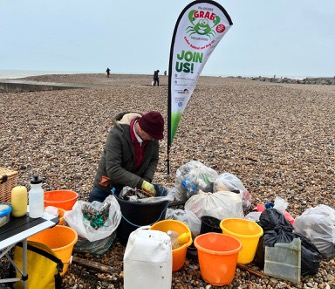
The Deans Beach and Environment Volunteers are a group of volunteers. They raise awareness about ocean litter, and they remove rubbish that has been left on Brighton’s beaches. This organisation has been active for over ten years. They have organised a beach clean event on the 2nd of April 2023 at Saltdean beach. It starts at 11am and ends at 12:30pm. This event is open to the public and people will be provided with equipment, such as gloves and litter pickers. People can also bring their own equipment.
Rona Hunnisett, Deans Beach and Environment volunteer, said: “We regularly have more than one hundred people turning up and helping, which is amazing.” Once the litter has been collected, this organisation sorts through it and recycles as much as possible. “We weigh it because we then send the information, we’ve got back to the Environment Agency to say to them, this is the type of stuff we are seeing.”
Some of the waste that is found on the beaches is not recyclable, such as crisp packets and different plastics. These will remain on the beach for many years, and they will be ground down into microplastics. These microplastics end up in the food chain, as they are eaten by the fish and humans will eat the fish. “The oldest thing I’ve seen was a crisp packet which we dated back to 1984, I remember it from when I was a kid. They don’t break down,” said Rona. Other items that this group finds on the beaches includes clothing, fishing boat trays, glass cans, and food wrappers. “Last month we found the most enormous plastic tank, it took three of us to lift it off the beach.”
This volunteer group works with the Marine Conservation Society, who highlight the work of different beach cleaning groups. This group are also participating in the Great British Spring Clean campaign. This is the nation’s biggest environmental campaign, by independent charity Keep Britain Tidy. “We have committed to ten huge bags of rubbish that we are going to take away.”
We read with interest Ann Rushworth Lown’s letter in the October/November Whistler, regarding the traffic problems on Surrey Street. We sympathise. As nearby residents, we are also experiencing the spillover effects of the traffic logjams around the station, which have worsened since the Brighton Station Gateway scheme. Continue reading Letters to The Whistler→
Everything you ever wanted to know about life in Brighton (OK, and Hove)





 The Whistler