Tag Archives: Brighton

Benita Matofska looks at Sussex Bay

I’ve long been fascinated by the wonders of our waterscapes and how vital ocean conservation is to our very existence. 70% of our planet is covered in water – from seas and salt marshes, to rivers and inland coastal waterways, these shape the land, the way we live, eat and breathe – they’re vital to our health, wealth and happiness and we need them to survive. When they thrive collectively, this is Blue Magic.

I grew up in land-locked Leeds and the first time I saw the sea, I was 18 months old and stood and stared and was silent for the first time. It was my first encounter and it would come to shape my life. 

Fast forward to when I was 10. Riddled with eczema, my parents took me to the Dead Sea. They’d heard about its healing powers and had been told that if you submerge yourself in the water for seven minutes, it can heal even the most damaged skin. Willing to give it a go I gripped his hands tightly and in we walked. The pain in my open sores was terrible, but I persevered and managed to stay submerged. Within three weeks, my eczema had cleared. It felt like a miracle. Nature’s minerals in the Dead Sea – magnesium, calcium and potassium – had worked their Blue Magic. 

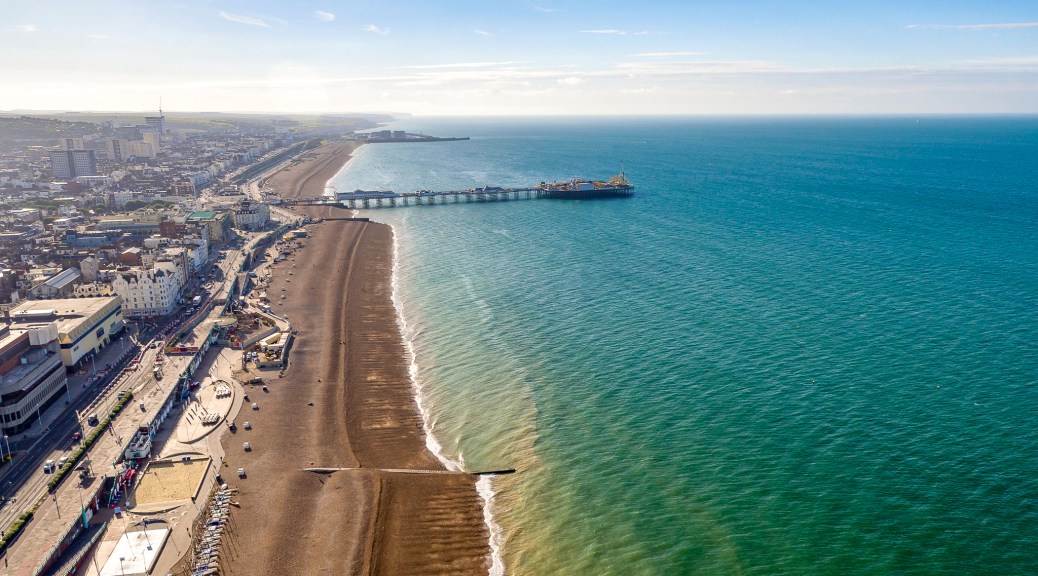
So what does all this have to do with us Brightonians? Well a new initiative called Sussex Bay is set to bring Blue Magic to our very own shores, so we can reap the benefits. Sussex Bay is a mission to regenerate, restore and revive 100 miles of our Sussex coastline. Paul Brewer, the Director for Sustainability and Resources at Adur and Worthing Council and Dean Aragon-Spears, Head of Blue Natural Capital are spearheading this incredible project. 

Dean describes Sussex Bay as ‘a movement initiated by Adur & Worthing Councils, powered by civic organisations, local businesses, communities and people.’ 

Through what they describe as ‘bold collaboration’ they aim to generate £50 million by 2050 to accelerate local seascape recovery along this incredible coastline – from Selsey in the west to Camber
Sands in the east including its river systems, coastline and marine area out to 12 nautical miles.

Sussex Bay came about after Adur & Worthing Council declared a climate emergency in 2019. Two  local projects inspired the next step: the Knepp Estate which has rewilded 951 hectares of farmland and seen massive increases in wildlife and biodiversity, and secondly the work of the Sussex Inshore Fisheries Association to introduce a 300 km2 trawler exclusion zone off West Sussex to restore the decimated historic kelp forest. If yoiu could rewild the land, why couldn’t you rewild the sea?

“There’s an urgent need to reverse the catastrophic decline in marine biodiversity.  Sea-based rewilding projects are far less common than those on land. The Blue Marine Foundation defines rewilding the sea as ​‘any effort to improve the health of the ocean by actively restoring habitats and species, or by leaving it alone to recover’. Healthy seabed drive a richer marine ecology, so when habitats recover so does everything that relies upon it. 

“Now more than ever we must bring nature back to our seabed, reefs and rivers. Restoring these ecosystems and their blue natural capital helps protect our coasts from storms, clean our waters, store carbon and support biodiversity.

And as nature recovers, people and the coastal economy will benefit too; from sustainable fisheries to enhanced health and wellbeing, and new commercial opportunities in ecotourism and leisure.” And that is magic. 

https://www.sussexbay.org.uk/

Benita Matofska is a speaker and author of Generation Share, a collection of 200 stories of changemakers.

benita@benitamatofska.com


Reasons to believe in the power of the seas
1.Globally, the Blue Economy is worth $1.5 trillion, provides over 30 million jobs and food for three billion people. And that’s predicted to double by 2030. A similar initiative to Sussex Bay is The Great Blue Wall, an African initiative to secure livelihoods for 70 million people, restoring two million hectares of ocean, capturing 100 million tonnes of CO2. The network of seascapes will be connected by a living blue wall that act as regional ecological corridor created by conserved and restored blue ecosystems such as mangroves, seagrass and corals.

2.Another initiative is Ireland’s Eco Showboat, the brainchild of Anne Cleary and Denis Connolly who travelled the coast of Ireland by solar powered electric boat on a zero carbon journey to connect scientists, artists, communities to spark climate action.

3.We’ve lost half of our coral reefs in the last 30 years and are estimated to lose 90% by 2050 because of climate change, pollution and over fishing. The better news is that scientists have found that marine ecosystems recover very fast and we can restore marine life by 2050 if we act now. 

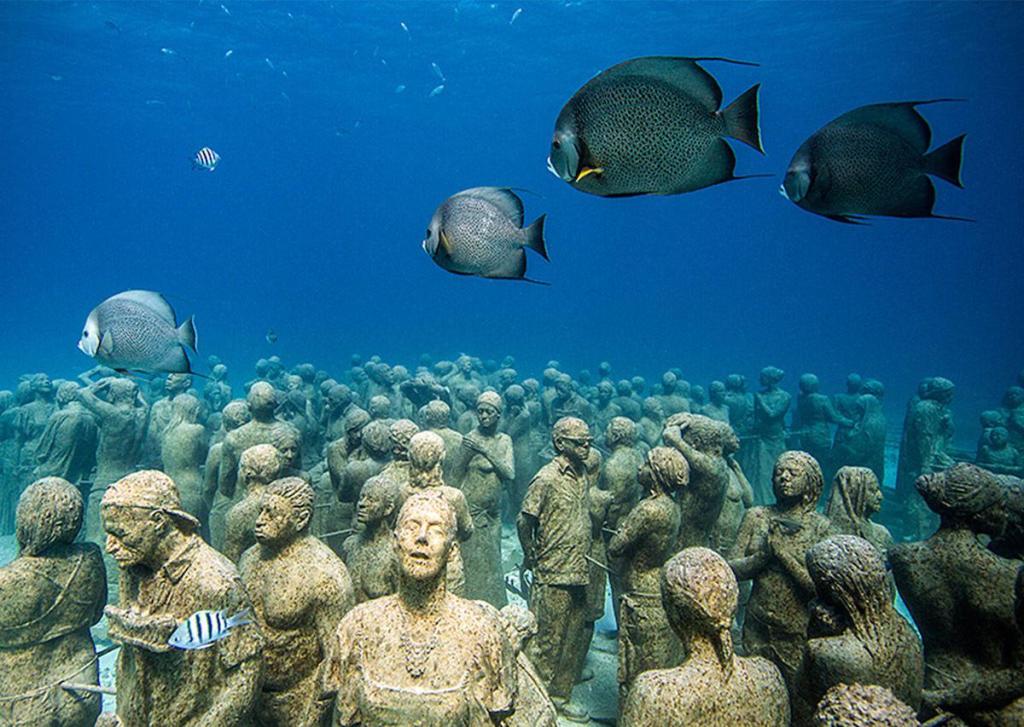
At the Museum of Underwater Art in Australia, underwater sculpture artist Jason DeCaires Taylor has created installations and beautiful artificial environments installations also lure divers and visitors away from the Great Barrier Reef, helping to protect it. 

4.Wetlands are biological super systems that store up to 50 times more carbon than rainforests. 40% of all plants & animals live and breed in wetlands and over a billion people depend on them for their living. We need to preserve our wetlands and our waterways to survive. The floating gardens is a project in Bangladesh to bring wetlands back to life using ancient Aztec traditions providing food, livelihoods and flood defences, combating impacts of climate change. 

5.The South African charity Waves for Change is a project offering surf therapy to children. By making the ocean accessible, children are learning new skills, and having a magical, life changing experience. 

6.Alejandro Duran, a Mexican environmentalist and artist, has created The Museum of Garbage and Washed Up, an installation and photography project using rubbish that washes up on Mexico’s Caribbean coast, a UNESCO world heritage site. His mission is to wake us up to the impacts of plastic pollution and consumerism. Alejandro and a team of volunteers found trash washed up from 58 countries and 6 continents.

How You Can Get Involved

1.Help to regenerate Sussex Bay by donating to the crowdfunding campaign. 

2.Volunteer with one of the Sussex Bay projects such as Sussex Underwater, the Sussex Kelp Project or the Sussex Dolphin Project.

3.Document wildlife sightings at the coast and get involved in citizen science. For more information, visit sussexbay.org.uk

4.Submit your idea. What’s your vision for Sussex Bay? Be part of the region’s biggest, boldest coastal collaboration ever. 

Contact hello@sussexbay.org.uk

Editorial – Sept 2024

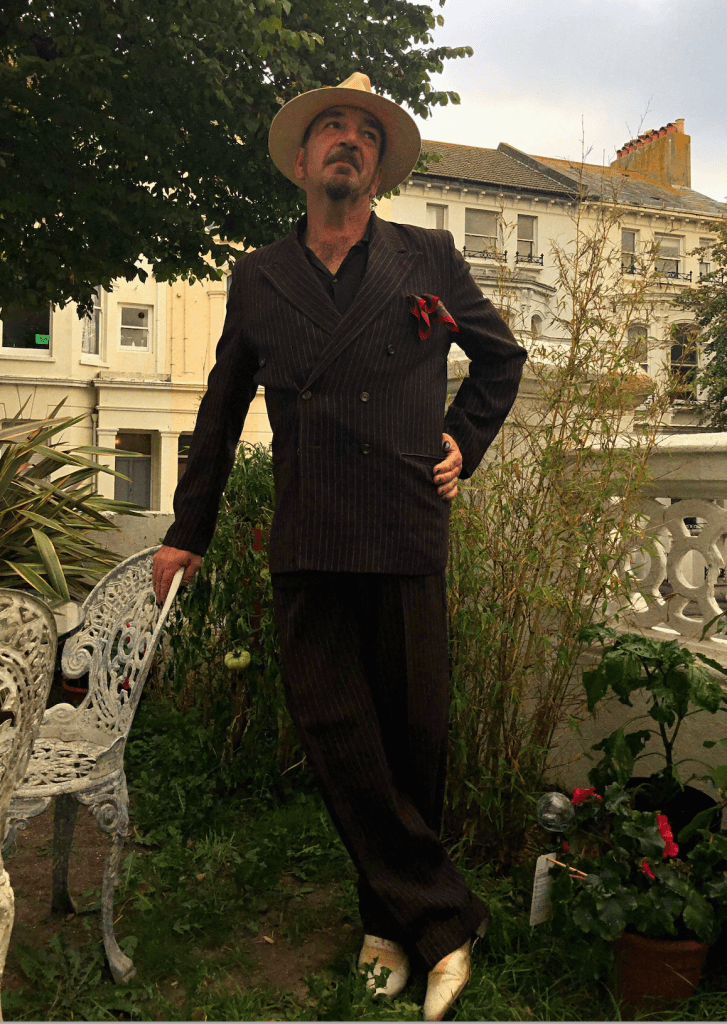
A long time ago, I was 14 maybe 15, I had a two tone suit. No, not two tone like The Specials, but proper two tone. Tonic, where the material is two different colour threads, cross weaved to create a beautiful shimmer. Tonic became popular with the original Mods and while I wasn’t that – I’m not that blimmin old – I loved the style. My suit was brown and blue tonic and was just beautiful. Later, I got married in a blown chalkstripe zoot, like Neal Cassady wore in On The Road. Still got that one

I’ve always loved suits. Always. Forties style, double breasted. Chalkstripe, not pinstripe. Louder the better. I was Bogart, now I’m more Melly. Sometimes though, standing out isn’t such a great thing. Not long ago, I was in That London on the tube. It was late. There was a group of four lads…

“Did you win, mate? Did you win?” one of them said, looking at his mates for the laugh. 

I just looked straight ahead. Didn’t engage. 

“The fancy dress competition mate. Did you win it?” he laughed, trying to up the ante. 

“No, I came second to some twat in high street jeans and trainers” I didn’t say, because while I’m well dressed, I’m not stupid. 

You don’t get that here. One of the things I love about being in Brighton is mostly I get “Dapper, mate” or maybe “Cool suit, fella”.  

I was thinking about this because there’s a shop in the ‘hood that sells clothes I haven’t got a clue about. I went past the hairy bikers shop and there’s a pair of mechanic’s overalls hanging in the window. What’s that about? I have no idea what that’s about. Is it a sales thing? Are you supposed  to buy them? Am I supposed to walk past and think “Mechanic’s overalls. That’s really cool. That’s what I want to look like”?  In fairness, I’m. guessing they’re vintage mechanic’s overalls. Maybe they’re selvedge mechanic’s overalls. We’re getting into some serious cloth now. Maybe it’s an aspiration thing. I wanna hang out where the guys in the mechanic’s overalls hang out. I have no idea. And you know what? I like that. I like that there’s stuff I just don’t understand. I’ve just had a rather spendid blue and white tartan linen suit made. Six button, double breasted, no vents. Proper. I’ve got a friend who’ll spend more on a pair of jeans than that suit cost to have made. A pair of jeans. I wouldn’t wash the car in a pair of jeans. OK, I don’t own a pair of jeans, but that’s detail. Curiously, the friend in question is also a biker. I make no judgement. 

Like I say, what I like about being here is that I can look really good and the bikers can dress on mechanic’s overalls and everyone’s happy. We all just get on with it. (I could get all Hallmark card and go off on one about how we’re a rainbow community, all different and yet all the same, but… let’s not). Actually it’s a bit odd because, in full disclosure, the bikers won’t talk to us. Their call. Different idea about community, I guess. Or maybe they do try to talk to us and we just can’t hear them over the very manly noise of their very manly bikes. (I never did get over my parents not getting me a Chopper)

Next to the mechanic’s overalls, there’s a lumberjack shirt. Can you imagine what the twat on the tube would say to that? 

Gardening Corner with Nancy Kirk – May 2024

Many of our properties in West Hill are Victorian or thereabouts and over the years, decades and centuries the soil has been enriched with all sorts of organic material. Many gardeners for the early part of the century would have incorporated vegetable peelings into the soil or sprinkled their borders with coal dust; one of my elderly clients regularly dusted the top of her lawn with coal dust claiming it kept the weeds at bay; I have no idea about the science of her decision, all I know is that her lawn was resplendent. 

Composting is a habit I gained in my 30’s when I moved from a flat into a house. I had tended to my communal garden in my flat, but all the decisions had to be made by all the freeholders, so the freedom to do as I pleased was new to me. Added to this, the local council was promoting it’s pledge to provide every garden in the borough with free composting bins. 

Getting a compost bin going to the hard part. It took years for me to work out a formula that worked for me. As my compost bins filled with grass clippings, prunings and raw vegetable waste I noticed nothing was happening, everything just sat there, belligerently not breaking down at all. I headed to the local library to mug up on the secrets of composting to find very little in the way of advice, but a visit to my father’s allotment answered all my questions and more. All the allotment folk had compost bins, and most importantly they had composters that worked and their owners were more than happy to show me the error of my ways.

Initially my new friends suspected I had plonked my compost bins on a hard standing, they explained that the worms need to be in contact with the soil; but I hadn’t broken this rule. Then they talked me through layering, and I was woefully guilty of this compost law. I would cut the grass and lob all the trimmings in one big heap, this was my first mistake. Thin layers of vegetable peelings, grass cuttings and pruned bits were required. Also my pruned bits and pieces were large branches of buddlejia, I needed to snip them down to hand sized pieces. The final rule surprised me, moisture. My bins were parched. As everything had dried out so much, just adding water was not going to cut it, as nothing would absorb the water quickly as it ran through to the soil. My solution was rather unpleasant but it really worked. I dug out a dusty old 1970’s blender which was hiding at the back of my kitchen cupboard and used it to store my vegetable peelings. When it was half full I would add water and blend the mixture to add it to the compost heap. The worms moved in and I never looked back. Once the internal temperature of the heap started to work there was no need for the blended mixture anymore. 

Here are the basic rules of thumb:

1.Always on soil, never on a hard standing

2.Think layers

3.Cut down pruned bits to hand size

4.Moisture. Try blending or mixing wet material with water to add to your heap

And the final hint I got for those wise allotment folk was male urine really helped get things going; I’m not going to publicly endorse such a thing because our gardens are so small. You didn’t hear it from me.

Composting is an art form. Every compost heap is different, but the pure gold it produces will continue to enrich our soil for the price of a small receptacle, so isn’t it worth a go?

Nancy Kirk is a gardener who provides bespoke gardening lessons in your own garden. Packages start at £250. Contact westhillgardenoracle@gmail.com for details 

Nicholas Lezard – View From The Hill May 2024

So, how was your Easter? Because of the obligations and vagaries of magazine production, I’m writing this before it’s even happened. So what shall I write about? What is still in my heart and soul to tell you? The endless rain? My endless poverty? My latest run-in with Vodafone? I’m sorry, I can’t this week, I really can’t. So instead I’ll tell you about something nice that happened to me during my week off. 

What happened was that my friend, who coincidentally happens to be the editor of The Whistler, invited me to a gig at the Prince Albert. Not only is the editor of The Whistler, he is also a gentleman of exquisite taste, so when he invites you along to a gig you go along without asking who’s playing, because you know it’s going to be good. A few days later, I asked “who are we seeing anyway?” and he replied “Jah Wobble”, and I fainted.

You might remember my having written about Mr Wobble a few months back, when I saw that he had followed me on Twitter. This put a spring in my step. For I had been a fan of his since October 1978, when Public Image Ltd’s first, eponymous single came out, with its simple but devastating bassline, played and conceived by Wobble. Since then he has released several groovy records, including collaborations with Sinead O’Connor and Holger Czukay of Can, but now is not the time for a discography. 

Now as it happens my friend, the editor of The Whistler, knows Jah Wobble (he was christened John Wardle, but “Jah Wobble” is how a drunken Sid Vicious pronounced it once, and the name stuck). As it also happens, I get a bit giddy in the company of musicians, especially in the company of musicians of whose work I approve. A girlfriend of mine once saw me in the company of Jim Reid from the Jesus and Mary Chain, and said she’d never seen me act like that ever before: simpering and giggling like a schoolkid with a crush. Writers don’t impress me nearly as much: I know their specious ways all too well. Artists can make me go a bit silly but then I knew Marc Quinn at university and I thought “grifter” and “he’ll go far”, but I once met Francis Bacon and I was deeply impressed and wondered if he’d paint me if I slept with him. But I was with another girlfriend at the time and couldn’t think of a way to drop it into the conversation. 

T

he plan was to meet with JW at the pub before the gig. I got into a right tizzy thinking about this. I shaved and bathed and brushed the few remaining hairs on the top of my head. It turned out that Spurs were playing Fulham that evening and Wobble, who is a huge Spurs fan, wanted to see the match. Only there was some rugby nonsense going on that evening, and the only pub playing the match was a cavernous pile by Old Steine mostly frequented by students. I was a bit anxious: I am not a Spurs fan, which I thought would put a spoke in the wheels of my friendship with JW before it had even got moving. As it happened he couldn’t even make it into the pub: there was a queue and he thought Sod that for a lark and went back to the Albert to watch it on his phone. 

As history records, Spurs barely even showed up either and Fulham slaughtered them 3-0 and it would have ben 4-0 but for the slimmest of offsides. After the match we went off to the Albert. “Hurry up,” I kept saying. “I want to meet Jah Wobble.”

“I’ve never seen him like this,” my friend said to another friend, another journalist who also knows Jah Wobble. Does everyone in this stupid town know Jah Wobble apart from me? 

So we finally made it to the Albert and went to see Jah Wobble in the dressing room which is even tinier than the room he was about to play in. I was, by this stage, quivering with excitement. And so what did they all talk about? Football. Worse than that: Spurs football. I’ve never been so bored in my life. Never meet your heroes, I thought.

But the gig was brilliant, and as Mr Wobble came off stage he squeezed my arm and I’m in love all over again. 

l Previously published inThe New Statesman 

Tom Gray – Labour Party candidate


Here in Brighton Pavilion, we’ve had  the same MP since 2010. Tom Gray, the new Labour Party candidate, talks to Jed Novick about changing that

Did you go full Spinal Tap? Did you throw strop about the miniature bread and get all the brown M&Ms taken out?

“No, no. I’ve always been too tethered, too down to earth.”

So OK. What was the most riderish rider you ever had?

“At one point I was struggling to keep all my socks clean, because doing your laundry on tour is an absolute ache, trying to find a launderette in Cleveland… So I added socks to the rider because I was thinking it would be nice to have some fresh, clean socks.” 

Did you stipulate how many?

“Yeah, five pairs of clean socks.”

Colour? 

“Whatever, just grey, blue or black.”

Clean socks. Grey, blue or black. And I was hoping for Nigel Tufnel.  

I’m with Tom Gray, founding member of 1999 Mercury Prize winning band Gomez and now Labour Party candidate for Brighton Pavilion, a seat currently held by Caroline Lucas with a majority of nearly 20,000. Normally that would be considered a safe seat, but Caroline’s standing down and suddenly that 20,000 feels a bit vulnerable, a bit marginal. 

“I think that’s because it’s Brighton Pavilion. It’s a unique place and has a unique standing in the electoral universe. It’s very particular and a very unusual group of people who live here. There’s an extraordinarily high level of education, of cultural engagement, of familiarity with international politics. There’s also a lot of money here, it’s actually quite a wealthy seat overall compared to most seats in the country, although there are areas of deprivation, real deprivation. 

“Now, within that group, what you have is a huge number of people who’d consider themselves progressive. They wouldn’t say they’re Labour, they wouldn’t say they were Green, they might even have voted for the Lib Dems after Iraq. So you’re dealing with a huge number of people who are essentially unaffiliated floating progressive voters. And that is a fascinating group of people to aim yourself at. 

“And so you say ‘What is it you actually want from your MP?’ Maybe you want somebody, as was clearly the case with Caroline, somebody who’s unique, a talented speaker, someone you felt reflected the insight and intelligence we have as a group of people in this constituency.” 

But Caroline Lucas has gone – or will be soon. The question for Tom – and the other candidates is this. After 14 years of having the only Green MP in the country, what comes next?  Or rather, who comes next?

“Maybe you think the natural successor is not a London councillor who’s been mired in local Green politics their entire life, but somebody who lives here, who comes from the creative industries, who’s been a musician and has been fighting all over the world for a change in the way that we perceive cultural workers, and who has a very distinctive voice of their own. Maybe that’s the natural successor.”

Sounds great but where could we find somebody like that? 

“I couldn’t tell you. Where could we find someone like that?”

Labour’s slogan for the forthcoming (and frankly not forthcoming soon enough) election is “Let’s get Britain’s future back”. I’m a bit disappointed. I wanted it to be “Bring it on”, the title of Gomez’s first album. 

“I keep saying ‘Bring it on. Let’s have that’, but I do understand why they’ve gone for that. It speaks to the fact that everything feels like it’s in terminal decline. Everything has been allowed to break and we’re pouring money into trying to solve the chaos they’ve created. They’re taking the investment out of people’s education, out of public health and housing and once you start to do that, everything falls apart. For example, A&E wards, on any given night, are 10 to 15% full of young people having mental health episodes. You think what’s gone wrong, where was the prevention? Where was the engagement? It’s no surprise to me that we’ve got a rise in car crime in big urban centers when we got rid of Sure Start 14 years ago. We took away the money and the support for underprivileged families, and when you do that, those communities start to disintegrate. It’s not hard this stuff, but you need time to fix it. 

It’s not hard, this stuff. But no one has been able to do it. 

“We can do it and we did do it. I joined the party in 1992. I joined the party of Neil Kinnock which became the party of John Smith and then became the party of Tony Blair, and the point is that even though my politics might have been some way to the left of Tony Blair, his government hauled millions of kids out of poverty, he gave us the minimum wage, gave us so many things that set us on the right track. Look back to 2010. 

Whatever people thought of the country, waiting lists at the hospital were three months not three years. We really need to look at just that one fact and go, who’s better at doing this? The people who love and care for and believe in public services, or the Etonians who want to see the whole thing fall down?

Where did the passion for politics come from? Tom joined Labour when he was 15, the age when he should have been smoking behind the bike sheds and… 

“Oh, I was doing that too”

“But it’s an interesting question. My family, on one side, it’s working class Roman Catholic from Salford, and on my mum’s side, my grandparents were Holocaust survivors, they were German Jews who ran from the Holocaust, so I’m a really weird mix. 

“I grew up in Southport, a quiet suburban place and I suppose it’s just in the fibre of all of that, a real strong sense of duty to community. 

That’s really what my politics are and that’s what has affected all the things that I’ve done along the way, outside of just making music for fun. But in terms of the other things, it’s always driven by asking how will we actually affect change? Can we really do something better for these people. I get very tired of gestures and conversation. I want people to be doing stuff. I’m like, What are we doing? What are we actually doing?

“So if people have just had enough, what I would say to people is you have to understand the scale of… look, when was the last time in British history, that we swung from a party with a working majority, to a party of a different stripe with a working majority? When was the last time that happened?” 

If you read the papers and listen to the news, a Labour victory at the next election is almost inevitable. All you hear is talk of 20plus point leads in polls, but Tom’s right. It’s a major swing, a bigger swing than Tony Blair achieved in 1997. “People just seem to think it’s inevitable and I keep saying there is nothing inevitable about what we’re trying to achieve. But it really feels like the safety of the country hangs in the balance, the sanity of the country hangs in the balance. Everything hangs in the balance of this election and it’s so important that we fix this stuff.”

Labour still have, for many people, the ghost of the past hanging over them. For a long time, certainly at the time of the last election, the party was unelectable. By making Corbyn leader, they opened the door for Boris Johnson with his 80 seat majority and, arguably, for the disaster that is Brexit. The more you think about it – and incidentally, it was 1970. The last time a swing of this size happened was 54 years ago – winning the next election isn’t inevitable. Maybe right now we should look at what’s needed now rather than talk about mistakes made in the past. “If you’re not going to do something or change something, why be involved? I could be a member of the Green Party. Some of their policies are OK, but the truth is, the reason I’m in politics is not because I want to wear a badge that suits my ideology. I’m in politics, because I want to make things better. I want to do stuff. I don’t understand the politics of not doing stuff.

T

om Gray moved to Brighton in 1997 – “I came here for a gig and never left. I was sofa surfing for a year or so and had a permanent address by ‘99. I’d grown up in Merseyside and even in the creative areas, it felt you could feel physically threatened quite a lot. Whereas in Brighton it didn’t really have that. It felt safer. As soon as I  came here, I felt ‘I’ve found my people’. Everyone’s cool with everyone. You can dress how you like, everyone’s comfortable with it. I couldn’t believe it existed. I was 20 years old and had spent most of my life in Liverpool and Leeds and, believe me, it’s very different.”

According to his Wikipedia page – and where else do you look to find out about people? – “Tom Gray is a Mercury Prize-winning British songwriter, composer, and activist. He is a founding member of the rock band Gomez, the founder of the Broken Record campaign, and the elected Chair of the Ivors Academy. He is an elected Council Member of PRS For Music and sits on the board of UK Music. He is a UK Labour Party activist based in Brighton & Hove, and a member of the Musicians’ Union. He was the recipient of the 2022 Unsung Hero Award presented by the Music Producer’s Guild UK”. 

If that’s not enough, he’s also writing a stage musical now around “Danny, Champion of The World”, a Roald Dahl story about a boy and his dad who go nicking pheasants off the rich landowner up the road. It’s great. It’s my kind of stuff, sticking it to authority. But the main thing is it’s just a really beautiful story of a non toxic male relationship between a man and a son. You very rarely see that depicted and I think that’s why I’m really attracted to it.”

We talked long about local issues, housing, the environment – he doesn’t fly, Gomez toured carbon neutral – but what I was really interested in was this. 

What was that like, winning the Mercury Prize. You were up against Massive Attack’s Mezzanine. 

“I mean, they were robbed,” he laughs. 

Do you still remember when the envelope was opened?

“Just. I was 20. I had no way of understanding what was happening. I was too young. I was just like, ‘Wow, we made a tape and it won the Mercury Prize’. How do you process that? 

Do you remember that feeling, the night? 

“Yeah, we lost the Mercury Prize that night.” 

Do you remember where? 

He laughs, again. Clearly it was a good night.

That whole music thing, was it great?

“Oh, come on. I loved it. I’ve had an absolutely charmed life. Honestly, I’ve been so lucky  to have been able to make stuff and be involved with brilliant people. The reason I stopped touring was that my son started going to school, and I wanted to take him to school. That’s what I wanted to do. I didn’t want to travelli the world any more. 

You did a lot of all that travelling the world?

“Mate, we were massive in North America. We had our biggest album in America with our fifth album, when no one was thinking about us here, that’s when we were starting to have radio hits in America. In 2007 we were in the top 30 grossing acts in America, playing 240 shows a year and playing big theatres all over North America, Australia, Asia, Japan.”

Does one moment stand out? 

“There were loads of times when you’d just think ‘This is ridiculous’, but I had a moment on stage in Glastonbury in ‘99. The sun was setting behind the audience and I could see it and they couldn’t see it. So I just stopped the gig and got everyone to turn round and look at that and like 80,000 people turned round faced away from the stage and looked at the sunset. And you just heard everyone go ‘Wow’. There’s not many times in your life where you get to do that.”