Air Conditioning Unit: harming the appearance of Guildford Road
The owners of number 18 did not seek permission when they installed the air conditioning unit on the front of this corner property. They were held to account by the Council’s Planning Enforcement Team but then made a “retrospective planning application” in an effort to retain it.
This application was inevitably refused with officers saying the unit is contrary to the character of the building and harmful to the appearance of the conservation area.
The neighbouring properties have attractive shop fronts, especially that of “Adrian Robins Interiors” two doors down and this ugly metal box is undoubtedly an eyesore and besides surely unnecessary. It’s therefore surprising that the owners of number 18 have lodged an appeal against the Council’s decision.
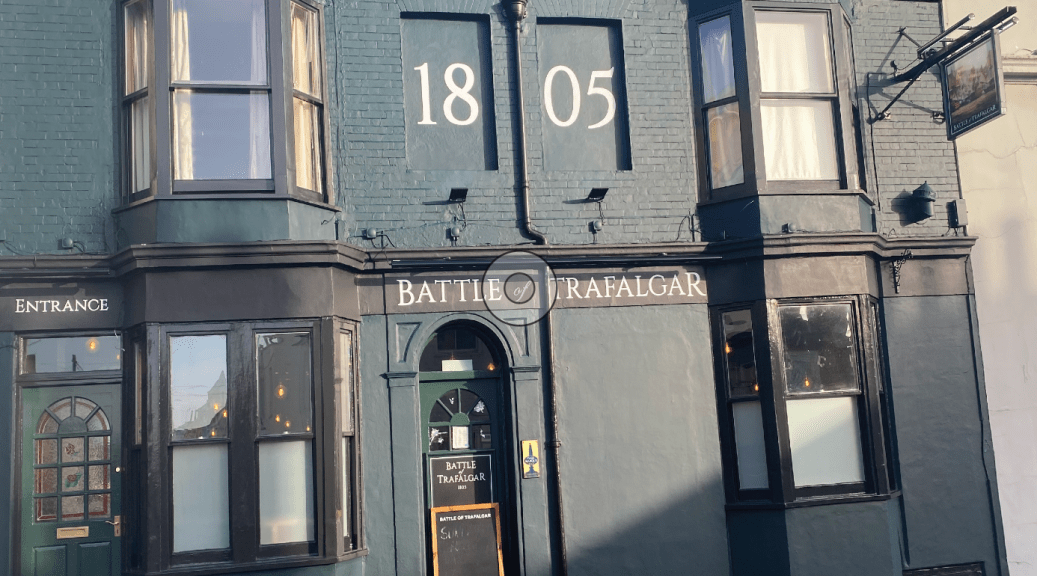
Battle of Trafalgar Pub: preserving the appearance of Guildford Road
Whilst residents have expressed some concern about the increase in lighting levels, the application to display a newly designed pub sign (see picture) and install lanterns and uplighters to the front elevation has been approved by officers. The current fashion of painting pubs in dark colours is being followed, in this case a “Mallard” (dark) green which is a radical change from the existing white. The current sign simply carries the name of the pub and the date 1805 but the proposed sign again depicts a scene from the famous sea battle although not the same as the one which disappeared in about 2015. The proposed traditional signwriting is to be welcomed. This is to be in a colour described as “Indian White”. The paint manufacturer describes this as “an extremely flexible, pale, warm white that captures the purity and optimism of a bright spring morning”. After 15 pints on a Saturday night punters might well want to capture that purity and optimism!
The Prince Albert, you know, the one by the station, a downhill stumble from the peak of West Hill, is one of the greatest pubs in a town with a greater abundance and favourable ratio to bad pubs than in any town I have ever seen, and I’ve seen a few. Both towns and pubs. I really know what I’m talking about. And such is the way of the world, or the way of this country, pubs are being closed down and this is terrible.
The Prince Albert – and I am open to the suggestion that the lewd piercing referred to by this name originated if not in this very pub but at least in this very town, for reasons I do not need to elaborate – is one of those places where the traditional and the counterculture meet as one.
My first proper evening there was when I finally, some years ago, moved to Brighton for good with the last items of my scant luggage. There wasn’t much: it was mostly my grandfather’s overcoat, which I was wearing, and a plastic bag containing, mostly, a teapot. I was tired, and it was late, and my new lodgings were up a steep hill – you know the one I mean – but the Albert was a brief step downhill and I could hear the noise of a band thudding through the walls and the mist, the kind of band I used to stay up late to tape off John Peel in the 70s. A truly horrendous noise, designed to both offend and charm – there were tunes behind it – with what I could tell even at a distance was a very angry female singer. This, I have to say, is one of my favourite genres.
So I went in the pub and went upstairs to listen to the band and even though I was wearing an ancient overcoat and carrying a teapot and was, by some decades, the oldest person in the room, I was utterly charmed. The band were called something that I cannot repeat even here; let’s just say a four-letter word was involved. They were clearly not aiming for chart success. But I stayed for the whole set and even chatted with the lead singer (her traumatised backing band, mostly men, had disappeared) for a while afterwards, and of course she turned out to be as sweet and modest and considerate as her on-stage persona had been confrontational and furious. This is so often the way.
And yet downstairs it’s all fireplaces and wallpaper from the 1920s as far as I can tell and, well you get the idea. The problem is that the pub has been under threat from developers. The latest recent plans have rejected by councillors but we need to make sure new plans don’t rear their ugly heads again. The best way to do that is to pop down there for a pint some time, just to let you know you love them. You don’t have to see Bleeding Ohyouknow upstairs but if they are playing, give them a listen.
It’s dark and cold and I’ve been wondering if it was ever going to stop raining. I’ve never been sure about winter – whose idea was that? I mean really. It’s not as good an idea as summer. Or spring. Or anything else that’s ever been ever. But even in winter exciting things happen.
As I write, there’s a woman I’ve never met called Sarah driving a van across the vast landscape of Europe, across countries and rivers, across seas and boundaries. In the van are lots of cages, each containing a puppy dog leaving the remarkable Sue Deeth and her Healing Paws rescue centre in Zante, Greece and heading to a new world, a new life. Their furever home, as the dog rescue fraternity has it. They’re sedated and hopefully oblivious, probably scared, probably nervous, almost certainly cold. How can they know what’s in store?
They might not know what’s in store, but for two of those pups, The Whistler knows. In one small cage there’s a black and white smiley thing called Freckle who is apparently a Labrador/Collie cross (that’s what she said anyway and I’m pretty sure she must have heard somewhere people like labradors and collies), and in another there’s a shy little Spaniel called Domino and by the time Your Friendly Neighbourhood Whistler glides effortlessly through your letter box, Freckle and Domino will be part of our family.
According to the Healing Paws website, Domino was found in an abandoned olive grove, and Freckle… who knows? Already I don’t believe her. But another similar tale no doubt.
If you’re a dog person and you go walking in St Nick’s Rest Garden with the rest of the Pooch Pals, you’ll probably already know them. They’ll be ones trying to keep up with Pickle, their 13-year-old new dad/mentor as he races around, woofing and smiling and woofing (the St Nick’s guys know).
Three dogs. I know. In a small flat in West Hill. I know. With a regular car. Really, I know. Right now I feel like spending every waking minute sitting on the sofa, because I’m not sure I’ll ever see it again. Stretching out in bed. That’s probably another distant memory. Staying in that bed longer than the sun stays down? Not a chance. They’ll team up, take turns, sort it out, and as the chorus of “Dad, I need a wee” breaks out… You’re going to get up, aren’t you?” But as much as they need us, we need them. What’s life without a bit of unconditional canine love? But three dogs. That’s us, outnumbered.
Quite what Pickle will make of his new family, who knows? His life has changed a fair bit since we got him last September. He’d just been aband… Oh, let’s not talk about that. A bit of TLC, a raw egg every morning, some of our homeopath Foxey’s magic and he makes Steve Austin look like one of the flowerpot men. He’ll be fine. If Mum and Dad say it’s fine, it’ll be fine. Anyway, he’s only recently found a new calling. Mum and Dad are both journalists, and so… Turn a couple of pages and you’ll find out. There’ll be no stopping him now. He’ll be insufferable.
“It’s funny, we did Come Dine With Me. And I feel like I’m auditioning again.”
You were on it?
“No, we were bloody runners up, which is really annoying.”
I’m in Royston Horry and Eric Simpson’s kitchen and they’re telling me about their Lockdown project which has become their post-Lockdown work. Candles, diffusers, workshops…
So why candles? If you wanted to do something different, why not, I don’t know, pick up a bass guitar or something? “Because I like candles”. You really can’t say fairer than that.
“I like candles. I like diffusers. And that was the main thing. I wanted to do it. Because we spoke about it ages ago, like years and years before that Lockdown stuff. But Lockdown gave us the time and it was just like, if we don’t do it now, I don’t think we’ll ever do it.
Did you know anything about how to make candles? “YouTube”. YouTube? “Yeah, YouTube and Google. I mean, so much has changed since we started, we’ve got black glass, the design’s all different and then it was all about picking the scents and trying to work out what would sell”. And they do look beautiful and they do smell very nice and they are doing very well.
All Royston and Eric’s scents are named after their favourite areas of Brighton “and so you’ve got Clifton; Rose Cottage is where we live; you’ve got Bookshop because there’s so many book shops in Brighton and we love book shops; you’ve got Palmeira; Kemp Town; Montefiore; Beach; Brunswick; Hanover; Naked Beach…”
It’s a proper cottage industry – in a cottage. At one stage Eric disappears down to the basement. Is that where the magic happens? I ask when he comes back. “No, that’s just downstairs, We make all the candles here” he says pointing at the cooker. You make all the candles on the cooker? “Yes, that’s why we called one of the scents Rose Cottage”.
What’s your best seller? “Now it’s probably Bookshops. It’s a new one out and it’s a masculine powerful scent for men and women.” When you say masculine powerful one, what do you mean? “Because it’s black and the scent is stronger. It’s got tobacco and leather and biases (a rose scent) which is quite lovely. You wouldn’t have put leather and tobacco in there but it does smell quite lovely.”
Skip Kelly, coach of Montpelier Villa Women, explains why women’s football has transcended nationalism
It’s hard to predict the future, and what I’m about to write could come back to haunt me. For a man with a name like mine and a background like mine and a cultural upbringing like mine… Are these the words I’m commiting to print in the finest local magazine to be read by millions? The words that will finally see me charged and convicted?
I like the English football team. No, not that one. Let’s not get carried away. The English football team that puts a smile on your face. It’s been another incredible summer for The Lionesses and many of you will wonder if I am referring to the Lionesses of Singapore or the indomitable Lionesses of Cameroon or the humble, but local English Lionesses.
This summer was spent reacquainting ourselves with women’s football teams from around the world such as the Super Falcons (Nigeria), The Reggae Girlz (Jamaica) and, of course, The Girls in Green (Ireland).
Nationalism is one of those concepts like organised religion or low emission zones that emits a guttural reaction ignoring the sometime possible benefits. Such as laughing at your neighbours when they are knocked out of international football tournaments.
Like all those concepts, it’s often the subtlety that provokes shock – and Irish nationalism is no different. After sitting through a school curriculum that had the Gaelic language as a compulsory subject until the age of 18, a history syllabus that taught the wrongs of imperial nations in far flung places like India and Congo, the litany of English football failures serves as a small serving of revenge every couple of years. International football doesn’t allow for nuance and it was always a joy to watch England lose at anything.
It was suggested that the Australian team – the Matildas – success in the World Cup was the culmination of a co-ordinated online media campaign that itself was a response to the traditional media that supposedly reflects what middle Australia think and espouse good old-fashioned traditional Australian values had for a long time taken a dim view of women’s football. The Matildas were successful because they weren’t seen as representing good old-fashioned Australian values and good old-fashioned Australian morality – they were just seen as Australians.
I heard this argument and thought it reflected precisely why I found the Lionesses easy to like. The Lionesses had names like Niamh and Mary. Surnames like Daly, Walsh and even Kelly. My initial resentment was at their refusal to declare for Ireland but that has slowly but surely subsided when I realised that these surnames are no longer considered de facto Irish names.
The Lionesses and The Matildas have somehow transcended nationalism in favour of a more inclusive world for all of us. One that seeks to include rather than exclude. And it’s really hard to root against that, especially when you see first-hand the impact it has on people who’ve previously felt uncomfortable in their own sexuality. Those who felt they had to be in a metaphorical closet now get to see openly gay athletes being celebrated for their athleticism.
I’m fortunate enough to have a front row seat to this at Montpelier Villa. Our players have always been footballers first, and yet I see how much it means to players when they wear rainbow laces or put up Pride flags at our matches. Our little football team is one of many that has subverted what’s expected of a ‘traditional’ football team.
The only court I will be convicted in for liking another football team is the one of public opinion. In the most extraordinary act of self-sabotage ever seen before this court, I would like to present the footage captured by the BBC immediately after Chloe Kelly’s winning goal last summer. Although it’s not clear initially, I am featured in the crowd shot, and I can be seen celebrating wildly with 90,000 others . . . And, yes. I’m wearing my emerald green cap.
Everything you ever wanted to know about life in Brighton (OK, and Hove)




 The Whistler