Tag Archives: Fiction

It Ain’t Over…  ‘Til The Fat Boy Sings

You know how sometimes you look at someone and think “You look kinda familiar” but you can’t place the face and move on, think nothing more of it. But sometimes you think “You, I know”. Well… 

I was in the Helm Gallery to meet The Whistler’s food editor who was there to discuss a show she was recording and I was having a look around and… “You look kinda familiar. What’s going on here?”  

“What’s going on is I’m taking over the Helm Gallery for six weeks” Norman Cook tells me. “It’s half art exhibition and it’s half art sale. There’s lots of prints by artists that are associated with me or who I’ve collaborated with, and it’s all based around the book “It Ain’t Over…  ‘Til The Fat Boy Sings”.

“I realised at the beginning of this year that I am entering my 40th year since I quit my day job at Rounder Records and ran off to join the circus, and I was thinking about how to mark or celebrate that anniversary.  

“I’ve always shied away from doing an autobiography. I’ve been asked a few times and I just, I can’t remember the really good bits. And the bits I can remember I can’t tell while my children and my parents are still alive, so when this idea of a visual documentary came about it seemed a good idea. It’s a coffee table book, so mainly pictures. There’s no warts and all stories, nothing about celebrity drug taking, I’m afraid…”

Could we do an after hours version? 

“Yeah, talk to me about that later”. 
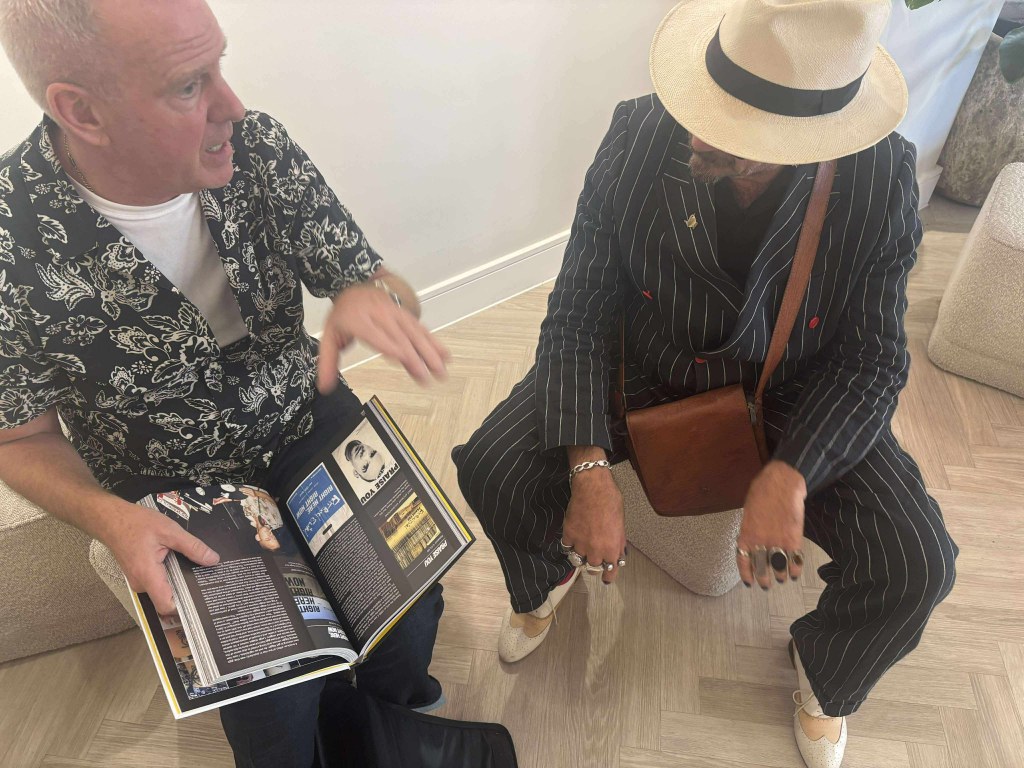
Are you one of these characters who’ve always squirreled stuff away? “Yes, I’ve got every single backstage pass I’ve ever have. The first year, I tried to keep tickets every gig I played, that was just untenable, but I’ve kept the backstage passes from every single one, and I’ve kept photos of all sorts, the boxer shorts that inspired the album title “You Come A Long Way, Baby”. I’ve also got the dubious honor of having a dildo named after me and we’ve got a photo of that in the book…

Moving swiftly past the inevitable line about it being a pop-up book… When you were a kid and you went to gigs when you’re 13 or whatever, have you still still got the stubs? 

“Yeah, the stubs are in the book, there’s the fanzine I used to write for…”

It’s a fantastic memorabilia collection, and while it’s obviously Norman’s book, a little bit This is Your Life, it’s also a lovely ride through the pop cultural landscape of the last 40 years.   

40 years. That’s a long time. Are you going to continue doing it?

“Doing what?”

You know the thing you do, where you stand there and play records. 

“Oh, that thing. Yeah, that’s what I do. I’ve done that thing twice this week already. I’ve got this weekend up the next weekend. I mean, Amsterdam, Stockholm and somewhere else, and then do some British dates in December. This year, I’ll do 109 shows, which is my personal all time record for shows in a year”.

That’s extraordinary. 109 shows. That’s… almost every other day. It’s not far off. 

“It’s two a week or one every three days. I mean, it has been quite relentless, but I love my job. It never feels like work. I just love it”.

l Helm Gallery 15 North Rd, Brighton and Hove, BN1 1YA    https://helm-gallery.com/

l It Ain’t Over… ’Til the Fatboy Sings (Rocket 88 Books) 
Climate Cafe: Cat Fletcher


Continuing our virtual Climate Café where we look at people making a positive contribution to the planet, Gilly Smith talks to Brighton’s queen of reuse Cat Fletcher

Cat Fletcher has always been a trailblazer when it comes to environmental consciousness. She moved to England from Sydney in 1992 for love, but quickly became passionate about waste. 

Recycling had been a part of Cat’s everyday life back in Sydney; it was easy and efficient. “People simply set out their recyclables by their doors, and they were collected weekly without much hassle,” she says. The absence of a similar system in Brighton had Cat initially just sorting the leftovers at her friends’ houses after parties, collecting their bottles, cans and cardboard to recycle. “They just thought I was a bit bonkers,” she laughs.   

Her passion for reducing waste was rooted in her Sydney upbringing. Her father, a professional yachtsman, instilled in her an appreciation for materials and the work that goes into making things. “I had a good understanding of materials and the work that goes into making something. I look at things and have this X-ray vision of how have they made that? What’s that made of?” 

This hands-on approach was particularly useful when she had three young children and a tight budget.  “I just had to get a bit creative,” she says. “I used to pick things up off the street, you know, chest of drawers, a bag of stuff, and I’d take it back and see if I couldn’t paint it or fix it.” 

With an eye for an upcycling bargain, she took on a stall for years at Brighton Station’s legendary Sunday car boot. “ It was a place full of old school duck and dive guys. There were the Victorian antique boys who used to get there at three in the morning with their mining lamps, and they’d be gone by 7am.” With the kids asleep in the back of her van, she was perfecting her craft while making a name for herself and enough cash to pay the bills. It was this vibrant reuse scene that inspired Cat to take her passion to the next level. 

In 2007, when she had to downsize her home, she discovered Freecycle – an online platform for giving away unwanted items. Impressed by the concept, Cat decided to launch her own local group, Brighton Freecycle which quickly gained a loyal following. But frustrated by the rigid rules imposed by the US-based company,  she began to think about upcycling the group itself.  “I just thought, you know, I don’t need their Yahoo group. The group doesn’t even have to be called Freecycle. I can just make another Yahoo group. And so I did, at three o’clock in the morning, I just made up a name called a Greencycle Sussex, and I just transferred all the members of Brighton Freecycle onto that new group.” 

This bold move caught the attention of a Guardian journalist, who wrote a story about Cat’s independent venture. The article sparked a domino effect, with Freecycle groups across the UK abandoning the US organisation to join Cat’s new network. “By Friday night, I think 60 Freecycle groups had gone.”

A

nd so Freegle was born – a decentralised, volunteer-led network of reuse groups across the country. Over the next 15 years, Freegle would grow into a well-organized, legally recognised cooperative, with a team of dedicated volunteers supporting local groups, winning Cat a Sussex Eco Volunteer Award. 

It also won the attention of the head of sustainability at Brighton and Hove Council who was one of the judges. He invited her to join its sustainability partnership along with the main players in the city’s infrastructure. “So I turn up there and there’d be a skip outside full of furniture. I was like, ‘Guys, there’s a pile of reusable stuff being smashed to pieces outside. What’s wrong with you? Either give it to someone to use, or you can get money for metal that could be income for the council. Why are you paying a waste management company for a skip?’” 

Using Freegle to shift everything from desks to filing cabinets, windows to heaters to NHS surgeries, schools and individuals, she was soon emptying Council buildings, 16.9 tons of furniture from Bartholomews House alone. “I even gave away the carpet tiles on the floor”, she laughs. 

The clearance of the old Council HQ at Kings House won her a Naticnal Recycling Award, but also an introduction to the CEO of the UK’s largest waste management company bidding for a contract in Greater Manchester, valued at £50 million annually. As the contract demanded an element of social value, Cat spotted the opportunity to recycle the work that she was doing for the Council in Brighton and Hove and adapt it for Manchester’s specific needs. 

“They deconstructed this huge anaerobic digester, a great big industrial building, hollowed it out, brought in 20 shipping containers, turned them into art galleries and makers’ units. They brought in all the people that I’d found around Manchester that could fix, reupholster, upcycle, repair, jewellery and they all came in and got a hub, a place to work. And then they retrained 650 staff all around the tips, so now, when anyone in Manchester goes to the tip with anything that’s upcyclable, it goes back to all the different makers in that one hub and back out shops at the tips where they sell it. It makes over a quarter of a million in profit every year which goes back into the community.”

Cat can be found at the Freegle Free Shop in the Open Market on Thursdays to Saturdays

Andrew Clover: Talks to the trees

The Hidden Life of Trees, Peter Wohlleben’s 2016 bestselling novel may have revealed trees talk to each other: but what would trees say to us? 

Yes… the idea seems odd – but it wouldn’t to Druids, The Sioux, or early Buddhists. It’s no surprise that the Buddha found nirvana by the Bodhi Tree, or that the Old Irish word for oak is duir: a druid is someone who connects to the oak – which brings wisdom, strength, and – even – vision.

But how does this work? How would you do that? Well…

1) Walk to your favourite oak. Already you’ll be feeling good. (Trees’ dappled light calms the mind; they emit chemicals that boost our immune systems). 

2) Greet your oak in some way. I fancy they like a hum. So I place lips and heart, and hum the question, “Can I sit, and be your sapling?” 

3) Most oaks will seem to say “Yes”. (Most yews will tell you to sod off). 

4) Sit, shut eyes, breathe slowly out. This stimulates the parasympathetic nervous system – releasing oxytocin – the body’s own version of the valium.

5) Meanwhile, mouth the seven magic words, ‘I breathe down and push down roots’. You’ll get a sense of fears and worries being drained down into the earth. 

6) Breathing up, mouth: “I breathe up and breathe up strength”. Imagine energy coming up, from the ground, filling your chest, your head, and passing up into the oak’s strong trunk. (By now you’ll be feeling way stronger).

7) Next time, breathe up to the oak’s calmly spreading boughs, mouthing, “I breathe up and breathe up calm”.

8) Next, breathe to the oak’s playfully wiggly twigs. In Latin, the oak was called quercus: and the oak is quirky. It’s the playful grandad of trees. Mouth, “I breathe up and breathe up lightness”.

9) Now, don’t hurry. If the oak might wish you to do one thing it’s that -never hurry. But when you’re feeling very calm indeed, breathe on the essential invitation the oak offers: think, “I am safe, to imagine, the future, that I need”

10) Let your imagination fly, like a bird, five years into the future. Imagine a tree, growing by the house, that you need. How big is it? What can you see in the garden?

11) Imagine entering its front door. What’s the floor like? 

12) You might see a photo of you, on the wall. What are you doing?

13) When you’ve returned home later, write down what you saw. The oak is known as The Gatway To The Mysteries. Your vision could be the start of something. 

Perhaps imagine the oak as Phil Oakey, singer of The Human League, a strange but trusted figure, inciting you to Open Your Heart. Imagine its rutted trunk is leading you into a better future. And it may.

When I first did this exercise, I saw the future I needed involved a shack, surrounded by jungle trees, that I’d helped plant, which, a year later, inspired me to sail the Atlantic, to plant 2500 trees. I lead this meditation, once, for a coaching client, who saw herself creating a company to empower female sport. Six months later, she’d raised a hundred million in investment. 

Now… hang on… I’m not saying breathing on trees makes you rich. Far more likely, you’ll embrace the lesson of the chestnut, “I want nothing… I have it all right now.” I’m just saying that there’s powerful magic, in the oak – and in all trees. 

And that connecting to them can bring a powerful, quirky magic into your life.

What’s your favourite tree? Would you like me to walk to it with you, to tell something of its magic? If so, get in touch. You’ll know what I’ll say. 

mrcloverthefamoussnail@gmail.com