Tag Archives: Gilly Smith

The Chilli Pickle in Brighton by Gilly Smith


The Chilli Pickle’s Alun and Dawn Sperring are two of Brighton’s most intrepid restaurateurs and have been travelling through South Asia on a quest for adventure and the best food they can find. They tell Gilly Smith what treasures they brought home. 
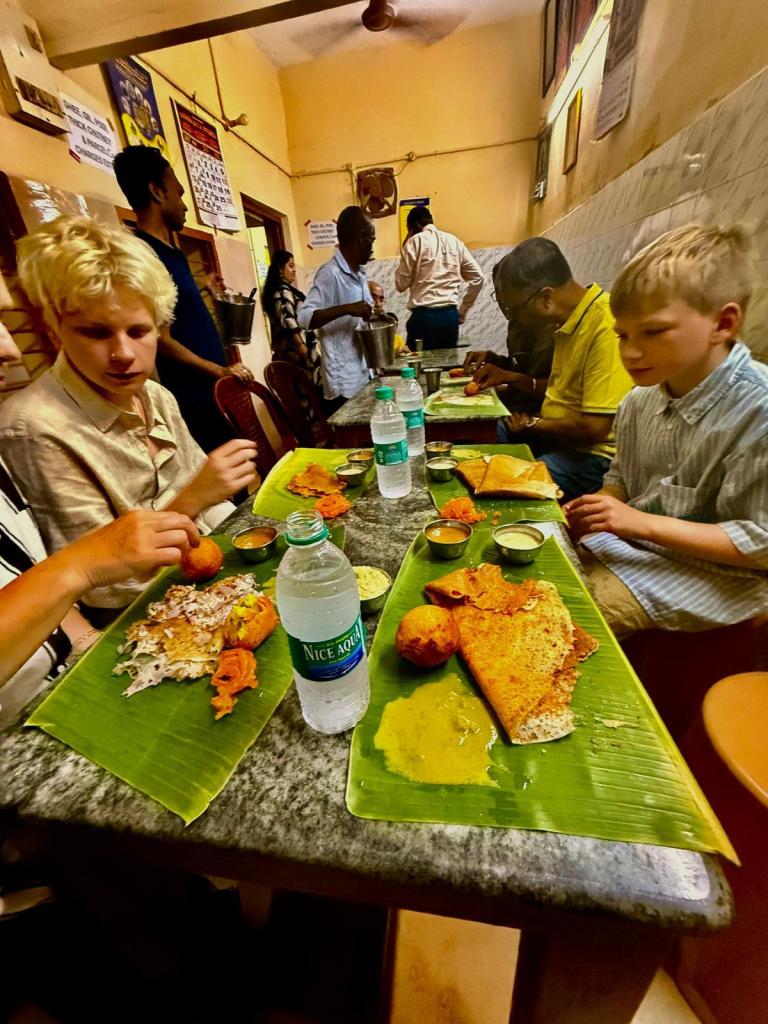
With kids, Fletcher, now 12, and Stanley, 18 in tow, Alun and Dawn Sperring have spent most of their lives exploring India, from the crazy bazaars of Old Delhi to the hill stations in the western ghats to the tropics in the south and the deserts of Rajasthan. 

Much of what they’ve found over the years has made its way onto the menu of their restaurant, the award winning, OctoberBest favourite, Chilli Pickle, now back in its original home in the Lanes. The Laal Maas, a fiery mutton curry comes from an early trip to Jaipur, its deep red chilli colour and a robust taste of whole garam masala served with hot red pickled onions and naan. The lassi, a traditional yoghurt drink seasoned with cardamom and signature tasty milk skin on top, they found served in a clay pot which, once finished, is smashed. 

Now they’re back from their latest trips through Kerala, Varanasi, Chennai in India and Lahore in Pakistan with new flavours and stories to tell. 

“When we visited Lahore this time, it was all about the nose to tail eating and meat cooked over fire on the streets”, Alun tells me. “We’d go for an early breakfast meal of paya which is goat’s trotter soup, which they’ve cooked overnight for the locals who start work at around 5am. It’s a wonderful way to start the day, a big dose of collagen and protein in one go. They finish the vat and then they start cooking all over again through the night.”  

Paya, Chilli Pickle-style isn’t quite the whole trotter, but its broth, cooked down into a sticky consommé, is going down a storm in Brighton. Alun and Dawn pride themselves on offering the real South Asian taste that they’ve found on their countless adventures. Their spicing is honest and unapologetic, and they’re happy to replicate some of the more challenging dishes; even the brain curry has been on the menu. But will the Katakat make it to the specials? “Ooh that was good”, he sighs. “It’s street food that’s a bit like the Japanese Tepanyaki but made with goat testicles chopped up with mixed spice, green chilli and butter.”

I asked him how he can recreate the rich eating experiences of India and Pakistan, the throngs of local workers in the vegetarian canteens, or messes, of industrial Madras, or the unruly crowds at Kebab Corner in Chennai, and the calm of the house boats of Kerala where flat fish is a must. Answer: they don’t. The taste is enough to transport anyone who dreams of India. “We loved the kebabs in Chennai,” says Alun. “We now do the Malai chicken kebab which is topped with a spicy rich cream drizzled with butter and spiked with cardamom and kewra. It’s another level. We accompany all our kebabs with razor thin onion salad with a loose spicy green chutney, so we’re accompanying all our kebabs on the menu that way now.”

The indigenous Keralan pomfret is simply replaced with local plaice in our Kettuvallam Whole Plaice Fry”, he tells me. “It’s just rubbed with a really spicy marinade, ginger, chilli powder, awain seeds, rice flour, fresh lime curry leaf and fried dry and served with a lovely punchy ginger chutney and tempered coconut rice. And it makes a lovely side lunch or dinner special.”

Look out for the Nihari keema kulcha from Lahore with marrow bone gravy, a flatbread stuffed with beef Koobidah and served with a deliciously unctuous sticky spiced marrow bone gravy mopped up with stuffed flat bread.

l The Chilli Pickle – 6-8 Meeting House Lane, BN1 1HB

01273 442893

The Charleston Festival: Hugh Fearnley-Whittingstall and Bee Wilson

The Charleston Festival was packed with food book fans last week as the current culinary kings and queens teamed up with the world of art and literature to discuss all of life through the prism of food. Composer/musician Nitin Sawhney chewed over the symbiotic relationship between art, politics and society with food writer, chef and restaurateur Ravinder Bhogal, while food royalty Bee Wilson and Hugh Fearnley-Whittingstall explored the moral, ethical and health choices we’re forced to make about food every day.

There was even a surprise visit from Queen Camilla who opened the event with poet laureate Joseph Coelho, presenter and comedian Lenny Henry, children’s authors Jacqueline Wilson and Francesca Simon, and actor Jenny Agutter. Shame she didn’t hang on for the Bee and Hugh session; I think she’d have had a lot to chat about with Charles had she stayed on to learn how to eat 30 plants a week

But it was why we need to eat 30 plants a week that was the subject of the afternoon. The impact of factory farmed animals on climate change and the immorality of eating industrially fast-grown caged birds who can barely move, let alone exhibit their natural behaviour was high on the list for Hugh. And as host, the Food Programme presenter, Leyla Kazim asked how the average shopper can choose between the many and various ethical signposting, thank the Lord that Hugh put paid to any suggestion that Red Tractor has anything to do with compassion in farming.

Deliberately confusing the messaging is what retailers do best, and Hugh and Bee suggested that we simply side step the ultra-processed aisles in the supermarket. ‘It’s a mind bomb that sets you free,’ said Bee, as she urged us to think about real ingredients – vegetables, fruit, meat and fish – instead of the ultra processed foods that have cast a spell over an increasingly robotic shopper.

For Hugh, eating more vegetables to improve the health of the nation and the planet is about storytelling. ‘It’s about elevating the way we eat, rather than being banging on about being virtuous’, he said. And he reminded us that our ancestors were obsessed with storytelling about food. They would spend the whole day hunting and gathering, he told us, and as the community gathered to cook and eat together at the end of the day, they’d chat about what they’d been up to. And that was food. Instagram’s obsession with food has nothing on the Hunter Gatherers.

Be more hunter gatherer, was the take out of the afternoon. Forage for nettles with the kids, pick blackberries with the grandchildren, taste and tell in schools, and a whole new generation will grow up not in the shadow of their food wasting, UPF addicted, climate changing community, but of their deer stalking, herb picking ancestors.

Gilly Smith

More than just a breadhead

The very word Gail’s got the armchair grumpies and keyboard warriors out in force, but slow down. Put away your prejudices. Just because somewhere has more than one branch doesn’t meant they’re the bad guys. Gilly Smith reports

Once upon a time in Brighton, you could gauge the feel of a neighbourhood by whether or not it had a Tin Drum. The family-run chain of bars and eateries, latterly serving charcuterie boards from the owners’ home-raised pigs, first opened on Dyke Road, home now to The Cow, and became a badge of gentrification. These days, it’s a Wolfox. Or maybe a Gail’s.

The number of Gail’s opening across the south east has long exceeded a bakers’ dozen. Our new one in the Dials will be the 130th to opens its doors since the first bakery over 30 years ago in Hampstead High Street. The new Gail’s set up shop in Night Shift, formerly the collaboration between Flour Pot, Curing Rebels, Curio Wines, and local artist, She Paints, which has camped out there since the demise of Brighton-born Small Batch. And it’s already had a pasting. It was daubed with graffiti declaring it ‘boring’ before it had even opened, a spray-painted penis summing up the outpouring of anti-establishment feelings all over social media. 

Which is odd really, as Gail herself was a bit of a radical.

Gail’s began with a mission to do things differently. Back in the early 1990s, it created a bit of a rise in the restaurant industry by taking the values of sour dough – slow, crafted, natural, like bread used to be, as bread should be. 

At its helm was artisanal baker, Gail Mejia, whose ironically named Bread Factory had been a wholesale retailer in Hampstead. She and her tiny team of bakers quickly realised that what they were making for top notch restaurants just wasn’t available in most neighbourhoods. They decided to fix that, and Gail’s Bakery was born.

Thirty years later, Gail is a biodynamic farmer in Portugal, as Tom Molnar (pictured), Gail’s CEO tells me as we chat about the new opening in The Dials. “She spent 10 really hard years before I met her, putting together the bakers, working with some top chefs, and building the thing that I fell in love with.”  A disruptor, a visionary, she was part of the Slow Food movement that has been so influential in making us rethink our relationship with food.

“She represents a whole bunch of hippies in food who changed so much,” says Tom. He means chefs like Rose Gray, Alistair Little and Sally Clarke who came back to London from America in the 80s and 90s with a dream of a simpler way of eating fresh, organic food, as  championed by restaurateur and food legend, Alice Waters. Fermented sour dough was just part of the mix. ‘When everything was becoming mass (market), they just stuck to their guns and said, ‘Look, that doesn’t make sense’. It wasn’t the engineers and the business people that got it right” says Tom, a former management consultant who recognised the potential for Gail’s back in 2005, “it was the hippies and the food pioneers.”

Now 130 Gail’s bakeries are quietly changing the food industry, not least by working with Natoora, a distribution hub on a mission to fix the food system by building direct relationships with small-scale growers and independent producers.  Gail’s distributes its surplus food through Neighbourly, a network of over 29,000 charities and community groups and an award-winning giving platform “that connects company funds, surplus and volunteer time with local causes to make a positive impact.” But does any of that matter to the customers? 

Presumably it doesn’t to Juliet who wonders on Instagram how they justify £5 for a pain au chocolat in a cost-of-living crisis. Or Laura on Seven Dials Facebook group who’s boycotted Gail’s since they stopped taking cash. “Maybe not all of them”, concedes Tom. “Maybe there’s 10-20% that do care.”  So who tells them about the spirit of Gail that’s still stirred into every loaf of bread so long after she left the building to sow her own seeds.  “Yeah, it’s tricky”, admits Tom. There’s no messaging in the shops, and you’d have to read the website to get any real sense of what Gail’s is all about. Tom says he struggles with how loud the revolution should be. “You don’t want to be the person at the party who talks all the time, and you don’t want to be that person who doesn’t say anything. You’ve got to be somewhere in between to be heard. And I don’t know if we found the right balance yet.”  

I think he’s missing a trick; give me some blackboards in a café telling the back stories of growers and carbon reducing mission statements, and I’m in. Tom doesn’t think it would have been Gail’s style. “She’s still one of my teachers’, he says. “I’m just trying to do my best to keep her view on food alive. I didn’t want to destroy what she had built. My job was to just let it flourish, I guess.”

Like a good loaf of bread, one might say.

l Gail’s in Seven Dials is opening soon 

In the meantime, you can sample their wares at: 

93 North Rd, BN1 1YE

Mon – Fri: 7.15am-5.30pm; Sat: 7.30am-6pm; Sun: 7.30am-5pm