Tag Archives: nature

Andrew Clover: Talks to the trees

The Hidden Life of Trees, Peter Wohlleben’s 2016 bestselling novel may have revealed trees talk to each other: but what would trees say to us? 

Yes… the idea seems odd – but it wouldn’t to Druids, The Sioux, or early Buddhists. It’s no surprise that the Buddha found nirvana by the Bodhi Tree, or that the Old Irish word for oak is duir: a druid is someone who connects to the oak – which brings wisdom, strength, and – even – vision.

But how does this work? How would you do that? Well…

1) Walk to your favourite oak. Already you’ll be feeling good. (Trees’ dappled light calms the mind; they emit chemicals that boost our immune systems). 

2) Greet your oak in some way. I fancy they like a hum. So I place lips and heart, and hum the question, “Can I sit, and be your sapling?” 

3) Most oaks will seem to say “Yes”. (Most yews will tell you to sod off). 

4) Sit, shut eyes, breathe slowly out. This stimulates the parasympathetic nervous system – releasing oxytocin – the body’s own version of the valium.

5) Meanwhile, mouth the seven magic words, ‘I breathe down and push down roots’. You’ll get a sense of fears and worries being drained down into the earth. 

6) Breathing up, mouth: “I breathe up and breathe up strength”. Imagine energy coming up, from the ground, filling your chest, your head, and passing up into the oak’s strong trunk. (By now you’ll be feeling way stronger).

7) Next time, breathe up to the oak’s calmly spreading boughs, mouthing, “I breathe up and breathe up calm”.

8) Next, breathe to the oak’s playfully wiggly twigs. In Latin, the oak was called quercus: and the oak is quirky. It’s the playful grandad of trees. Mouth, “I breathe up and breathe up lightness”.

9) Now, don’t hurry. If the oak might wish you to do one thing it’s that -never hurry. But when you’re feeling very calm indeed, breathe on the essential invitation the oak offers: think, “I am safe, to imagine, the future, that I need”

10) Let your imagination fly, like a bird, five years into the future. Imagine a tree, growing by the house, that you need. How big is it? What can you see in the garden?

11) Imagine entering its front door. What’s the floor like? 

12) You might see a photo of you, on the wall. What are you doing?

13) When you’ve returned home later, write down what you saw. The oak is known as The Gatway To The Mysteries. Your vision could be the start of something. 

Perhaps imagine the oak as Phil Oakey, singer of The Human League, a strange but trusted figure, inciting you to Open Your Heart. Imagine its rutted trunk is leading you into a better future. And it may.

When I first did this exercise, I saw the future I needed involved a shack, surrounded by jungle trees, that I’d helped plant, which, a year later, inspired me to sail the Atlantic, to plant 2500 trees. I lead this meditation, once, for a coaching client, who saw herself creating a company to empower female sport. Six months later, she’d raised a hundred million in investment. 

Now… hang on… I’m not saying breathing on trees makes you rich. Far more likely, you’ll embrace the lesson of the chestnut, “I want nothing… I have it all right now.” I’m just saying that there’s powerful magic, in the oak – and in all trees. 

And that connecting to them can bring a powerful, quirky magic into your life.

What’s your favourite tree? Would you like me to walk to it with you, to tell something of its magic? If so, get in touch. You’ll know what I’ll say. 

mrcloverthefamoussnail@gmail.com 
The secret diary of a microdoser #4

We are in a dance. A cosmic dance of monumental proportions and majesty. But we are not alone. Once a month the full beauty our dance partner is revealed and the Moon basks in all her glory, calmly accepting the Sun’s spotlight. Even though we often take her name in vain, she is still prepared to take a hit for us, as she follows our celestial rhythm. 

The music that weaves through our universe is conducted by four virtuosos, according to our current scientific understanding. We call them “Forces”: Nuclear Fusion, Nuclear Fission, Electromagnetism and Gravity. It is those forces that carve the shape of our reality. 

Physicists can show you how the first three work. They know how they communicate their message. They can measure them, photograph and record their stories with minute sensors. We’ve all sprinkled iron filings on a blank page to see how a magnet writes its script. But no physicist can actually tell you how the Moon says to the oceans “Come to me”. We can see the effect of that message, sure. But in reality we’re as close to understanding gravity as a mechanic gauging the torque of an engine by sniffing the burnt rubber left behind by a wheel spin. As it stands, nobody can actually tell you how the Moon speaks to our seas, nor how our oceans obey its command. We can see and hear the opera, we just can’t tell you how it is played. 

We are all told that the chances of us existing on this perfectly positioned planet are a billion trillion to one, but the moon is an enigma. It is apparently travelling away from the Earth by two inches every year. What we are not told is that, just at the point when we achieve consciousness as a species, the moon is the perfect size and at the exact distance between us and our nearest star to occasionally create a total solar eclipse, producing a perfect corona. Another billion to one chance? Pure coincidence? It has nothing to do with anything, right? Unless, of course, it is Everything. Unless it is absolutely pivotal to our existence and our development as a species. Unless we wouldn’t have achieved our current level of sentience without it. We just haven’t fully understood its importance because that can only be attained once we have reached the end of that particular journey, and we’ve still got some way to go. 

Some journeys are waiting for us to determine their outcome. Others are a race. The one in which we have found ourselves is a race between natural resources on one axis, population growth and technology on the others. It’s a race we have to win if we are to survive as a species. 

The apple is falling from the tree. It needs to be caught before it hits the ground. 

Predicting a solar eclipse was the ultimate statement of power in ancient times. Greek sponge divers made a stunning discovery in the Mediterranean in 1900. Named after a nearby island, the Antkithera Mechanism, most likely created by Archimedes, was the technology which could deliver that prediction. Much as Alan Turing is credited for creating the first computer, it actually started two thousand years beforehand. It is around that time that the race began. The time when we became a super-predator. But we have reached the point where we need a new Archimedes. 

Is he Elon Musk? There could be a lot worse candidates for the position. A self-confessed high-functioning autist. I approve. I understand his fixation with rockets, but unfortunately his obsession is misplaced and badly timed. Aiming for Mars is fine, just fix the Earth first. Maybe I should post him some mushrooms. Retune his Hyperfocus. He’s already got a Duncan Fearnley. He just needs to be pushed out on to the right wicket. 

Recent revelations have brought the holy grail of Cold Fusion much closer as a promising ingredient, Deuterium Hydrogen (which critically contains an extra neutron), has been found in a stunningly abundant source: seawater… In theory, a gallon of seawater could produce the same amount of energy as 300 gallons of petrol. If only we could artificially create anywhere near the gravitational force of the sun, or harness the Earth’s magnetism… 

Like Newton, Einstein, Darwin, and many others, the new Archimedes will very likely be an autist, this is not an arena where a neurotypical will excel. However, Alan Turing’s reward for his brilliance was chemical castration. Archimedes’ ultimate conclusion was a thrust of a Roman sword delivered by a soldier who didn’t give a shit about “disturbing his circles”. Discrimination and ignorance persist. The current stance of the Australian government is not to issue a foreigner with a working visa if they are diagnosed with autism or ADHD, much to their loss. 

In order to win this race, it is essential to house the new Archimedes in a Bletchley Park appropriate for our age. Because the code of this enigma is far harder to crack and way more important. They will need the support of a nation who realises that we are the Steward, not the Owner, and that it is our duty to stand on the shoulders of our forefathers, save us from this lunacy, and reach for the sun.  

With love, Ray, Brighton, 2024

For back issues: https://www.instagram.com/sdoam.therayman/

Editor’s note: The Whistler does not condone Ray’s opinions. We chose to publish this as we know there are many microdosers in the city. But remember, what works for Ray may not work for anyone else. 

Climate Cafe – Rewilding The Sea

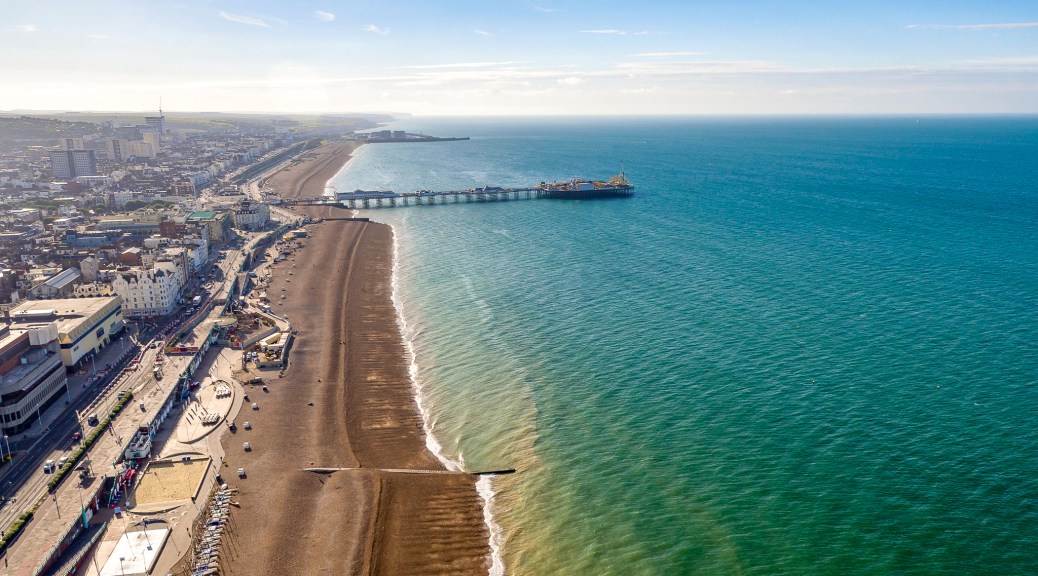
Brighton’s seaside is a playground, a health spa and a boon to the local economy. But in our crazy industrial food culture, we’re much more likely to buy our fish already battered in a shrink-wrapped plastic package from the supermarket than one of the lovely fish stalls on the beach or the fish shops – Andrew’s in the Open Market or Brighton & Newhaven Fish Sales next to Hove Lagoon, where the fish come straight off the day boats, supporting the environment and the local fishers.

Our coastline has been through its own boom and bust, with fish stocks on the critical list and the ocean’s eco-system becoming decimated by the heavy hand of the industrial food system. But there’s good news coming in on the Sussex waves; Dolphin Head, south of Selsey Bill, was designated a Highly Protected Marine Area (HPMA) last year, after years of campaigning. Following decades of bottom-towed trawling, the site has become degraded, but these new protections will allow the area to fully recover. The area is a hotspot for bio-diversity, with several habitats found there and is used by numerous seabirds and marine mammals, including Risso’s dolphins and Harbour porpoises.

It was a lone fisherman we met on a dog walk on the beach at Shoreham who told us that Rampion wind farm has brought all sorts of fish back to its waters, that the sea bass and plaice come right up to the beach now, and there are plenty of sea bream further out. “It doesn’t just stop the trawlers. It’s created a reef which provides new habitats.” 

And that creates a whole new eco-system. 

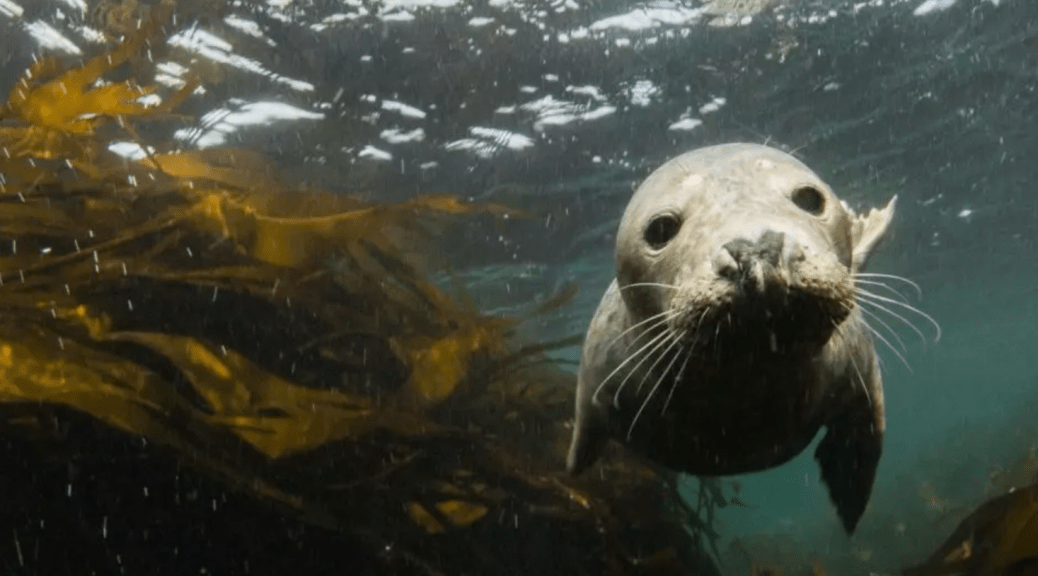
Local campaign group, Sussex Underwater, which only this autumn won a coveted Maritime Award for their film Our Sea Forest, reports that mussel beds are returning. Like oysters, these biovalves create important habitats for other species, and provide food for rays and other fish. 

It’s an astonishing reminder of a world that turns out of our view. Charles Clover, author of Rewilding the Sea, and seasoned environmental journalist says that we need to dive deep and wake up to what’s happening in our oceans not just to save the planet but to remind ourselves of what the Channel might have been like many years ago. “The dynamism of nature is just quite fantastic” he tells me. “If you leave it alone and harvest it really sustainably, using methods that don’t damage the rest of the ecosystem, then it does you multiple favours.”

Co-founder of the campaigning Blue Marine Foundation, Clover is bringing life back to our oceans and writing about it beautifully. Margaret Atwood calls his book “a game changer”. Knepp’s Isabella Tree says it’s “desperately needed”. George Monbiot says, “What if our seas became productive again with giant sturgeon, halibut and skate? It’s closer than you think.”

 “It’s not about not eating fish”, Clover tells me. “It’s about making sure the fish are managed properly. An extremely good example of the resurgence is the Bluefin Tuna around Britain’s shores. It’s not been there for 70, 80, 90 years, but it’s back. And it’s back principally because of a fisheries management decision.”

Industrial fishing has an enormous impact upon biodiversity; trawling and dredging smashes up the seabed, destroying “the forests of the sea” where the humble seaweed draws down CO2 and locks it away forever. But as Charles explains, Sussex Kelp has turned the tide on trawling.

“Sussex Kelp brings together the three reasons why we must rewild the sea: for greater food security, for biodiversity and for climate,” he says. In his book, he tells the story of Eric Smith, the Shoreham free-diver with Sussex Underwater who campaigned for the protection of the kelp belt, and continues to report on the astonishing recovery of this area from trawling. As a result of his work, mussel beds are expanding, stingrays have been sighted and the kelp is returning, says Clover.

“Kelp is one of many as-yet unquantified mechanisms that can help sequester carbon from the atmosphere and lock it up in sediments, though where its leaves go to that are not washed up on the shore is complicated and hard to quantify. But in the end, it will take its place with seagrass, saltmarsh, mangrove and, I believe, other forests of the seabed, in being recognised as an important mechanism that must be protected, that makes our planet more resilient.”

With the protection of the Sussex kelp, fish have come back as well as lots of other organisms, and local fishermen are happy too. “It shows what we could do all round our shores and it shows that in some places at least, we are moving in the right direction. As Eric puts it, “we are winning.”’

l Rewilding The Sea: How To Save Our Oceans by Charles Clover (Penguin) 

l Hear more from Charles Clover on Gilly Smith’s podcast “Cooking The Books with Gilly Smith”

Benita Matofska looks at Sussex Bay

I’ve long been fascinated by the wonders of our waterscapes and how vital ocean conservation is to our very existence. 70% of our planet is covered in water – from seas and salt marshes, to rivers and inland coastal waterways, these shape the land, the way we live, eat and breathe – they’re vital to our health, wealth and happiness and we need them to survive. When they thrive collectively, this is Blue Magic.

I grew up in land-locked Leeds and the first time I saw the sea, I was 18 months old and stood and stared and was silent for the first time. It was my first encounter and it would come to shape my life. 

Fast forward to when I was 10. Riddled with eczema, my parents took me to the Dead Sea. They’d heard about its healing powers and had been told that if you submerge yourself in the water for seven minutes, it can heal even the most damaged skin. Willing to give it a go I gripped his hands tightly and in we walked. The pain in my open sores was terrible, but I persevered and managed to stay submerged. Within three weeks, my eczema had cleared. It felt like a miracle. Nature’s minerals in the Dead Sea – magnesium, calcium and potassium – had worked their Blue Magic. 

So what does all this have to do with us Brightonians? Well a new initiative called Sussex Bay is set to bring Blue Magic to our very own shores, so we can reap the benefits. Sussex Bay is a mission to regenerate, restore and revive 100 miles of our Sussex coastline. Paul Brewer, the Director for Sustainability and Resources at Adur and Worthing Council and Dean Aragon-Spears, Head of Blue Natural Capital are spearheading this incredible project. 

Dean describes Sussex Bay as ‘a movement initiated by Adur & Worthing Councils, powered by civic organisations, local businesses, communities and people.’ 

Through what they describe as ‘bold collaboration’ they aim to generate £50 million by 2050 to accelerate local seascape recovery along this incredible coastline – from Selsey in the west to Camber
Sands in the east including its river systems, coastline and marine area out to 12 nautical miles.

Sussex Bay came about after Adur & Worthing Council declared a climate emergency in 2019. Two  local projects inspired the next step: the Knepp Estate which has rewilded 951 hectares of farmland and seen massive increases in wildlife and biodiversity, and secondly the work of the Sussex Inshore Fisheries Association to introduce a 300 km2 trawler exclusion zone off West Sussex to restore the decimated historic kelp forest. If yoiu could rewild the land, why couldn’t you rewild the sea?

“There’s an urgent need to reverse the catastrophic decline in marine biodiversity.  Sea-based rewilding projects are far less common than those on land. The Blue Marine Foundation defines rewilding the sea as ​‘any effort to improve the health of the ocean by actively restoring habitats and species, or by leaving it alone to recover’. Healthy seabed drive a richer marine ecology, so when habitats recover so does everything that relies upon it. 

“Now more than ever we must bring nature back to our seabed, reefs and rivers. Restoring these ecosystems and their blue natural capital helps protect our coasts from storms, clean our waters, store carbon and support biodiversity.

And as nature recovers, people and the coastal economy will benefit too; from sustainable fisheries to enhanced health and wellbeing, and new commercial opportunities in ecotourism and leisure.” And that is magic. 

https://www.sussexbay.org.uk/

Benita Matofska is a speaker and author of Generation Share, a collection of 200 stories of changemakers.

benita@benitamatofska.com


Reasons to believe in the power of the seas

1.Globally, the Blue Economy is worth $1.5 trillion, provides over 30 million jobs and food for three billion people. And that’s predicted to double by 2030. A similar initiative to Sussex Bay is The Great Blue Wall, an African initiative to secure livelihoods for 70 million people, restoring two million hectares of ocean, capturing 100 million tonnes of CO2. The network of seascapes will be connected by a living blue wall that act as regional ecological corridor created by conserved and restored blue ecosystems such as mangroves, seagrass and corals.

2.Another initiative is Ireland’s Eco Showboat, the brainchild of Anne Cleary and Denis Connolly who travelled the coast of Ireland by solar powered electric boat on a zero carbon journey to connect scientists, artists, communities to spark climate action.

3.We’ve lost half of our coral reefs in the last 30 years and are estimated to lose 90% by 2050 because of climate change, pollution and over fishing. The better news is that scientists have found that marine ecosystems recover very fast and we can restore marine life by 2050 if we act now. 

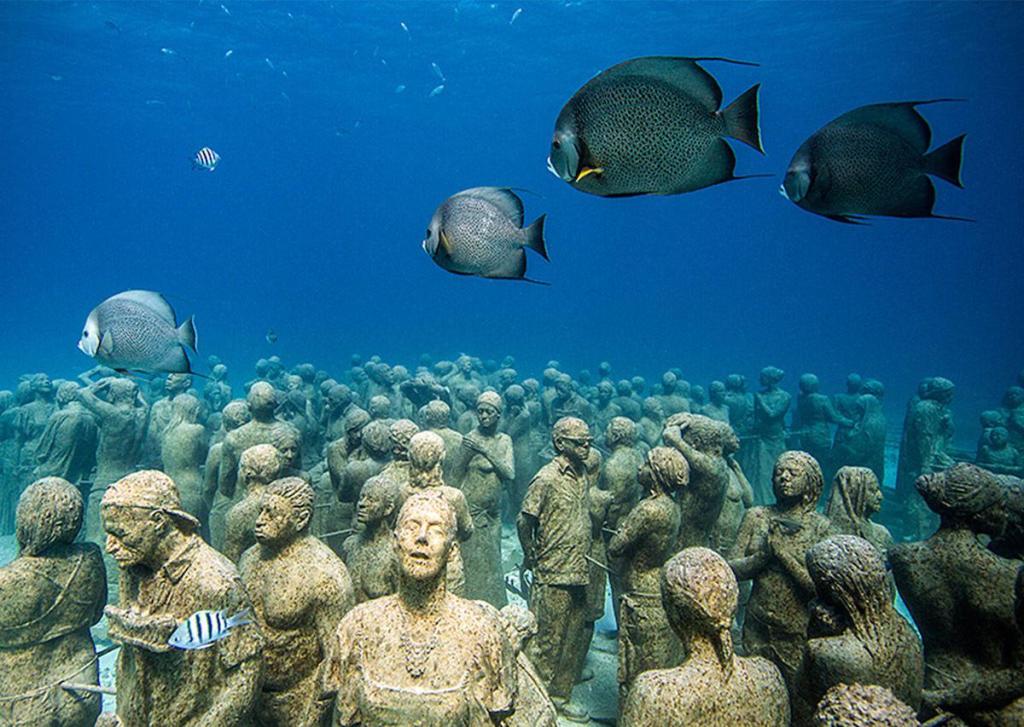
At the Museum of Underwater Art in Australia, underwater sculpture artist Jason DeCaires Taylor has created installations and beautiful artificial environments installations also lure divers and visitors away from the Great Barrier Reef, helping to protect it. 

4.Wetlands are biological super systems that store up to 50 times more carbon than rainforests. 40% of all plants & animals live and breed in wetlands and over a billion people depend on them for their living. We need to preserve our wetlands and our waterways to survive. The floating gardens is a project in Bangladesh to bring wetlands back to life using ancient Aztec traditions providing food, livelihoods and flood defences, combating impacts of climate change. 

5.The South African charity Waves for Change is a project offering surf therapy to children. By making the ocean accessible, children are learning new skills, and having a magical, life changing experience. 

6.Alejandro Duran, a Mexican environmentalist and artist, has created The Museum of Garbage and Washed Up, an installation and photography project using rubbish that washes up on Mexico’s Caribbean coast, a UNESCO world heritage site. His mission is to wake us up to the impacts of plastic pollution and consumerism. Alejandro and a team of volunteers found trash washed up from 58 countries and 6 continents.

How You Can Get Involved

1.Help to regenerate Sussex Bay by donating to the crowdfunding campaign. 

2.Volunteer with one of the Sussex Bay projects such as Sussex Underwater, the Sussex Kelp Project or the Sussex Dolphin Project.

3.Document wildlife sightings at the coast and get involved in citizen science. For more information, visit sussexbay.org.uk

4.Submit your idea. What’s your vision for Sussex Bay? Be part of the region’s biggest, boldest coastal collaboration ever. 

Contact hello@sussexbay.org.uk