


In the first in a new series, Andrew says “Yes” to volunteering
at The Real Junk Food Cafe. But first, table tennis was calling
As a boy, I was obsessed with table-tennis. I dreamed of competing at high levels but a career stopped in its tracks at the Shropshire Under-13 tournaments, where I was dumped out 11-0, by the eventual champion. A once promising career never recovered, and like so many other once promising careers, I hadn’t really thought about it since. But then, out of the blue, The Whistler called.
“Do you want to come to a night of table-tennis at The Fitzherbert Cafe?”
“Yes.”
I was in a bit of a swamp after the failure of a dramatically difficult project, dithering about the right way out, so this was perfect timing.
The Fitz Café is in Bristol Road in the St George’s Rd bit of Kemptown, right beside The Brighton Table-Tennis Club. Inside, I was warmly greeted by Tim, the club’s inspirational Head Coach, who proudly introduced me to Harry, who’s apparently the UK’s top ranked player with Downs Syndrome. He was smacking down backhand drives to Bly, who he assured me, would soon be a World Paralympic Number One.
I just knew he’d ask me to play, and I knew I would – I can’t refuse to do anything!] – but for now I felt shy, and ducked into the café.
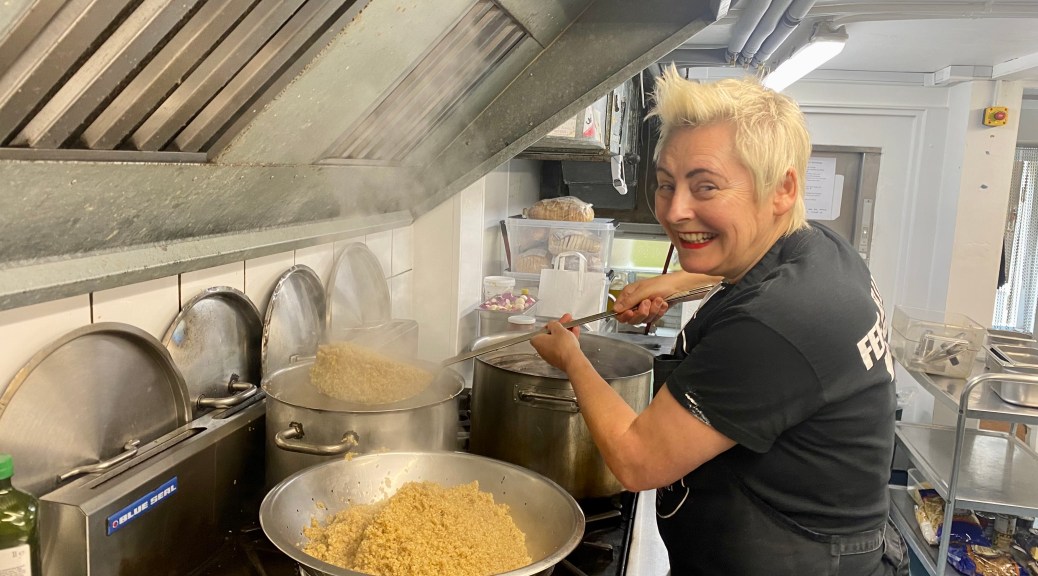
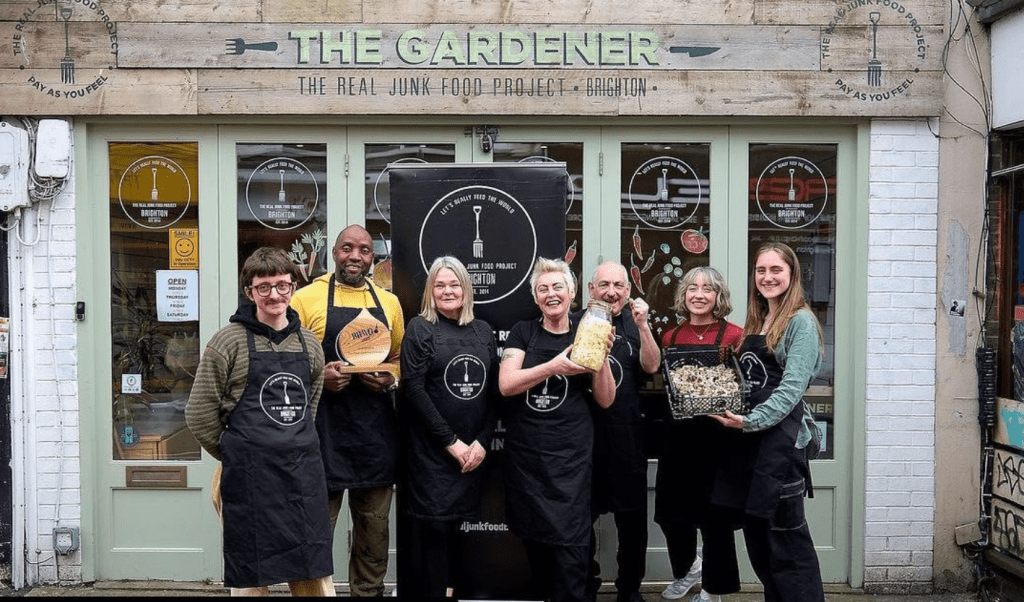
The Real Junk Food Project was set up in 2014 by Adam Buckingham, who would visit supermarkets, and allotments, picking up surplus, or almost-off food, which would be cooked to cater for a Pay As You Feel Café, where the richer diners – who want to eat delicious food, while doing some good – help to fund a community of people who might be rough sleepers, or just hungry.
Café Manager Kathy loves this element. “I used to help run a soup kitchen in Florida, and we’d turn hungry people away, since they couldn’t prove their credentials. The mix of people makes everyone feel good. You should come and volunteer!” I said I would, and came back the next day, when…
I started with Front of House, which basically means chatting to people. I sat with DJ and Rob discussing addiction. DJ’s been five weeks sober; Rob has gone 12 months without crack or smack.
“Wow,” I said, “I hear they’re quite more-ish!”
“That’s why I’m here!” he said. “It distracts me. Most days I volunteer somewhere, but here I just come for the chat!”
“It’s same for me,” said DJ, “I love that you meet rich people, poor people, sober people, street people, famous people, but also it’s incredibly good food.”
“Who’s famous?” I asked. “You’ll have to work that out, yourself!” he said.
In the kitchen, I met Jimmy, who was making Dauphinoise. “I worked in the music business, which can be all about ego and solo glory. I love that here, you turn up, you’re part of a team, and you feel you’ve done something. Plus the food’s amazing!”
I met Elodie, Head Chef, who’s worked in Michelin-starred restaurants. ‘But I prefer it here. You work with the ingredients that turn up, so it’s creative. Try!”
I sat down with Anna, who was beaming the room’s warmest smile. An Arabic woman, recently moved from Italy, she was with Voices In Exile – an organisation that helps refugees with food or toiletries or legal help. “I love to come so I can practice my English.” I smiled at her friends.
“You need to play table-tennis,” commanded Wadie, a Syrian refugee.
There was no putting it off, and, when you haven’t played ping-pong in 38 years, your game’s rusty. But four minutes in, he hit a ball high, and I thwacked back a backhand topspin. “Good shot!” said Tim, and I could see why his club’s so successful. It’s not just that the guy’s got skill: he takes an interest.
And suddenly there I was, playing doubles with Tim (former UK Number 8), against Wadie and Harry. I barely hit a good shot, but it was as Jimmy said: success is not about solo glory; it’s about being in a team; and sometimes you’ve just got to step up, and stay in the point. We won two games to one, and I left feeling connected and content and proud.
I went outside where I’d been invited to help plant a new tree, but it was on a slope, so the water was draining away. But this is the thing about volunteering: you find you can offer something.
“I know what to do here,” I said, and dug a moat around the tree. That’s how they taught me in Haiti.
“So what was your dramatically difficult project?” asked Deb, Head of Gardening. “I sailed the Atlantic, and I persuaded 1000 Caribbean kids, to plant 1000 trees.”
“So what was a failure about that?”
“Well,” I said, “I haven’t told anyone about it!”
“Well, you have now!,” said Tim.
God, I felt good about the whole day, and would urge anyone out there who’s vaguely thinking about it, to volunteer. Or just to get down to the Fitz Café, where if you pay for lunch, you’re paying it forward.
I’m now looking to volunteer for something else. So if you know of a community project, and wonder if I can join, you know what I’ll say.
Mrcloverthefamoussnail@gmail.com
l The Real Junk Food Project Brighton’s Community Cafe is now open at St John the Baptist parish hall, 2 Bristol Road BN2 1AP
Opening times:
Mon: 11.00-15.00 (lunch from noon)
Tues: Fri: 10.00-15.00 (lunch from noon)
Sat12.30-14.30
 The Whistler