Tag Archives: West Hill

Benita Matofska looks at Sussex Bay

I’ve long been fascinated by the wonders of our waterscapes and how vital ocean conservation is to our very existence. 70% of our planet is covered in water – from seas and salt marshes, to rivers and inland coastal waterways, these shape the land, the way we live, eat and breathe – they’re vital to our health, wealth and happiness and we need them to survive. When they thrive collectively, this is Blue Magic.

I grew up in land-locked Leeds and the first time I saw the sea, I was 18 months old and stood and stared and was silent for the first time. It was my first encounter and it would come to shape my life. 

Fast forward to when I was 10. Riddled with eczema, my parents took me to the Dead Sea. They’d heard about its healing powers and had been told that if you submerge yourself in the water for seven minutes, it can heal even the most damaged skin. Willing to give it a go I gripped his hands tightly and in we walked. The pain in my open sores was terrible, but I persevered and managed to stay submerged. Within three weeks, my eczema had cleared. It felt like a miracle. Nature’s minerals in the Dead Sea – magnesium, calcium and potassium – had worked their Blue Magic. 

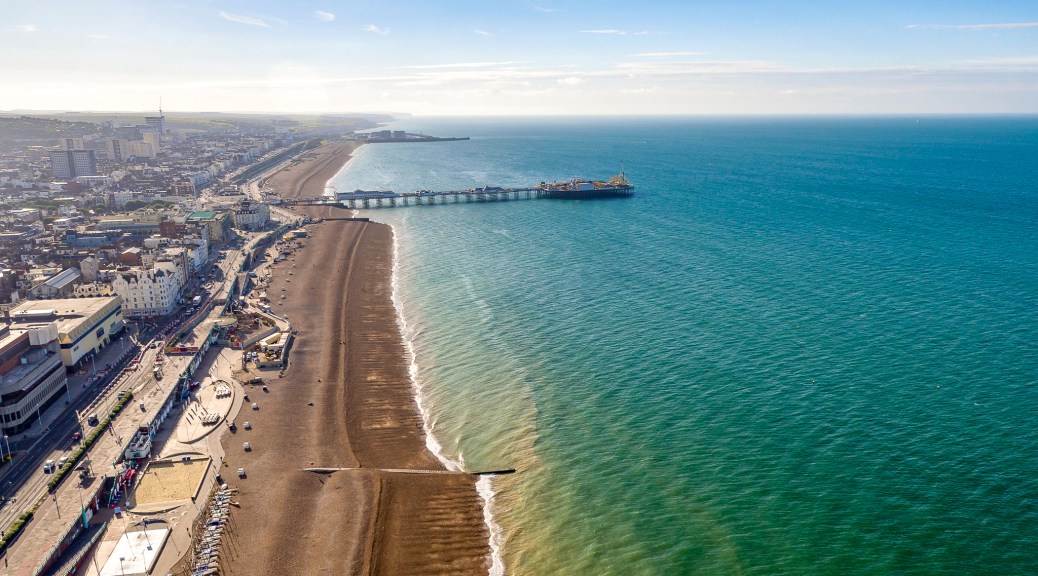
So what does all this have to do with us Brightonians? Well a new initiative called Sussex Bay is set to bring Blue Magic to our very own shores, so we can reap the benefits. Sussex Bay is a mission to regenerate, restore and revive 100 miles of our Sussex coastline. Paul Brewer, the Director for Sustainability and Resources at Adur and Worthing Council and Dean Aragon-Spears, Head of Blue Natural Capital are spearheading this incredible project. 

Dean describes Sussex Bay as ‘a movement initiated by Adur & Worthing Councils, powered by civic organisations, local businesses, communities and people.’ 

Through what they describe as ‘bold collaboration’ they aim to generate £50 million by 2050 to accelerate local seascape recovery along this incredible coastline – from Selsey in the west to Camber
Sands in the east including its river systems, coastline and marine area out to 12 nautical miles.

Sussex Bay came about after Adur & Worthing Council declared a climate emergency in 2019. Two  local projects inspired the next step: the Knepp Estate which has rewilded 951 hectares of farmland and seen massive increases in wildlife and biodiversity, and secondly the work of the Sussex Inshore Fisheries Association to introduce a 300 km2 trawler exclusion zone off West Sussex to restore the decimated historic kelp forest. If yoiu could rewild the land, why couldn’t you rewild the sea?

“There’s an urgent need to reverse the catastrophic decline in marine biodiversity.  Sea-based rewilding projects are far less common than those on land. The Blue Marine Foundation defines rewilding the sea as ​‘any effort to improve the health of the ocean by actively restoring habitats and species, or by leaving it alone to recover’. Healthy seabed drive a richer marine ecology, so when habitats recover so does everything that relies upon it. 

“Now more than ever we must bring nature back to our seabed, reefs and rivers. Restoring these ecosystems and their blue natural capital helps protect our coasts from storms, clean our waters, store carbon and support biodiversity.

And as nature recovers, people and the coastal economy will benefit too; from sustainable fisheries to enhanced health and wellbeing, and new commercial opportunities in ecotourism and leisure.” And that is magic. 

https://www.sussexbay.org.uk/

Benita Matofska is a speaker and author of Generation Share, a collection of 200 stories of changemakers.

benita@benitamatofska.com


Reasons to believe in the power of the seas
1.Globally, the Blue Economy is worth $1.5 trillion, provides over 30 million jobs and food for three billion people. And that’s predicted to double by 2030. A similar initiative to Sussex Bay is The Great Blue Wall, an African initiative to secure livelihoods for 70 million people, restoring two million hectares of ocean, capturing 100 million tonnes of CO2. The network of seascapes will be connected by a living blue wall that act as regional ecological corridor created by conserved and restored blue ecosystems such as mangroves, seagrass and corals.

2.Another initiative is Ireland’s Eco Showboat, the brainchild of Anne Cleary and Denis Connolly who travelled the coast of Ireland by solar powered electric boat on a zero carbon journey to connect scientists, artists, communities to spark climate action.

3.We’ve lost half of our coral reefs in the last 30 years and are estimated to lose 90% by 2050 because of climate change, pollution and over fishing. The better news is that scientists have found that marine ecosystems recover very fast and we can restore marine life by 2050 if we act now. 

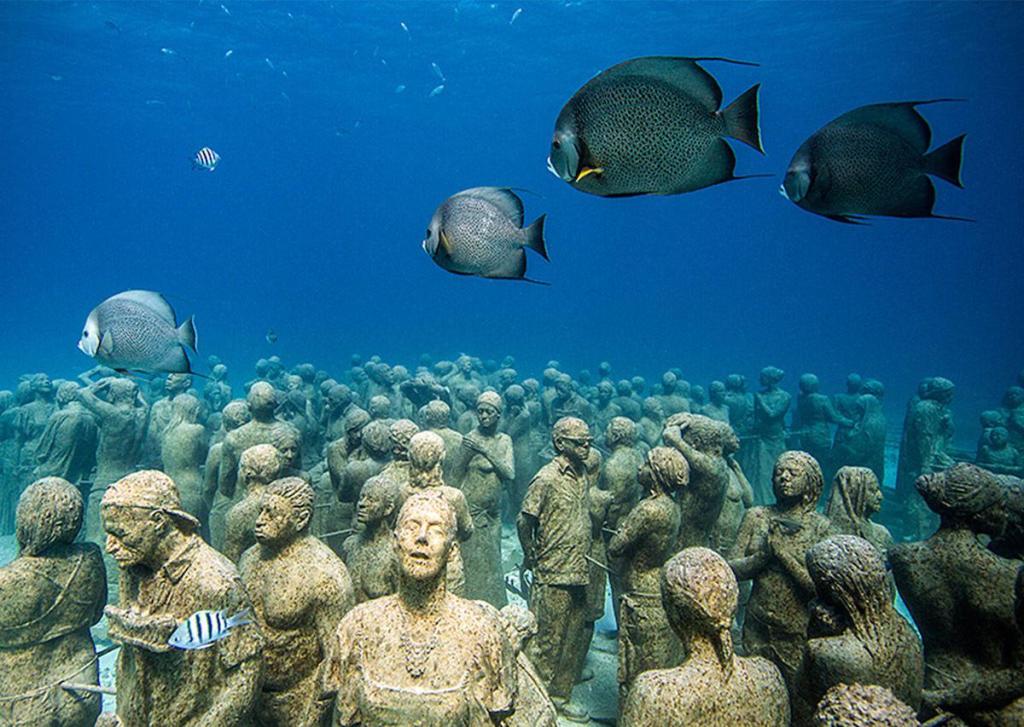
At the Museum of Underwater Art in Australia, underwater sculpture artist Jason DeCaires Taylor has created installations and beautiful artificial environments installations also lure divers and visitors away from the Great Barrier Reef, helping to protect it. 

4.Wetlands are biological super systems that store up to 50 times more carbon than rainforests. 40% of all plants & animals live and breed in wetlands and over a billion people depend on them for their living. We need to preserve our wetlands and our waterways to survive. The floating gardens is a project in Bangladesh to bring wetlands back to life using ancient Aztec traditions providing food, livelihoods and flood defences, combating impacts of climate change. 

5.The South African charity Waves for Change is a project offering surf therapy to children. By making the ocean accessible, children are learning new skills, and having a magical, life changing experience. 

6.Alejandro Duran, a Mexican environmentalist and artist, has created The Museum of Garbage and Washed Up, an installation and photography project using rubbish that washes up on Mexico’s Caribbean coast, a UNESCO world heritage site. His mission is to wake us up to the impacts of plastic pollution and consumerism. Alejandro and a team of volunteers found trash washed up from 58 countries and 6 continents.

How You Can Get Involved

1.Help to regenerate Sussex Bay by donating to the crowdfunding campaign. 

2.Volunteer with one of the Sussex Bay projects such as Sussex Underwater, the Sussex Kelp Project or the Sussex Dolphin Project.

3.Document wildlife sightings at the coast and get involved in citizen science. For more information, visit sussexbay.org.uk

4.Submit your idea. What’s your vision for Sussex Bay? Be part of the region’s biggest, boldest coastal collaboration ever. 

Contact hello@sussexbay.org.uk

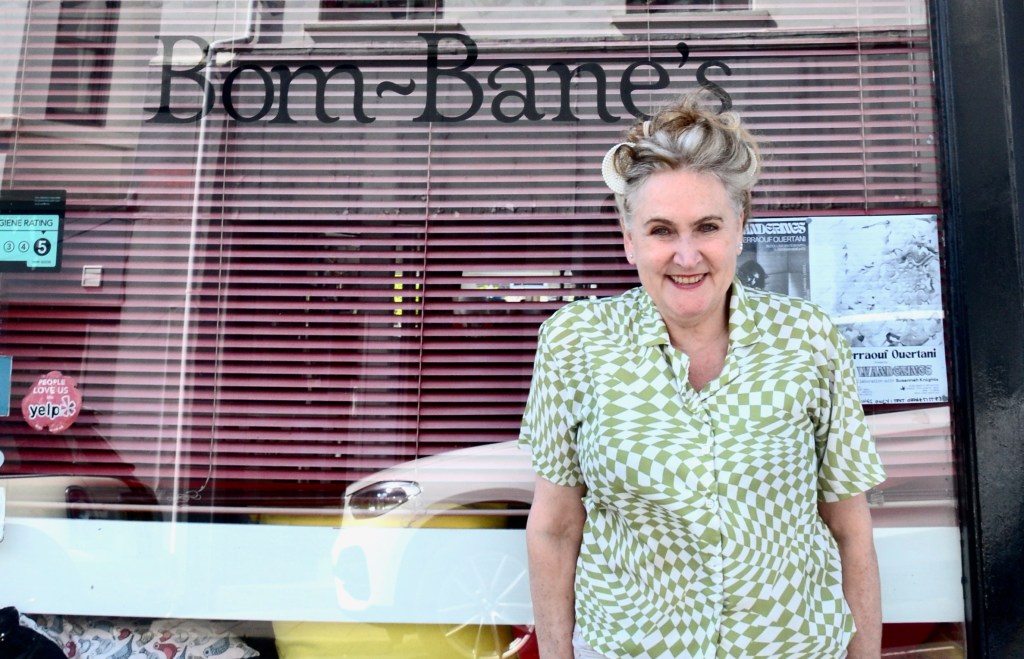
Peter Chrisp talks to Jane Bom-Bane

Jane Bom-Bane plays the harmonium while wearing beautiful mechanical hats, which illustrate her songs, such as ‘I’ve Got A Goldfish Bowl On My Head’. She had the idea to open a café while running musical evenings at the Sanctuary in Hove with her then partner, the multi-instrumentalist, Nick Pynn. After she bought 24 George Street in March 2006, they spent six months restoring the building and creating the café. 

“It was a wing and a prayer,” says Jane. “A lot we did ourselves. People who helped us were friends and gave us really good prices. For a lot of years after, we were giving people free sausage and mash.” Here she’s talking about stoemp and sausage, one of the café’s great Belgian dishes created by Andre Schmidt, the first chef. It’s still on the menu today.

Jane and Nick built seven mechanical tables inspired by table-related wordplay. These are the mirrored Tablerone, the Water Table (a model of the Palace Pier with working rides standing in a rippling sea) and two Aesop’s Tables, showing 1920s animal fable cartoons. The Uns-Table, the Turntable and the 27 Chimes Table all have delightful surprises which I leave to you to discover.

“Until the day before we opened, I still hadn’t worked out a way of putting water in the Water Table. I knew it had to be an oil because water would evaporate. I wanted a transparent oil, but the things I ordered on the net were yellow. And I was in Boots just around the corner and do you know what it was that I spotted? Baby oil! And that baby oil’s been in there for 18 years!”

The front wall of Bom-Bane’s has a bust of Jane with a revolving tray on her head with its own story to tell. Made in 2007 by her brother-in-law, Johnny Justin, it was stolen in 2012, later found in a student garden, minus its hat, and restored in 2017.

Go down the spiral stairway and you reach the basement, the main performance space, its walls covered with paintings and instruments. Although there’s only room for 25 people, it’s a room performers love. Stewart Lee, Bridget Christie, Jerry Dammers and Rich Hall are among the many who have played here.

Bom-Bane’s has a tradition of singing staff, beginning in 2008 with the waitresses Rosi Lalor and Candy Hilton, who Jane discovered were wonderful harmony singers. “I thought I’ve got to harness this, and so I wrote a musical. It was all about the café and how we cooked things, and how I got parsley and coriander mixed up.” 

This was the start of the Bom-Bane’s Family Players, who would perform a folk musical written by Jane every May fringe and at Christmas. These often used the whole building, with an audience of just five following a promenade performance from the attic to the basement.

Puppeteer Daisy Jordan, fresh from art college, joined Bom-Bane’s as a dishwasher in 2010, and soon found herself singing and performing puppetry as a member of the family players. Today she says, “I wonder if I would be a performer/puppeteer if it weren’t for Bom-Bane’s.” 

Isobel Smith, another puppeteer, had only made one puppet when Jane invited her to put on her first show here. Rosi Lalor, encouraged by Jane to write and perform her songs, has gone on to make two solo albums. 

To celebrate the centenary of the crossword in 2013, Jane turned the building into a big crossword puzzle, 5 Down and 20 Across. Her sister, the crossword setter Pegleg, wrote puzzles which were placed on the building’s 20 doors, which had all been turned into black and white paintings by different artists.

I painted one of the doors with the story of the explorer Sir John Franklin’s mysterious disappearance in the Arctic in 1845. By a curious coincidence (or Bom-Bane magic?), Sir John’s ship was discovered a year after I did the painting. This led to me hosting a series of Franklin Disaster Mystery evenings, with Arctic food, Inuit testimony, whale song and Jane as Sir John’s widow singing Franklin ballads.

The current chef is the singer-songwriter, Eliza Skelton. Unlike the waitresses who became singers, she was a singer to begin with. She performs here in the musicals, which she now co-writes, and as a member of the Silver Swans, a madrigal group with Jane and Emma Kilbey. She learned to be a great chef by working in Bom-Bane’s.

In 2008, Eliza and David Bramwell first staged Sing-a-long-a-Wickerman here. Audience members, invited to dress in character, were given a ‘Pagan Hymn Book’, which allowed them to sing along with the songs from the film. Eliza and David take this to festivals and theatres around the country, and still host Folk Horror film screenings in Bom-Bane’s. 

Today, Jane spends midweek with her mum in Coventry, and so the café is only open at weekends. It’s staffed by Jane, Eliza and recent recruit Kate Holden. Jane says, “Kate is helping me in the kitchen. She says she’s not musical, but I’m teaching her to play the guitar, and I think she can sing. Most people can sing.” That very evening Kate made her stage debut, accompanying Jane in a song.

We ended by talking about plans for the future. On the anniversary, 1 September, there’s a coming-of-age celebration, with 18 songs sung by Jane and her family of players. “There was a couple in last week who I got talking to. Somehow we got talking about when we first opened here and he said, “Was there anything that you planned to do that you didn’t do?” And I said “Yes, I wanted to make a tap with water music so that when you turned the tap on music came out with your water, but I never got around to it.” And he said, “I’ll do that for you!””

I tell Jane that I think the cultural impact of this little building has been massive. “When you look at it like that, yes, it’s been a springboard for a lot of people that normally wouldn’t do it. It’s because it’s so little and friendly, and that’s what Brighton’s like, isn’t it? It catches you if you fall.”

l Bom-Bane’s, 24 George St, Kemptown, BN2 1RH

For bookings email janebombane@yahoo.co.uk

https://janebom-bane.bandcamp.com

https://www.elizaskelton.com

https://www.daisyjordan.co.uk

https://rosilalor.bandcamp.com

Editorial – Sept 2024

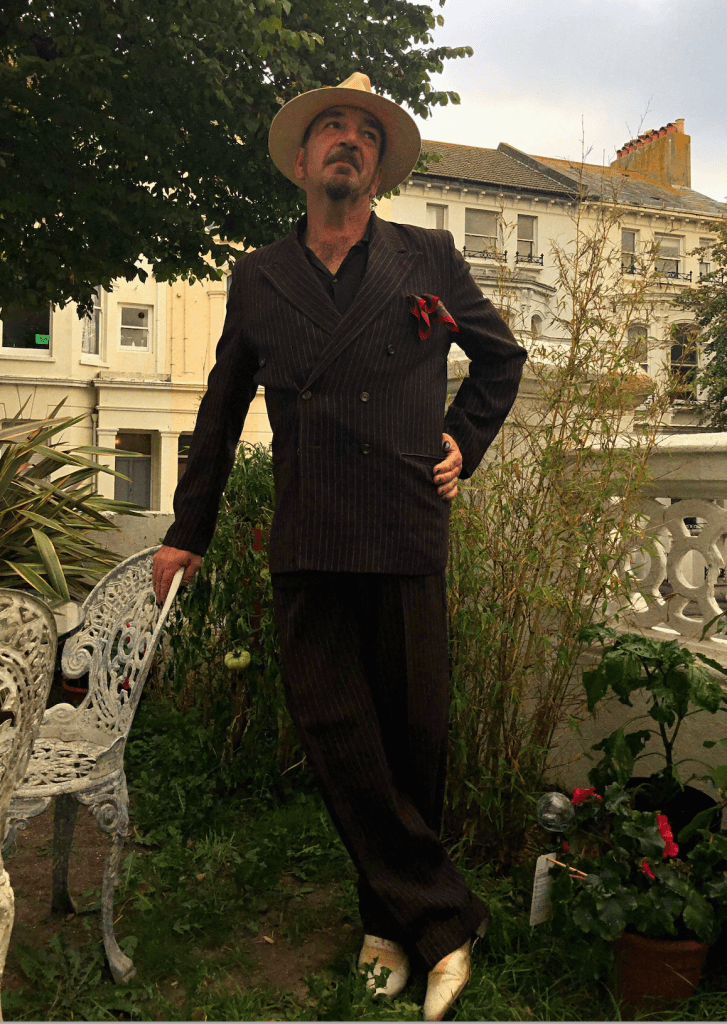
A long time ago, I was 14 maybe 15, I had a two tone suit. No, not two tone like The Specials, but proper two tone. Tonic, where the material is two different colour threads, cross weaved to create a beautiful shimmer. Tonic became popular with the original Mods and while I wasn’t that – I’m not that blimmin old – I loved the style. My suit was brown and blue tonic and was just beautiful. Later, I got married in a blown chalkstripe zoot, like Neal Cassady wore in On The Road. Still got that one

I’ve always loved suits. Always. Forties style, double breasted. Chalkstripe, not pinstripe. Louder the better. I was Bogart, now I’m more Melly. Sometimes though, standing out isn’t such a great thing. Not long ago, I was in That London on the tube. It was late. There was a group of four lads…

“Did you win, mate? Did you win?” one of them said, looking at his mates for the laugh. 

I just looked straight ahead. Didn’t engage. 

“The fancy dress competition mate. Did you win it?” he laughed, trying to up the ante. 

“No, I came second to some twat in high street jeans and trainers” I didn’t say, because while I’m well dressed, I’m not stupid. 

You don’t get that here. One of the things I love about being in Brighton is mostly I get “Dapper, mate” or maybe “Cool suit, fella”.  

I was thinking about this because there’s a shop in the ‘hood that sells clothes I haven’t got a clue about. I went past the hairy bikers shop and there’s a pair of mechanic’s overalls hanging in the window. What’s that about? I have no idea what that’s about. Is it a sales thing? Are you supposed  to buy them? Am I supposed to walk past and think “Mechanic’s overalls. That’s really cool. That’s what I want to look like”?  In fairness, I’m. guessing they’re vintage mechanic’s overalls. Maybe they’re selvedge mechanic’s overalls. We’re getting into some serious cloth now. Maybe it’s an aspiration thing. I wanna hang out where the guys in the mechanic’s overalls hang out. I have no idea. And you know what? I like that. I like that there’s stuff I just don’t understand. I’ve just had a rather spendid blue and white tartan linen suit made. Six button, double breasted, no vents. Proper. I’ve got a friend who’ll spend more on a pair of jeans than that suit cost to have made. A pair of jeans. I wouldn’t wash the car in a pair of jeans. OK, I don’t own a pair of jeans, but that’s detail. Curiously, the friend in question is also a biker. I make no judgement. 

Like I say, what I like about being here is that I can look really good and the bikers can dress on mechanic’s overalls and everyone’s happy. We all just get on with it. (I could get all Hallmark card and go off on one about how we’re a rainbow community, all different and yet all the same, but… let’s not). Actually it’s a bit odd because, in full disclosure, the bikers won’t talk to us. Their call. Different idea about community, I guess. Or maybe they do try to talk to us and we just can’t hear them over the very manly noise of their very manly bikes. (I never did get over my parents not getting me a Chopper)

Next to the mechanic’s overalls, there’s a lumberjack shirt. Can you imagine what the twat on the tube would say to that? 

Gardening Corner with Nancy Kirk – May 2024

Many of our properties in West Hill are Victorian or thereabouts and over the years, decades and centuries the soil has been enriched with all sorts of organic material. Many gardeners for the early part of the century would have incorporated vegetable peelings into the soil or sprinkled their borders with coal dust; one of my elderly clients regularly dusted the top of her lawn with coal dust claiming it kept the weeds at bay; I have no idea about the science of her decision, all I know is that her lawn was resplendent. 

Composting is a habit I gained in my 30’s when I moved from a flat into a house. I had tended to my communal garden in my flat, but all the decisions had to be made by all the freeholders, so the freedom to do as I pleased was new to me. Added to this, the local council was promoting it’s pledge to provide every garden in the borough with free composting bins. 

Getting a compost bin going to the hard part. It took years for me to work out a formula that worked for me. As my compost bins filled with grass clippings, prunings and raw vegetable waste I noticed nothing was happening, everything just sat there, belligerently not breaking down at all. I headed to the local library to mug up on the secrets of composting to find very little in the way of advice, but a visit to my father’s allotment answered all my questions and more. All the allotment folk had compost bins, and most importantly they had composters that worked and their owners were more than happy to show me the error of my ways.

Initially my new friends suspected I had plonked my compost bins on a hard standing, they explained that the worms need to be in contact with the soil; but I hadn’t broken this rule. Then they talked me through layering, and I was woefully guilty of this compost law. I would cut the grass and lob all the trimmings in one big heap, this was my first mistake. Thin layers of vegetable peelings, grass cuttings and pruned bits were required. Also my pruned bits and pieces were large branches of buddlejia, I needed to snip them down to hand sized pieces. The final rule surprised me, moisture. My bins were parched. As everything had dried out so much, just adding water was not going to cut it, as nothing would absorb the water quickly as it ran through to the soil. My solution was rather unpleasant but it really worked. I dug out a dusty old 1970’s blender which was hiding at the back of my kitchen cupboard and used it to store my vegetable peelings. When it was half full I would add water and blend the mixture to add it to the compost heap. The worms moved in and I never looked back. Once the internal temperature of the heap started to work there was no need for the blended mixture anymore. 

Here are the basic rules of thumb:

1.Always on soil, never on a hard standing

2.Think layers

3.Cut down pruned bits to hand size

4.Moisture. Try blending or mixing wet material with water to add to your heap

And the final hint I got for those wise allotment folk was male urine really helped get things going; I’m not going to publicly endorse such a thing because our gardens are so small. You didn’t hear it from me.

Composting is an art form. Every compost heap is different, but the pure gold it produces will continue to enrich our soil for the price of a small receptacle, so isn’t it worth a go?

Nancy Kirk is a gardener who provides bespoke gardening lessons in your own garden. Packages start at £250. Contact westhillgardenoracle@gmail.com for details 

Heaven Scent

Perfume correspondent Ceri Barnes Thompson goes to Solifiore and finds out perfume isn’t just about smell, it’s the door to memory 

“There’s no-one you can’t talk about perfume with”, said Sarah when I went to visit her in Soliflore, her lovely new Seven Dials store. It was a beautiful crisp early spring day, the deep green of the shop front vibrant in the sunshine, the original glass of the huge old windows sparkling like the little scent bottles sitting behind them.

Soliflore opened on Bonfire Night after Sarah completed a full renovation of the old premises. Peeling back the layers at the start of the shop-fit, the original dark green tiles of the original grocers shop of decades before were uncovered and her graphic design eye spotted the inspiration for the colour that is the trademark of the new shop. 

You could say a perfume store is indulgent in a cost of living crisis. But is it really? Perfume offers up connection to our stories and our memories. The name ‘Soliflore’ represents the idea of a single floral aroma – a fragrance built around one particular flower but which delivers different layers of meaning and interpretation depending on who is smelling it. As Sarah says, you can smell a particular scent and you are taken without thinking back to a place in time, the Proustian rush effect. For me it’s sitting on the bath watching my Mum get ready to go out, the smell of her Balmain perfume “Vent Vert’’ just about beating the smell of Elnet hairspray. 

Her mother, Mimi, owned an art gallery when Sarah was little and memories of those times which shaped her love of conversation and connection have her taking it all in, watching and listening. Then at home, evenings and weekends brought buyers and sellers to their house, artists bringing pictures, negotiations, joyful chatter soaked up. Mimi was mesmerizing to little Sarah. With her purple eyeshadow and Clinique’s “Aromatics Elixir” wafting in her wake she held a room. But it didn’t stop there – Mimi’s bathroom cabinet was a treasure trove of bottles and boxes which Sarah would open and marvel at, picking up and holding the lovely vessels imagining herself as a grown up, groomed, sophisticated, smelling amazing.

Having her own shop was always Sarah’s dream but she opted for a ‘proper job’. Finding herself gazing out from her office to St Martin’s School of Art realising she really didn’t belong behind a computer with spreadsheets. Retraining as a graphic designer, she worked in live music for a while and then took a job as a stylist for Body Shop. When the pandemic hit, Sarah contracted long covid and returning to work after four months, she realised that something had shifted in her and she no longer had the tolerance for creating by committee. A good friend encouraged her to leave: “Jump and the net will catch you!” he said, so she did.

 Free as a bird and casting around for ideas a friend asked her to do Christmas cover at the perfumiers, Jo Malone. Years before, her very first boss had gifted her a bottle of ‘White Jasmine and Mint’’ and she remembered the joy of having that in her hand-bag. So she took the temporary job and found her happy place. She would stand on the shop floor surrounded by scents she knew the layers and detail of and enjoyed every minute of her working life. And she was very good at it. 

‘’It was never selling, it was a conversation’’ she says now, standing on her very own shop floor. And that’s the experience of anyone entering her space. I first visited just as she’d opened and left 20 minutes later having talked non-stop about the memories conjured up as you open each of the beautifully creative scent tins on the counter that contain scraps of silk to carry the perfumes for you to smell before trying on your skin. One of them stopped me in my tracks and took me straight to my mum; fresh green grass and freesias. Sarah talks about people moved to tears sometimes by the scent memories conjured up there. 

I

 thought I’d try out a theory about people’s perfume memories, asking friends whether they could remember what their parents wore when they were little. The replies flooded in -‘Anais Anais’ in that little white bottle, ‘Miss Dior’ ‘Number 5’ ‘White Musk’ ‘Charlie’ “Tramp’ ‘Rive Gauche!’ in the black and blue metal case and of course ‘Old Spice’, ‘Brute’ and ‘Aramis’. Funny stories too rolled past – one friends mum stopped wearing a scent when she found out Margaret Thatcher also wore it.

Perfume for Sarah is an essential piece of getting dressed so that whilst Chanel’s “No5” is ever present for her, she’ll curate the layers on top of that depending on how she wants to show up in the world. Perfume can change your mood, she says, just like a song but it can also effect how you’re perceived in the world – you can, depending on the scents you wear, reflect your sophisticated, playful, complex, refined sides. 

Sarah wishes she’d known years ago the level of work and dedication that independent shop keepers devote to their businesses as she’d probably never have bothered with a single chain store in her life. “I’m the tester, the buyer, the designer, the financial manager, the seller, the cleaner, the social media strategist, the future planner, the negotiator with the council, the publicist. But I wouldn’t have it any other way”. 

She has great plans for the little shop. She tried over 400 scents before stocking it with small batch perfumes – often in smaller sizes and more affordable because she believes we need ‘perfume wardrobes’ giving us a choice depending on how the spirit moves us. She sells hand-made stationary too from local artists, another of her passions. Sarah’s determined that Soliflore will be part of the heart-beat of the local community that she loves. She’s created ‘Soliflore Social’ to offer events for local people to get involved, gather and enjoy. Scented hot chocolate nights as well as visiting perfumers who will share their knowledge and passion. Like she said everyone has a story about a scent, it’s part of our connection to each-other and to our world. And these little independent stores offer us a warm welcome with that at their very heart. I for one won’t be going to Boots for my perfume. 

Soliflore, 64 Dyke Road BN1 3JD