Tag Archives: Women’s football

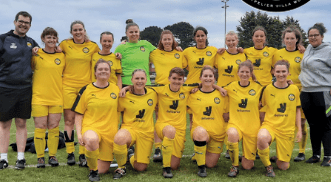
Skip Kelly – Hope Hawkins – Dec 2023

Recently at a game that had all been decided but for the final whistle, I was keen to share the knowledge I had acquired about the opposition and pointed to one of the players and revealed they had played in an FA Cup quarter-final. Hoping that this would give our team some solace in being on the receiving end of a team with some well-established pedigree, I was instead stunned into silence when one of our substitutes responded. “So what? so have I.”

This same person was responsible for ruining Christmas a few years ago when, as the opposition manager as well as their goalkeeper, they masterminded a 1-0 win over Montpelier Villa. It wasn’t a great day. I wasn’t happy. That all changed when we needed a goalkeeper. I put all that in the past, forged a new relationship and since then I’m pleased to say we’ve had some more Hope in our lives. 

“I feel special,” said Hope Hawkins when I said I wanted to interview her. Hope belongs to the generation of female footballers who’ve thrived and played at the highest level despite all the barriers and obstacles. 

“I remember playing football with my cousin who was football mad. There wasn’t a fence between his and the neighbour’s back garden so we used to use all of it as a big football pitch and breaking all my aunt’s plant pots and we also had to make sure we didn’t disturb my uncle’s pigeons. He was a couple of years older than me and he never went easy on me so he taught me a lot.”

Hope does humilty well. When I point out that she played at the Withdean Stadium in an FA Cup Quarter-Final against Arsenal, managed AFC Varndeanians there as well as hosting ourt recent FA Cup exit, she said “it’s also where I fractured my ankle,” 

Despite winning multiple leagues and cups with Brighton and sharing the pitch with a star-studded Arsenal side that included former England captain Faye White, Hope said she doesn’t get excited by winning trophies. 

“Winning leagues and cups is nice but when I think of my best memories it’s the friendships I have made that have lasted years although I remember the first team I joined was an all-boys team with my cousin, I wasn’t allowed play any matches because I was a girl even though I was one of the best players there,” she said, allowing the humility to slip for a second. “They let me play a friendly at the end of the season and I took a free-kick. It hit the crossbar. I was devastated it didn’t go in.”

Hope played for Hollingbury Hawks, Brighton, Rottingdean, and was player-coach

at AFC Varndeanians before reverting to a player once more at Montpelier Villa where she recently announced her retirement but as she points out, this will be the third time she attempts to retire. On this occasion it has come on the back of doctor’s advice but as always Hope has not taken too well to being told what she can’t do and has arguably defied expectations for longer than she should have for the benefit of her team. 

Hope made a brief cameo in the game I mentioned at the beginning of the article. The injuries sustained over a long career of always putting the team first finally catching up with her and although it wasn’t known at the time, this was the last time Hope would play football. 

Despite all, the enthusiasm and love for the game shines through. Hope struggles to contain her delight in describing the makeshift football pitch she shared with her cousin surrounded by pigeons and plant pots. For Hope, it’s never been about the trophies, the stadiums, famous players she’s played with and against. It’s been the lifelong friendships that will outlast all football careers but more importantly than that, it’s been about proving people wrong. 

Hear the Lioness roar

Skip Kelly, coach of Montpelier Villa Women, explains
why women’s football has transcended nationalism

It’s hard to predict the future, and what I’m about to write could come back to haunt me. For a man with a name like mine and a background like mine and a cultural upbringing like mine… Are these the words I’m commiting to print in the finest local magazine to be read by millions? The words that will finally see me charged and convicted? 

I like the English football team. No, not that one. Let’s not get carried away. The English football  team that puts a smile on your face. It’s been another incredible summer for The Lionesses and many of you will wonder if I am referring to the Lionesses of Singapore or the indomitable Lionesses of Cameroon or the humble, but local English Lionesses. 

This summer was spent reacquainting ourselves with women’s football teams from around the world such as the Super Falcons (Nigeria), The Reggae Girlz (Jamaica) and, of course, The Girls in Green (Ireland).

Nationalism is one of those concepts like organised religion or low emission zones that emits a guttural reaction ignoring the sometime possible benefits. Such as laughing at your neighbours when they are knocked out of international football tournaments. 

Like all those concepts, it’s often the subtlety that provokes shock – and Irish nationalism is no different. After sitting through a school curriculum that had the Gaelic language as a compulsory subject until the age of 18, a history syllabus that taught the wrongs of imperial nations in far flung places like India and Congo, the litany of English football failures serves as a small serving of revenge every couple of years. International football doesn’t allow for nuance and it was always a joy to watch England lose at anything. 

It was suggested that the Australian team – the Matildas – success in the World Cup was the culmination of a co-ordinated online media campaign that itself was a response to the traditional media that supposedly reflects what middle Australia think and espouse good old-fashioned traditional Australian values had for a long time taken a dim view of women’s football. The Matildas were successful because they weren’t seen as representing good old-fashioned Australian values and good old-fashioned Australian morality – they were just seen as Australians. 

I heard this argument and thought it reflected precisely why I found the Lionesses easy to like. The Lionesses had names like Niamh and Mary. Surnames like Daly, Walsh and even Kelly. My initial resentment was at their refusal to declare for Ireland but that has slowly but surely subsided when I realised that these surnames are no longer considered de facto Irish names. 

The Lionesses and The Matildas have somehow transcended nationalism in favour of a more inclusive world for all of us. One that seeks to include rather than exclude. And it’s really hard to root against that, especially when you see first-hand the impact it has on people who’ve previously felt uncomfortable in their own sexuality. Those who felt they had to be in a metaphorical closet now get to see openly gay athletes being celebrated for their athleticism. 

I’m fortunate enough to have a front row seat to this at Montpelier Villa. Our players have always been footballers first, and yet I see how much it means to players when they wear rainbow laces or put up Pride flags at our matches. Our little football team is one of many  that has subverted what’s expected of a ‘traditional’ football team. 

The only court I will be convicted in for liking another football team is the one of public opinion. In the most extraordinary act of self-sabotage ever seen before this court, I would like to present the footage captured by the BBC immediately after Chloe Kelly’s winning goal last summer. Although it’s not clear initially, I am featured in the crowd shot, and I can be seen celebrating wildly with 90,000 others . . . And, yes. I’m wearing my emerald green cap. 

Another tale told by an idiot?

Skip Kelly, Montpelier Villa Women’s own Ted Lasso, has an existential crisis

In my role as a football coach, I’m far more inclined to think about who’s going to follow in my footsteps not from an egotistical point of view but rather an awareness of how quickly institutions can change and how if that isn’t managed correctly you end up with Frank Lampard in charge. Or Sam Allardyce. 

In my role as an educator I occupy a classroom that’s much older than I am and although my name may not adorn the door frame, it is colloquially known as my room. I often think of the educators who claimed ownership of that room before me, and how there’s no record of that beyond the memories of the students who sat there. The conclusion I often draw is that no matter how important you think you are at the time, life goes on regardless. “Out, out, brief candle!”

When I first became the coach at Villa, I was reluctant because I was convinced there were better female coaches than me. Nothing since has dissuaded me from this view and I can now name people who are better coaches than I am but the sidelines in women’s football are still populated by people like me. 

It’s no coincidence that women’s football has grown exponentially since I became involved with it. However there are attitudes that still exist where coaches see womens football beneath them which in turn leads to a reduced talent pool in the coaching side and means a lot of womens sides are in the position of hiring substandard coaches. 

This isn’t a reflection on the many volunteers who give up their time, energy and often money to facilitate football for the growing womens game but rather a comment on the likes of the NWSL abuse scandal which led to five coaches resigning because of a systemic culture of sexual harassment and abuse, it’s a comment on the fact that this led to both the Venezuela and Australia national teams spoke about the abuse they had encountered and finally a question that if it can happen in these national organisations then what’s stopping it from happening at grassroots level? 

This isn’t a letter of resignation but the person that follows me needs to be capable and needs to ensure a safe environment for all who play the game. I have no doubt that our squad will be able to adapt to these changes when they come and appoint someone more capable than I am, however I am concerned about the apathy that still exists in some quarters to womens football which ultimately leads to horrendous experiences for people. 

Sinead Farrelly is likely to play for Ireland against Australia in the World Cup this summer, that in itself isn’t noteworthy but the fact she is coming out of retirement is. She retired at the age of 27 and now at 33 arguably lost her best football years struggling to deal with the trauma of being sexually coerced by a coach. How many other players have had to deal with similar issues and miss out on the game they love because of people abusing their power? 

Solutions are difficult but perhaps the FA could lead the way and make spending time in the women’s game mandatory for any aspiring coaches who want to coach in the professional game. This would have the effect on certain dinosaurs that these people are individuals who are impacted profoundly by what their coaches say and do. 

Not for the first time, women’s football is growing at a level that no-one is prepared for and decisions that will be made over the next few years will have impacts that will be felt for generations to come. 

What football as a whole can’t afford to happen is this story to be “a tale told by an idiot full of sound and fury signifying nothing.”