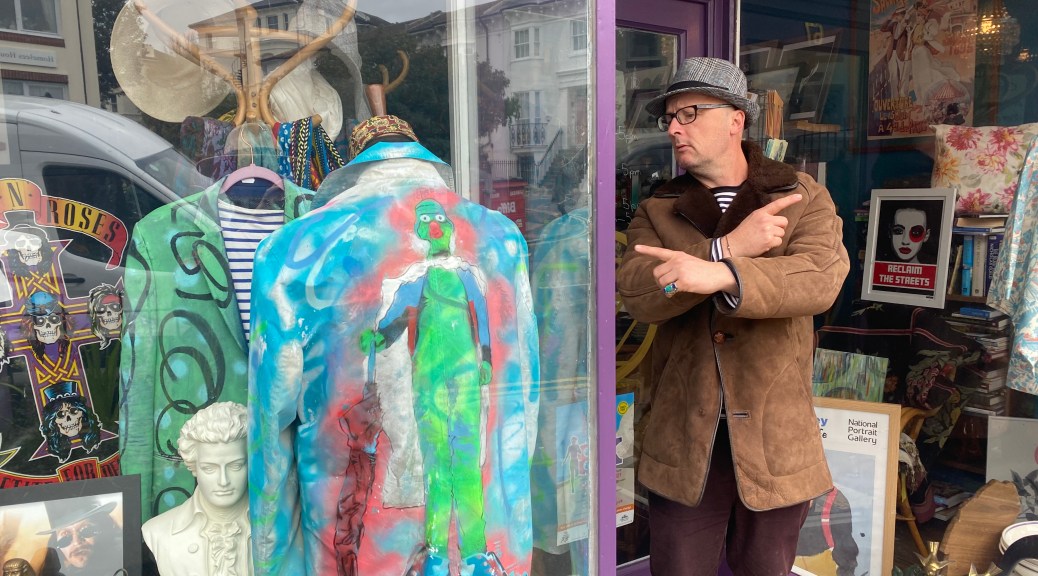
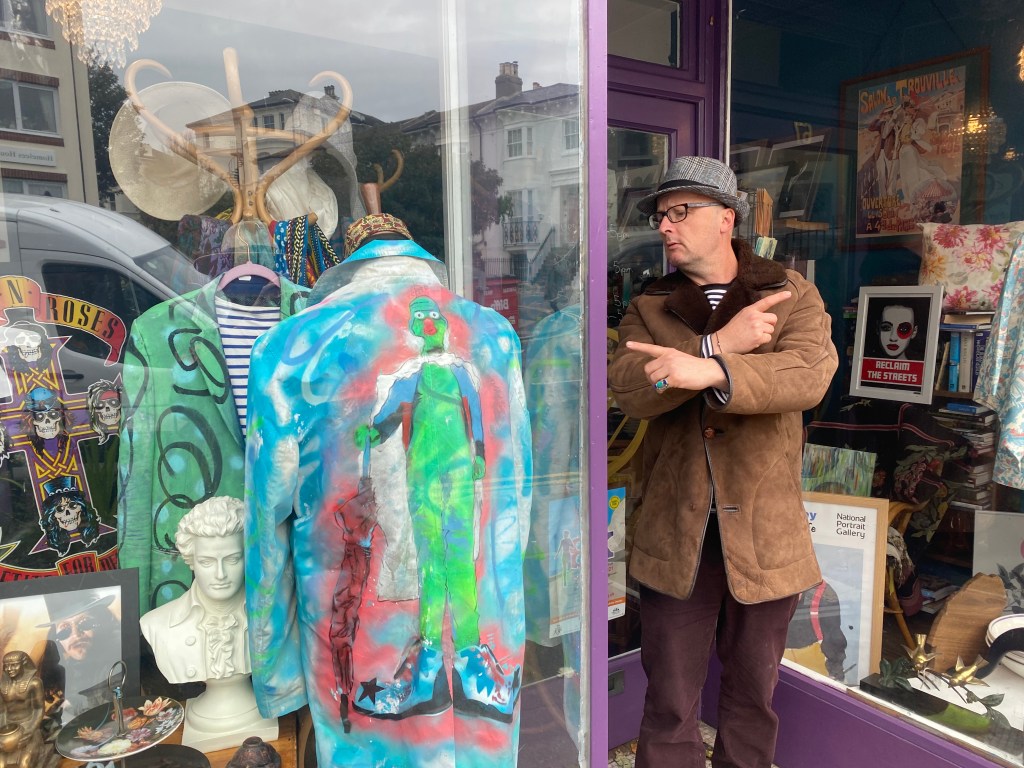
How to describe Matt Whistler? We could play it really straight and say he’s an artist. Or a performance artist. We could say he’s a comedian. When I asked him he said “Say I’m a modern day Charlie Chaplin. An eco clown. A walking artwork.” It might just be easier to say “all of the above”. A mischievious comedian with a creative free spirit. But if you scratch the surface there’s a serious message about the environment and waste.
“It pains me to walk past things that have been discarded. I just look at them and thing “What can we do with that?” (We met Matt outside Objet D’ials during the last / worst days of the bin strike and someone had left a huge pile of flattened cardboard boxes next to the throbbing pile of bin bags.
During our chat, he’d created a gallery exhibition of them, a sculpture, there was an idea to line the pavement with the cardboard and slogans and… Did any of it happen? Some of it, maybe all of it, maybe none. It doesn’t matter. There’ll be another idea along in a second. Talking to Matt is like talking to the little silver ball inside a pinball machine.
Matt’s recent projects have ranged from painting an old locomotive near Glastonbury, an exhibition of his dot-based work (“I don’t know what happened but I broke through to the other side and I haven’t stopped doing dots since”), a cafe in the Marina (“I went for a coffee there and just thought ‘Hold on a minute, there’s a canvas here. There’s a cafe in a really nice area next to the sea’…”) and a project involving painting – breathing new life into – the covers of hundreds of albums he found in a skip.
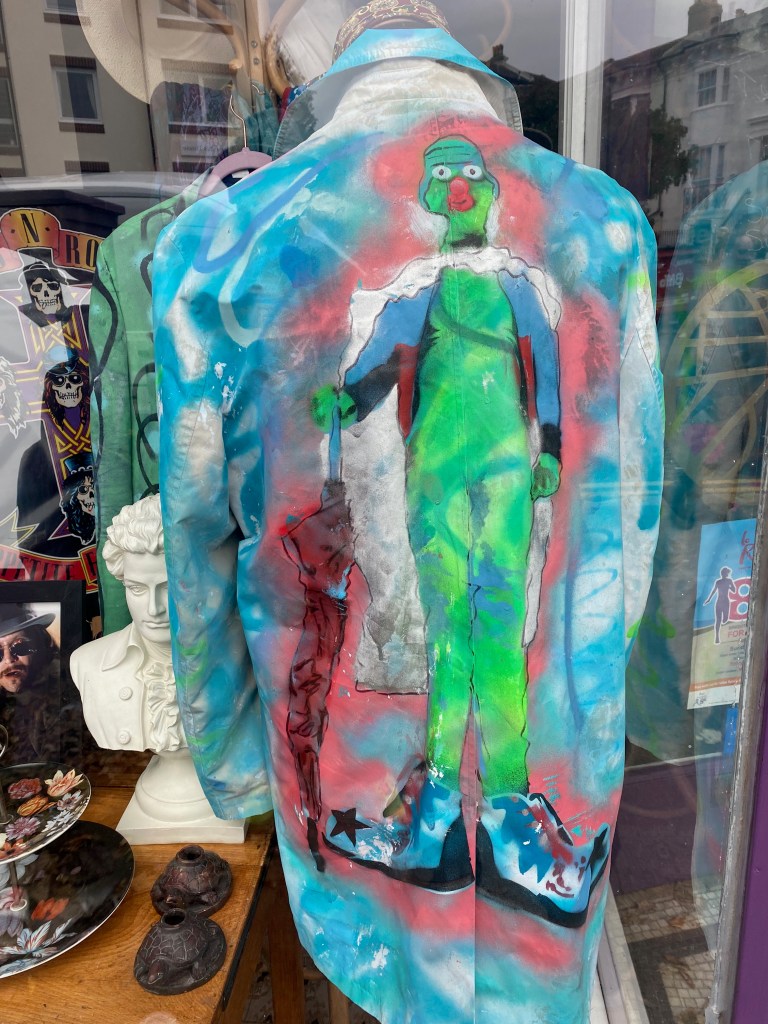
But it’s as his latest creation Artist Dotty that there’s most fun. An oversize character in a whose looks nod in the direction of Leigh Bowery but who, like so much of Matt’s work, treads the line between absurdist and message. Dotty has a habit of appearing where you least expect him. Right now you’ll find him on the back of a series of jackets in “Objet D’ials”.
Is Dotty a classic absurdist device to created to highlight the madness of our society – in this case, waste and the environment – or a very strange bloke in a green screen onesie? “Let’s say an eco clown whose job it is to make people look, laugh and maybe think.”
Rabindranath Tagore was a Bengali polymath – poet, philosopher, novelist, Nobel Prize winner… and resident of our fair city. And now there’s a plaque marking his life. Dr Jeanne Openshaw looks back at his life and times
Commemoration of Rabindranath Tagore in our city has been a long time coming. To state the obvious, a plaque needs a wall, and searches in local street directories and Indian archives for the Tagores’ precise home address have long drawn a blank. The solution was to switch focus to the school he attended, aged 17, in Ship Street (now part of the Hotel du Vin).
Rabindranath Tagore was a world-renowned polymath – poet, philosopher, novelist, visual artist, composer and activist. Born into a talented and cultured upper-class family in Calcutta (now Kolkata), India, with extensive estates in what is now Bangladesh, he came to embrace humanism and universalism.
He transformed Bengali written and visual culture, and in 1913 became the first non-Westerner to win the Nobel Prize for Literature. He was knighted by George V for his services to literature, an honour he later repudiated, in protest at the Jallianwala Bagh massacre in Amritsar.
A strong advocate of freedom from British rule in India, he nevertheless argued: ‘Patriotism cannot be our final spiritual shelter; my refuge is humanity. I will not buy glass for the price of diamonds, and I will never allow patriotism to triumph over humanity, as long as I live.’
Much later, two independent nations, India and Bangladesh, were to select Tagore’s song lyrics as their national anthems.
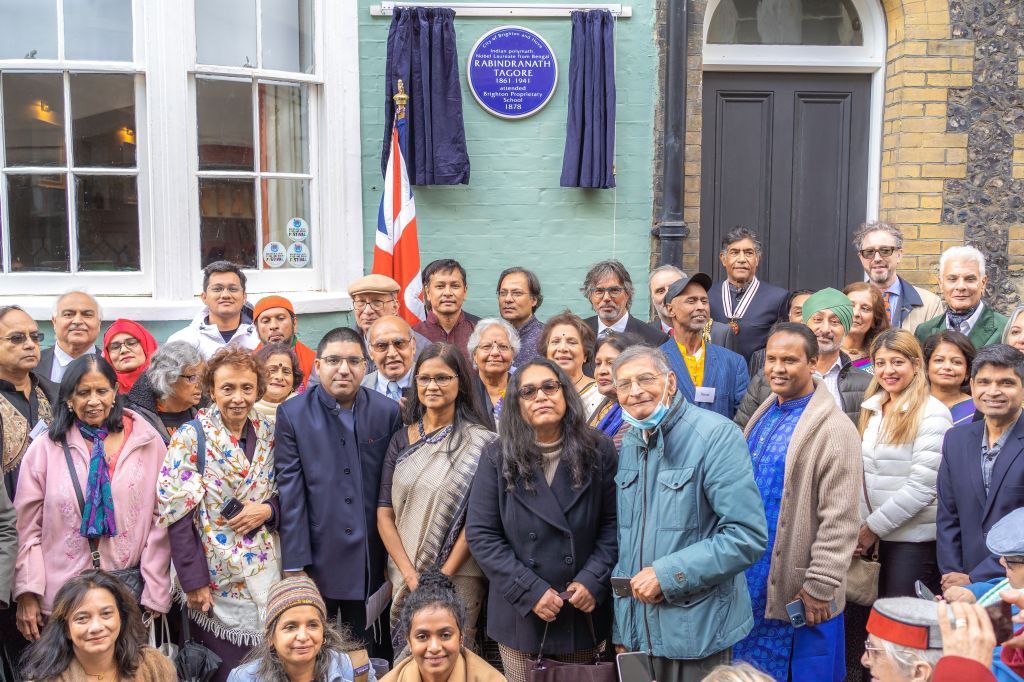
When the plaque was finally unveiled on 28th October, 7 Ship Street was accordingly festooned with three flags, and the Salvation Army played three national anthems.
Over 200 people turned up to the unveiling. But not, unfortunately, the High Commissioners of India and Bangladesh. COP 26 had claimed their presence instead. So the event was quieter than expected, although the seagulls tried to make up for that. The weather smiled on us – wind and rain held off until the following day.
Tagore was one of the most travelled persons of his time. However, the first place he lived in outside India was Brighton and Hove. He later wrote:
One thing in the Brighton school seemed very wonderful: the other boys were not at all rude to me. On the contrary they would often thrust oranges and apples into my pockets and run away. I can only ascribe this uncommon behaviour of theirs to my being a foreigner… (My reminiscences, translation from Bengali published in 1917).
On the day, Dr Kalyan Kundu, Tagore Centre UK, spoke about Tagore’s early schooling (or rather lack of it), and his first impressions of Britain.
Professor Shahaduz Zaman, University of Sussex, provided a Bangladeshi perspective. For Bangladeshis, Tagore is associated with the 1971 struggle for independence from Pakistan, and the new nation’s emphasis on Bengali language and culture.
Tagore’s descendants in India sent a touching email to all present.
A reception was held in the domed school room inside no.7 Ship Street, appropriately decorated with images of Tagore with various luminaries, as well as prints of his paintings, provided by the Tagore Centre UK. Songs by Rabindranath were performed by Mamata and Sunith Lahiri, also from the Tagore Centre.
Our neighbours, Vinod and Meena Mashru (of Bright News, Buckingham Road) provided vegetarian food and non-alcoholic champagne. Noori’s restaurant – across the road from the plaque – supplied the non-vegetarian Indian food. The Hotel du Vin provided ‘western’ food and drink (non-alcoholic on this occasion).
Credit is due to Brighton and Hove City Council, especially the Brighton and Hove Heritage Commission chair (also chair of the Brighton and Hove Commemorative Plaque Panel), Roger Amerena.
This issue’s history column comes from a more recent era as Mister Adam spends two and a half decades window shopping…
Brighton’s history isn’t just a distant past of fisherfolk, seawater pox doctors, dandy princes and Victorian machine heads. For many locals, sharing reminiscences of “back in my day” with contemporaries or descendants is far more interesting. This writer moved to Brighton in the autumn of 1996 so I’ll have lived here for exactly a generation (25 years) when this Whistler lands in your Inbox.
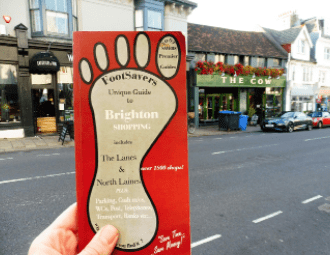
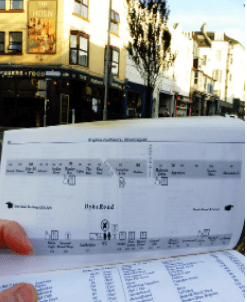
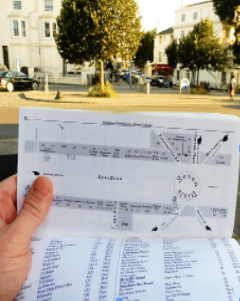
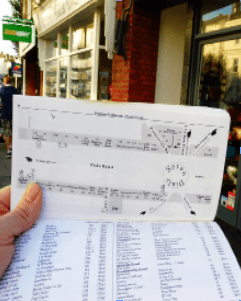
Handily, the first thing I bought after moving down was the FootSavers Guide to Brighton Shopping. This quirky book consisted of maps of major commercial streets with the name and category of every shop and service along them. So last week I dusted it off, turned to the Dyke Road section (a perfect snapshot of the area a generation ago) and walked the same route looking out for changes.
FootSavers covers from what are now Parker Kitchens and Hi Cacti up to the Good Companions and Ridgeland House. Other than Dyke Road, only the Post Office and shops on Prestonville and Chatham feature. I’m not sure what criteria the 1996ers used re client facing offices, but my modern comparison includes any with visible signage, eg Close Brothers and Austin Gray. Retailers that straddle two categories (hi Sawdust and Puck) I’ve counted towards whichever element dominates at street level.
The 65 shops and services from a generation ago drops to 62 today. Double-sized stores such as Kindly and Magdusia are probably the main reason. Building works at 107-109 are offset by a hairdressers and veggie café where the mid 90s had (locked) public toilets. Fourteen names from 25 years ago remain, a few slightly shifting location or focus: Fullerton’s, Tinker’s, Ashton’s, Parker, Berry, Jasmine, Uden, Just Gents, Curry Inn, Dial-a-Pizza, Seven Dials Flowers, the Good Companions, Coop and Post Office.
This resilience demonstrates the area’s community spirit and nature, although the online era has shunted out a few store types. Say goodbye to all our video libraries and banks, for example. The supermarkets and corner shops category is up by one and several of these are now physically larger. By the way, if you’re puzzled by the area having two Coop stores in such close proximity, look at the colour of their branding. Blue ones are owned by Coop itself, greens by a local co-operative – as strange as it seems, they’re technically competitors!
One of the biggest gains is in places to eat and drink, be that takeaway or inside, which have jumped from a total of 14 to 19 venues. It seems the biggest factor here is that the modern Dialler drinks a helluva lot more. This is particularly true of bean-based beverages with coffee shops and bakeries (which, let’s be honest, are just coffee shops with slightly more crumbs in their beard) springing up where once lived an opticians, TV repairer and building society.
That’s not to say grape-based drinks miss out as we now have more wine bars, bottle merchants or whatever the hip name for them this week is. As for pubs, it’s a common lament elsewhere in Brighton and beyond that many have been turned into supermarkets, eg the St James’s Street Coop usurping a former Tin Drum bar. All hail Seven Dials then for somehow reversing this trend. The Cow, which was also a Tin Drum in recent times, was actually a Happy Shopper supermarket back in 1996.
As for specialist retailers, this is the time of year when people are encouraged to shop locally for Christmas rather than feed more money into tax dodging online behemoths. So how will going on a local present buying spree differ from a quarter century ago? If it’s clothes or second hand fare you’re after, not too well. Both categories are down from three local outlets to a single one. Furniture/antiques, meanwhile, have a sole survivor from four. Should you wish to buy your loved one dry cleaning or a festive fiver on the 2.40 at Aintree, you’re also down to one (formerly two) location apiece.
Perhaps surprisingly, given the proliferation of suburban megastores, the household and hardware sector has held up well, dropping from six (one being a super niche cash register pedlar) to four. OK, we’re counting Parker as more than one here given separate names/frontages. Either way, you can still locally buy little baby Bella that socket wrench she’s had her eye on.
On an even happier note, if your kids want to swap your 1996 Xmas gift of a hamster for a clarinet, the local pet store is now a musical instrument vendor… and if physiotherapy or vape juice are what Great Uncle Bulgaria craves, fill your boots/lungs from these totally new arrivals. Looking to treat your postperson to a house for Christmas? You won’t be surprised to learn there are now a load more local estate agents, up from five to nine.
When it comes to more traditional gift buying, the Dials now has two rather than three flower shops – cacti count, yeah? Traditional card and gift shops have stuck at two. The category that has seen the biggest jump of all is the hair and beauty sector which has actually more than doubled. There are now eight (not three) places where you can get granny’s head or downstairs area shaved for Christmas – some do gift vouchers.
So that’s how to shop locally in either 1996 or 2021. We wonder how different the area’s available shops and services might look a further generation into the future. Will the community spirit of Diallers see us hoverboarding our way to an even broader selection of local outlets in 2046, or will the entire area just be one giant Amazon Locker? That, dear readers, is largely down to you.
Ruin your Christmas by visiting factmeup.com for Mister Adam’s mildly annoying Brighton history videos.
So a few days ago, I was floating through Facebook and there, in among all the really important stuff about Neal Maupay and arguments about what’s The Fall’s best album (you really want my Facebook feed now, don’t you), I saw this:
A VERY IMPORTANT NOTICE CONCERNING THE FUTURE OF THE DIALS
Hello Everyone
Some of you will be aware that the ‘small’ Co-op has obtained the lease to the block which contains Seven Cellars and Latina. As sad for the area as this obviously is, it seems like a done-deal and the Co-op will be taking over those two premises in 2025. It does not take too much understanding of 21st century business practice to guess that the Co-op will want to extend into the two shops and continue their takeover of the Dials and the pushing-out of independent traders that make ‘The Village’ what it is – a unique and precious part of Brighton & Hove.
Turns out the post was from Louise Oliver, owner of Seven Cellars (and shared by Tim Mortimer)
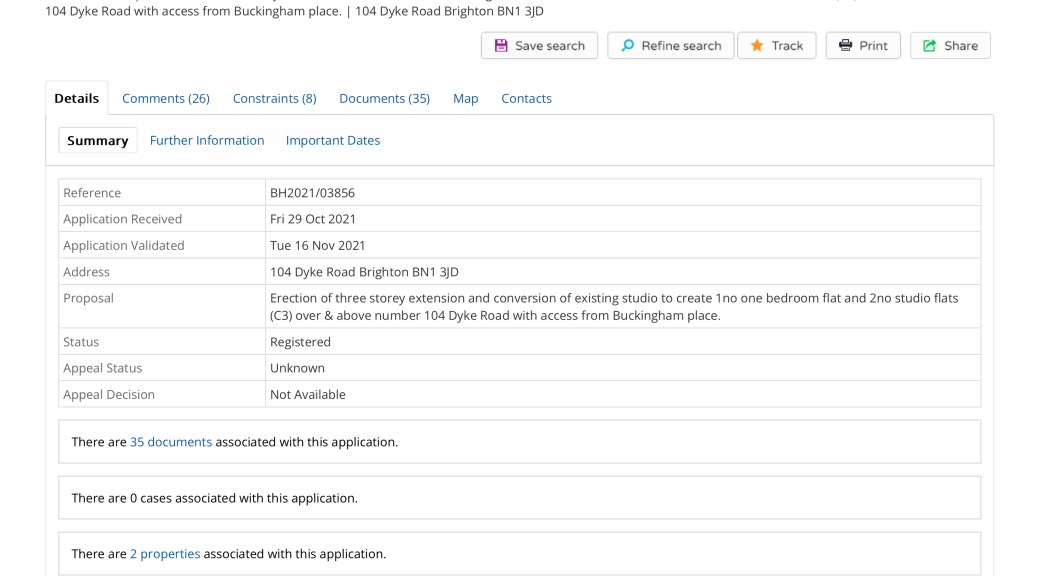
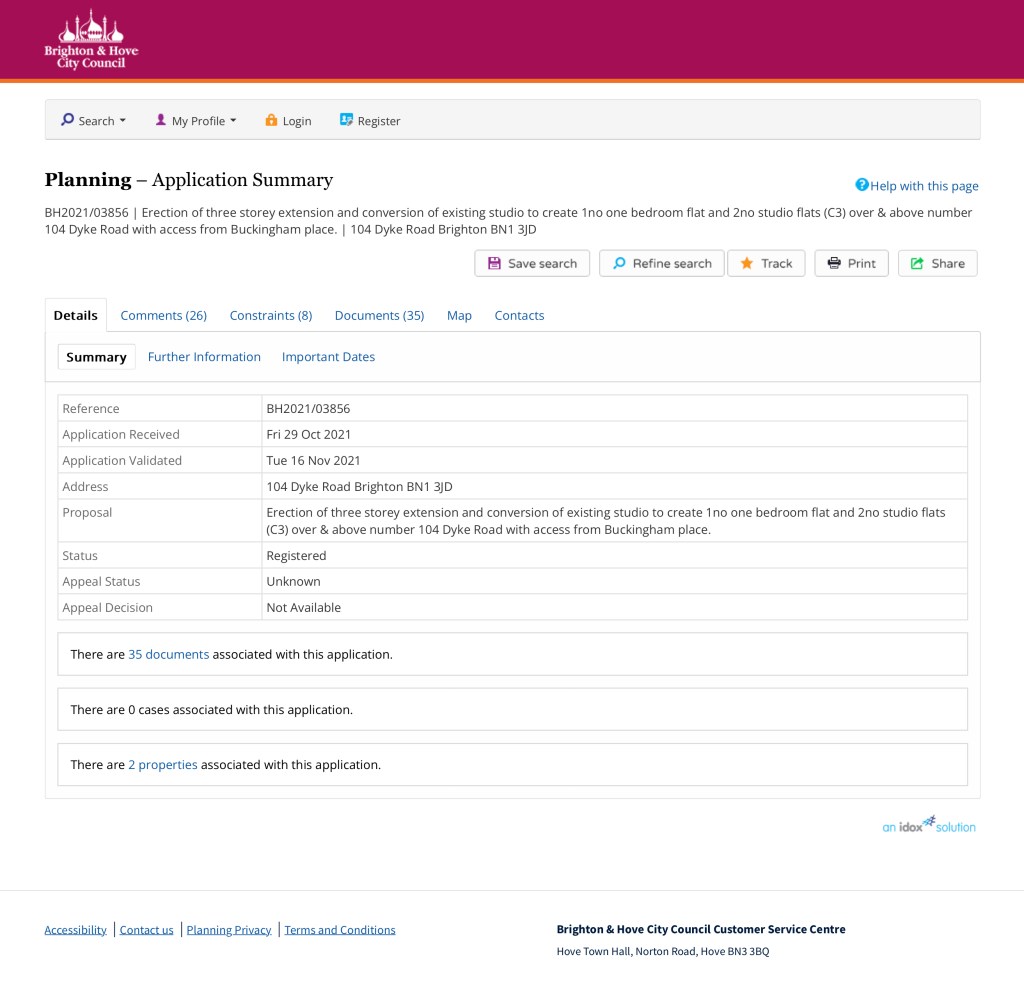
So yes. It seems there’s a proposal – application number no BH2021/03856 – to expand the Co-op, lose the Cellars and Latina, build some flats… A familiar story. But not one that’s written in stone.
We can change it. We can fight it. We can do stuff. The West Hill Hall was saved. There was the story of the Elm. This is no different. We can make our voices heard, we can fight back the forces of capitalism, we can cast off the yoke of oppression (OK, thank you, Wolfie).
No, really. We can. We love it here because of its independent spirit, because of its individuality. Because we can go in a local shop and have a chat. Because it’s our community.
There’s nothing wrong with having a Co-op. I’ve been in there, and I’m sure you have too. But we’ve got a Co-op. Actually we’ve got two. How much Co-op do we need?
What can we do? It would be possibly legally unwise to advocate a boycott of the Co-op, and we can all make our own decisions about those things. So, we can stop shopping there. (Not advocating a boycott, your honour). We can be a bit more conscious about where we spend our hard earned. (Still not advocating).
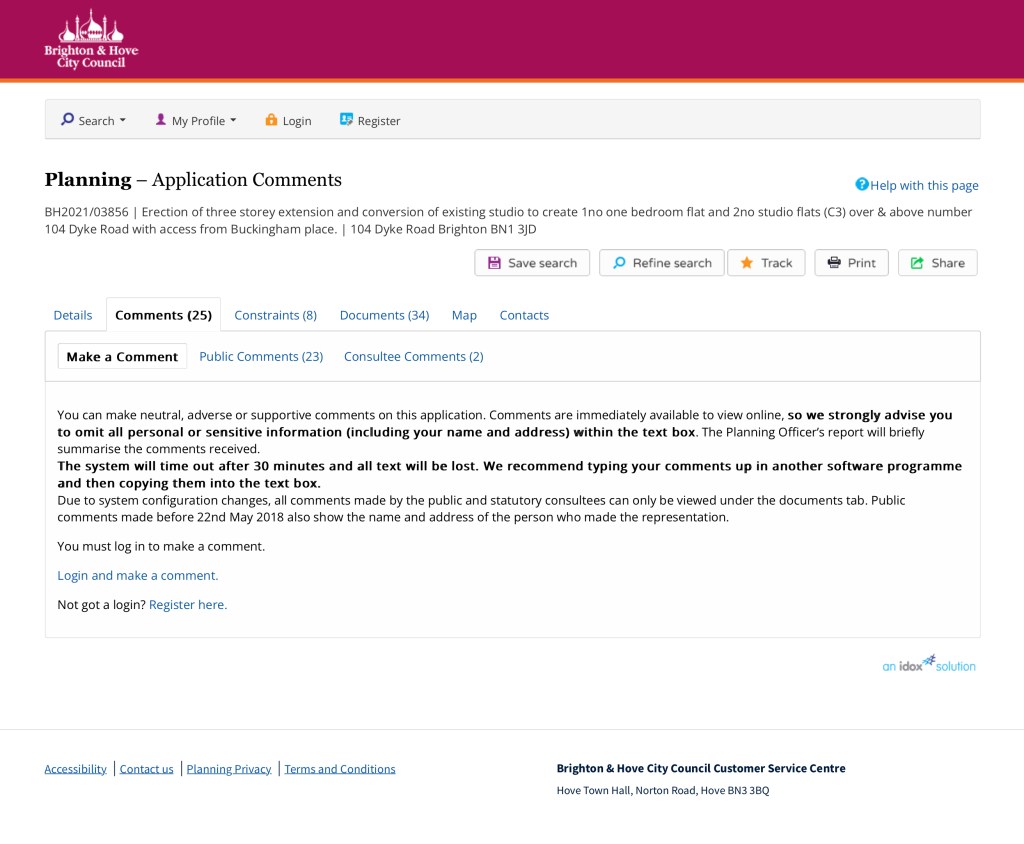
And we can write. The planning register can be found on the council website at
It’s officially winter. The nights have closed in, the straw hat is back in it box and coats are the season’s must-have accessory. Still, we’re out of lockdown and we’re allowed out. Remember that? Out? And if we’ve got to have a substantial meal, well that’s OK too. Lockdown’s had its moments. We’ve met people, well we’ve seen people on small screens, and as long as the West Hill quiz keeps going, so will we (even though we were robbed at the last quiz, positively robbed. Who knew what a Star bar looked like?).
But remember, if things are hard, if you have trouble getting out and about, Lovely Vinod at Bright News is doing deliveries and helping those who need it. It’s what community’s for.
Finally, a quick word about us going all 21st century – the website’s got a new look, there’s a new Instagram (@westhillwhistler) and Twitter (@WestHillWhistle) and a re-vamped Facbook page. You can probably guess what that’s called. It’s all very exciting.
And, as always, if you’ve got something to say, drop us a line. Join in. Life’s better that way.
Merry Xmas / New Year. See you on the other side.
XXX
Everything you ever wanted to know about life in Brighton (OK, and Hove)






 The Whistler