Tag Archives: West Hill

Hoping for a new Green future


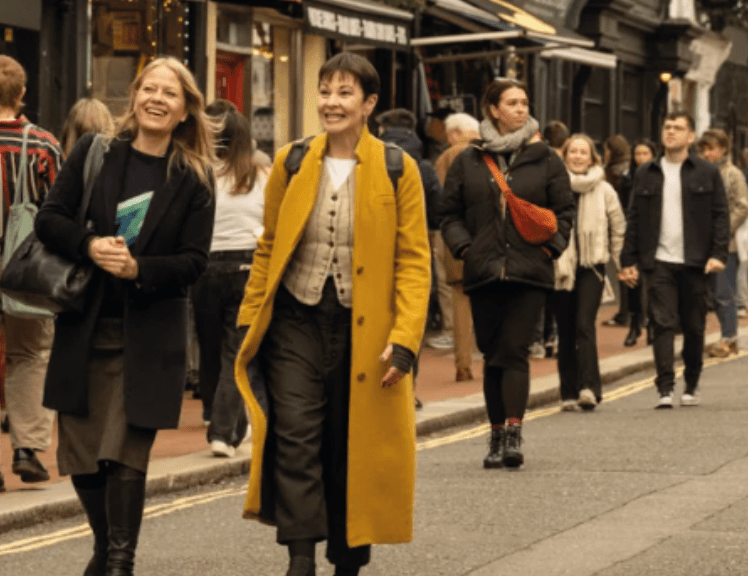
Brighton has the only Green MP in the country and that’s always felt nice. But is this time different? Did we vote for Party or person? Sian Berry tells Jed Novick the name has changed but the message is the same 

We’re sitting in the Green Party HQ just by the station. There’s more people than spaces and where there aren’t people there are cardboard boxes, all spilling leaflets everywhere. Everyone smiles, says “Hello”, asks how I am. 

“Hi Jed, do you want a drink?” says Matt, the man makes all this work. He gives me a glass of water, which suddenly feels a bit awkward because there’s nowhere to put the glass down. The atmosphere is vibrant, chaotic but exciting. It feels like a changing room just before the Cup Final. You can feel the positivity, the energy, there’s also a nervousness that comes partly from being the favourites but, to continue the already tenuous football analogy, the star striker who’s scored the goals that’s got them here has left. There’s a new striker, but… Can she do it? 

The shadow of Caroline Lucas hangs heavy. It’s not a surprise. The Green Party and Caroline have been synonymous for as long as anyone can remember. She’s been the Green MP, the Green face. She’s one of the most recognisable faces in British politics, one of the few politicians that transcend politics. She grew a marginal with a 1,252 majority in 2010 to a 20,000 majority. And now she’s gone. 

That must be a strange feeling, taking over from someone who’s an icon, a celebrity.

“And she’s loved and rightly so. She’s my mentor as well. She’s always encouraged me throughout my career.” says Sian Berry, Caroline’s successor. “And yeah, everyone is sorry to see her go, absolutely. I’m not thinking that I’m inheriting anything. I’m working for every single vote. I’m trying to meet as many people so they know me and they will vote for me. But what I’m finding is that people are sorry to see her go, but would be even sorrier to see her go and lose their Green voice. So people are very, very willing to back me, even though I’m newer to them than Caroline and remember Caroline was new to them once. She’s become this icon over 14 years.”

Sian talks like the Green office feels. Excited and full of “let’s go” energy. She doesn’t so much talk as watch as words cascade out of her mouth. So yes, excited and full of energy, but also ready. She’s been embedded in activist politics since the early 2000s, which is where she came on Caroline’s radar. 

“I’d been running a campaign, the Alliance against Urban Four by Fours. We campaigned outside the vegan shoe shop in the North Laine and did a stall where we were giving out these fake parking tickets which looked like Brighton Hove parking tickets, but said words like dirty and dangerous, and instead of a penalty charge notice, they would say poor vehicle choice, and then it would give information.”

Were you those people who went around letting people’s tyres down?

“Oh, the tyre people. No, that’s not legal, whereas sticking a fake parking ticket under someone’s windscreen is actually legal, and it started a really useful debate in the media. We also had big policy asks, so we wanted the government to change things like vehicle tax, so that if you bought a bigger or heavier vehicle or a more polluting vehicle, you would pay more. And Gordon Brown did do that.”

Sian’s background was in marketing as a medical writer and so knew how to tell a story, “but it was all paid for by big pharmaceutical companies, so I had to stop doing that” and after the 4×4 campaign found herself campaign coordinator for the Greens. She’s stood for Parliament before –  “as a Green, you’re often asked to stand in unwinnable places, just to get the point across” – the first time she was up against Glenda Jackson, the last time was in 2017 against, of all people, Keir Starmer. 

Say you get elected. Can you do much as one Green MP? Caroline’s personal fame allowed her a level of attention, but… Not for the first time I feel Sian getting a little bored with the Caroline comparisons. And fair enough.

“I’m really looking forward to getting the Green voice out, onto the national agenda. We deserve much more time debating with the other parties in the spotlight, because we have a legitimate point of view, and lots of people support it, and it ought to be heard.”

You could be the new voice of Question Time. 

“We deserve so many more slots on Question Time. I think if you add up every appearance a Green has ever made…”

You could change your name to Nigel. They’d never stop asking you.

What specifically for the good folk of Brighton Pavilion, does Sian offer? “I aim to be the best MP I can possibly be, and use Caroline’s work as an absolute model for that. I know how much from talking to people on the doorstep, I know how much they appreciate the excellent constituency work she’s done, the excellent casework. I’ve represented people for a long time, and that combination of listening to people’s problems and helping people overcome the system if they’re having trouble with bureaucracy, if they’ve been treated unfairly, and you can help unlock the path to putting in a complaint and getting it fixed.

“The other job is to be a voice for the city and its concerns and values. I very much want to make the case for water companies to be brought into public hands, and you can see the other parties taking steps along the way now, because the water companies are just getting worse and worse. and it’s so much clearer that bringing them under the way of you know, hopefully a regional democratic control would be, would be absolutely brilliant, and we absolutely have to argue for that. 

I’ve worked for years for a national charity campaigning for better transport. I love public transport. Let’s sort out the buses. Let’s get the trains working. You know, I have knowledge and how to influence that, and then housing, buying, not just building more council homes.”

Sian tells me about various schemes she’s worked on, from grants to upgrade their boilers, to councils buying houses and turning them into council houses. Real ideas that can make a real difference, and a little bit more positive than the incessant “We’ll cut taxes” rhetoric we’re hearing from the big parties.

Away from all this, what do you do when you’re not here?

“I’m been gardening a hell of a lot. It’s so nice. Honestly, we got a good garden. I’ve got a lovely patch that there’s previously been a fruit garden and looked after pretty organically. So I’m sticking I’m trying to grow as much food as possible, basically. During this period, the weeds are definitely going to have a bonanza and the slugs. But it’s, it’s, it’s so nice to at the end of the day, to just hang out there. And you know, it’s fantastic, isn’t it? 

Ten years of Brighton Open Air Theatre


Summer wouldn’t be summer without a night in Dyke Road Park, watching a play at the Brighton Open Air Theatre, glass in one hand, blanket in the other. Peter Chrisp looks back at what’s happened to Adrian Bunting’s dream

This summer, we’re celebrating the tenth season of Brighton Open Air Theatre in Dyke Road Park. It’s the legacy of Adrian Bunting (1966-2013), theatre maker and construction manager. 

Adrian had been thinking about building a permanent open-air theatre in Brighton for years. He knew what the theatre should look like, and had even picked the perfect location, the bowling club in his local park. Yet it seemed unlikely that it could ever be done.

In April 2013, when Adrian was diagnosed with incurable cancer, the council announced it was looking for a new use for the bowling club. Adrian spent his last weeks initiating plans to build his theatre there, and asked five close friends to help create it. 

Interviewed in the week before he died, Adrian said, “I lived in Seven Dials for nearly 22 years and I had this idea for building an open-air theatre for Brighton, and because my favourite park is Dyke Road Park, I would constantly go up there and imagine putting it there. And the bowling lawn was always the place that I dreamed of – it’s a magical place, with its own copse, hidden from the world…But of course it was a bowling lawn. You’ve heard about my unfortunate illness. That, combining with the fact that the bowling green is no longer needed, was almost too big a coincidence to think about. I really think that Brighton deserves an open-air theatre…that one of the most artistic towns in England can have a theatre that it can be proud of, alongside all the big, beautiful theatres inside…And this is a chance for us to make one, and enjoy it for the whole of the summer.”

Adrian left his savings of £18,000 for the project, and £100,000 more was raised by benefits, art auctions and donations. It took just two years to create the theatre, which was opened by Adrian’s mother Isabelle on 9 May 2015. Adrian used to say, “I want the audience to be part of the show.” As a theatre maker, he always wanted to break the fourth wall, the imaginary barrier between audience and performance. He did this on an intimate scale with his World’s Smallest Theatre, which he took to Edinburgh fringe in 1996. This was a box, with just enough space for the heads of three people – one audience member and two actors, Adrian and Clea Smith.

He broke the fourth wall on a big scale with his play Kemble’s Riot, which won best theatre award at Brighton Fringe in 2011. Here the audience takes sides in the 1809 riots at Covent Garden Theatre, sparked when actor-manager John Kemble raised the ticket prices to cover the costs of rebuilding the theatre.  

The most striking feature of Adrian’s plan for BOAT is its long-thrust stage, which brings the performers out among the audience – another way of getting rid of the fourth wall. You can see how radical this is if you compare it with earlier open-air theatres, such as Regents Park and the Minack in Cornwall, where audience and stage are separated. 

Claire Raftery, one of the founding Trustees, recalls, “Ross Gurney-Randall and I measured out the planned dimensions for the BOAT stage – with 30 metal pins and a rope on a sunny afternoon in Victoria Gardens – adjusting dimensions to make sure it would work, and trying out different types of performance in relationship to audience proximity. The stage needed to be large enough for larger casts and ensemble shows, for movement and dance, whilst making sure it had enough intimacy and connection for solo performer….”

BOAT’s tenth season began with a revival of Kemble’s Riot, staged by Brighton Little Theatre. This was the first performance of the full-length version, as written by Adrian. Audience members sang songs and made their own banners, writing slogans such as “No to Kembleflation!” or “We love you Kemble!” 

I went to the show with three of the founding Trustees, James Payne, Steve Turner and Donna Close. After, we talked about Adrian’s stage design, and how this was the perfect meeting place of a play and a space. James said, “He was rightly proud of this innovative design. I can’t help feeling that it has inspired other open-air theatres. Take the Thorington woodland theatre for example, not to mention the Downlands theatre in Hassocks.”

In Brighton, we didn’t realise just how much we needed a purpose-built open-air theatre until we saw what the space could do. Alongside drama, BOAT has hosted wrestling, opera, rock concerts, circus, contemporary dance, poetry slams, live art, drag in the park, Glen Richardson’s epic one-man recreation of the Live Aid concert, and stand-up comedy for dogs. In 2020, we had a midwinter pantomime – Hansel and Gretel.

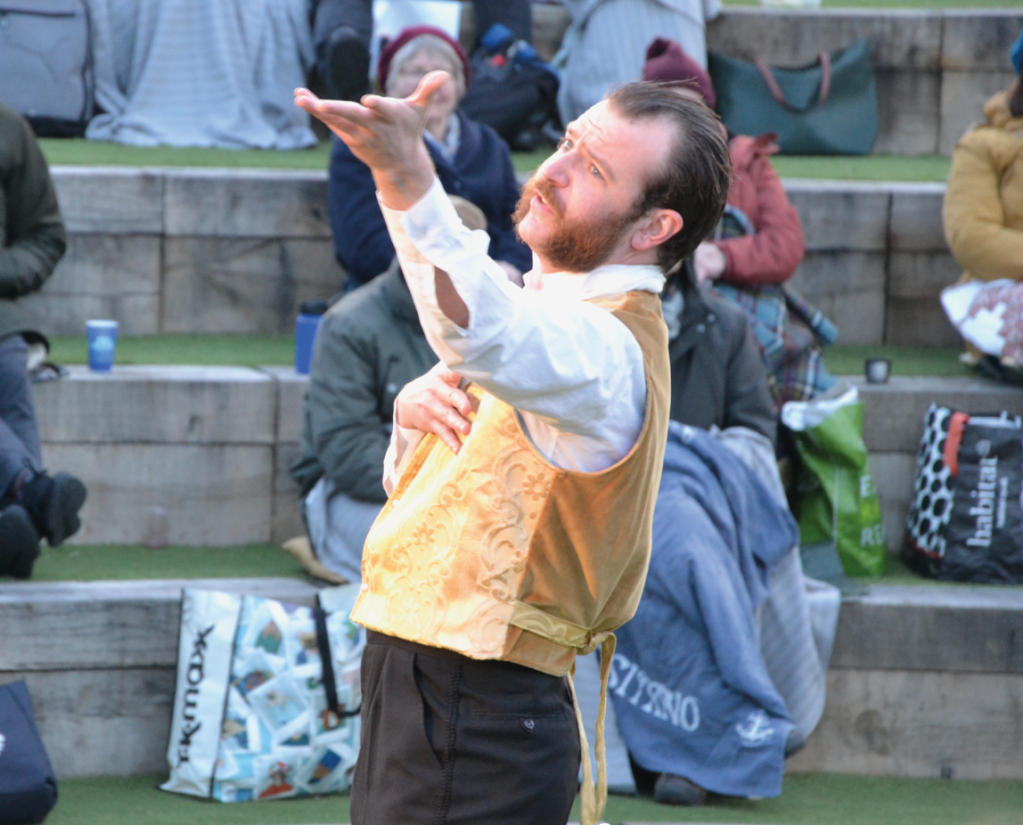
Many companies make use of the whole space. Wrestlers enter through the audience, with the heroic blue-eyes high-fiving, and the heels getting whacked by children with inflated clubs. Suspiciously Elvis will do walkabouts, even sitting on people’s laps mid song. By the end of one of his magnificent shows, half the audience has joined him dancing on the thrust stage.

It’s lovely to watch the sky above change as the sun goes down, and listen to the birds singing in the trees. Even rain can bring extra drama, such as the time during Mark Brailsford’s production of Julius Caesar when real thunder and lightning accompanied the storm in Shakespeare’s play. 

What a remarkable journey. BOAT now runs for a six-month season, staffed by a small expert team, its Trustees and upwards of 80 committed volunteers. Without public subsidy, BOAT is kept afloat through income from ticket sales and from donations, with any profits invested into making the venue even more accessible, green and welcoming. 

Take a look at this year’s programme on the BOAT website; there are lots of great shows to see until the end of September. If you’ve not yet been, you’re in for a treat.

Brighton Open Air Theatre, Dyke Rd, Brighton and Hove, Hove BN3 6EH

http://www. brightonopenairtheatre.co.uk/

07391 357542 (Mon-Fri, 1pm-6pm)

Climate Cafe – People, Planet, Pint

We’ve been thinking a lot about what we can do at Whistler Towers about Climate Change. And it was in the book Spinning Out by the brilliant activist, Charlie Hertzog Young that we first heard about climate cafes. These are spaces where people can talk about their eco anxiety, share ideas and feel like they’re not alone that first inspired this page. 

But mostly, they’re physical spaces; in the last issue, we read about Circles’ monthly meet-up for women involved in sustainability, either through activism or business, and in this issue, we meet Sam Zindle, managing director of Brighton B Corp certified digital marketing company, Propellernet who organises Brighton’s People, Planet, Pint monthly get togethers which have spread all over the world. Over to you, Sam.

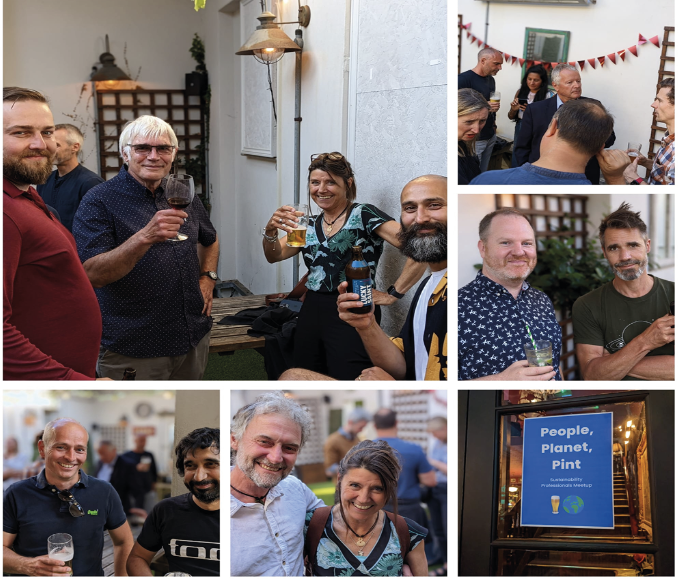
“People, Planet, Pint is an international meet-up group now. It was started by Adam Bastock, who founded Small99, which creates carbon reduction plans for small businesses. I was there when he ran the first one in 2021 at Cop 26 in Glasgow. It was essentially just a room in the back of a pub in Glasgow, and it’s grown and grown. Brighton was one of the first other cities to start running people planning meet-ups. 

We meet once a month, alternating between The Walrus – that’s the one that I’m responsible for – and at the old Albion. It’s always the third Thursday of the month from six until whenever people want to go home. It needs to be regular for people. You just sign up at Eventbrite, and it’s completely free. 

This is for anyone who’s interested in sustainability, but it’s purposefully non agenda based. We get people from all walks of life, from people in academia to startups in the kind of tech sustainability space. Or they may simply care about the environment. So, if you’re just curious people in the city who want to talk more, you can come down. There are never any speakers. There’s never a running order. It’s literally that you get your first drink bought for you, courtesy of our sponsors, Crystal Hosting and Propellernet. And then you can have your chats. It’s just a place where you’re surrounded by people who feel the same way. 

I think Brighton is awash with some brilliant independently run, volunteer-based community groups and it thrives on that. There used to be something in Brighton years ago called like, the Green Drinks, but back then sustainability wasn’t mainstream or a conscious thought for many people. I think attendance didn’t really last; it was always the same people. Every time we do People, Planet, Pint, we get about 40% of people that are new. So, it does have an amazing kind of new energy to each one. 

You do get maybe 20 people or so I’d say that are there for most of them. But you just get an array of different people coming through the door of the pub that each meetup which makes it keeps it fresh, keeps it exciting and keeps new conversations happening. We get somewhere between 50 and 100 people each month which makes it the largest sustainability meet up in the city. I guess it’s just a really vibrant and active community around sustainability and Brighton.

In the last month alone, I’ve spoken with a guy who’s pressing plant-based vinyl records who’s now done a deal with a major label, and a guy who works in agri tech and is using AI to direct plant-enhancing products onto the crops to grow them better in a really sustainable way. I speak to people who work in marketing and we talk about green washing and green hushing and how to help companies navigate that whole space. I mean, I could go on… you meet people from 101 different backgrounds. 

And my hope is that the conversations go on beyond the evening. I know for a fact there’s been some connections made and people who’ve kind of collaborated, which is a really big part of this and that everyone has there has a shared interest in doing something for the planet and environment in whatever form that may take. 

So it’s a very successful meetup and it will endure, I have no doubt, for years to come and hopefully grow in attendance. There’s no move to change how we do it. It seems to work for people 

There are People, Planet Pints all over the world now. I think it’s in 30 different cities in the UK, including Manchester, London and Bristol, and even smaller places like Cheltenham. But there’s one in California, there’s one in Berlin, there’s a couple I think in Scandinavia. You can go onto the People, Planet, Pint website to find out more about where the local events are happening all over the world. 

We don’t have big budgets to advertise. We don’t have massive sponsors. And actually, that’s part of its attraction, I think, because the minute you start kind of having to deliver a sponsored message or advertised, you know, to certain people that it becomes something different. So I’m pretty comfortable with the kind of grassroots scene in Brighton but of course, we’re always always looking for new people to find out about us and come along and spread the word. 

GILLY SMITH

https://small99.co.uk/people-planet-pint-meetup/

Nicholas Lezard – View From The Hill July 2024

“I must go down to the sea again, to the sea and the lonely sky …”

The opening line of John Masefield’s poem “Sea Fever” often occurs to me as I look out of my window, for from it, I can see the sea. When I lived in a basement flat in Dyke Road I couldn’t see the sea at all; in fact, I couldn’t even see the street. There is a part of Dyke Road by St Nicholas’s where you do get to se the sea, and something about the geography and the layout of the street means that it looks as though the sea is gigher up than you, which much impressed my children when they first came to visit. But now I have moved to the lower slopes of West Hill I have a view of a patch of sea every time I sit at my desk, and this pleases me, although it sometimes acts as a rebuke. Because what I am doing is looking at it, and not walking by it.

I wonder if this is means I have turned into a true Brightonian. When I lived on Dyke Road I only rarely went to the sea, because I lived at the very summit of West Hill and walking down to the shore meant a long uphill climb back home, and hills and I don’t get on very well. So now I live much nearer the Channel, do I go down to visit it every day? After all, living by the sea is a privilege. People go daffy trying to buy properties near the sea. (Well, ok, maybe not all places by the sea are desirable. I have a friend who lives in Southend and, believe me, you don’t even want to go there, let alone buy somewhere there.) But I don’t go down to the sea, to the lonely sea and the sky. I just look at it and admire its changing moods from afar. It’s never dull, even when it’s flat, as it is now (and blue: it’s a sunny day).

It makes me think of the place I lived in in London for ten years: because my flat, and the house it was in, was a shambles, it was the last affordable place in Central London. And all of London’s galleries and museums were within walking distance. Did I walk to them? No? Did I even take public transport to them? Also no. Because I knew I could walk there whenever I wanted, I felt no pressure to go there. And so it is with the seaside: it’s for visitors. And I wonder also if the view I have of a patch of sea, and only that, rem,inds me of my childhood, when we knew that the real holiday was beginning: when we could see, through a gap in the trees, the twinkling blue of the Cornish Atlantic. And on blustery, bright sunny days the sea, from my window, looks just the same as it did from my dad’s Vauxhall when I was 10. It’s close enough. 

Besides, it’s full of poo these days.

Sam Harrington-Lowe July 2024

I’m writing this in June and you’re reading this in July. And the General Election may very well be over by now. I really hope it’s gone the right way – if I had to predict the outcome, my money would be on a Labour victory, or possibly a Lab/Lib coalition. 

When talking to my venerable editor about this month’s magazine, I asked if he had any theme, and he said (obviously) that politics seemed likely to feature. I generally don’t write about politics, mostly because I don’t have a thick enough skin to deal with rabid disagreement, and I hate the immoveable and binary right/wrong arguments. When did the elegant skill of discussion and discourse disappear? I blame algorithms, and bubbles, and particularly Twitter. But I digress. 

Growing up, I was led to believe that discussing your political leaning was bad manners. I’m going to guess that this is a painfully middle class thing, saved mostly for the mish-mash of the middle orders where people might vote any which way, but you might not want the Joneses to know your bent. Whereas perhaps in the olden days you could reasonably rely on the working class to vote left, and the poshos to vote right, in the centre it was all to play for, and very much an indicator of your social ambition. 

As social mobility took hold in the 70s, I think perhaps this nouveau bourgeoise practice of not talking about politics was executed by the middle classes to avoid having to stick their flag in the sand. One might want to be upwardly mobile, but not be seen to be abandoning one’s lower-class roots. Or, in a fit of reverse snobbery, have your brats at private school and live in a big house but pretend to be working class, and support the lefties.

Things these days are a lot more fluid. I’m not sure how the class system works in Britain anymore, but it’s not as clear-cut politically. The advent of UKIP, The Reform Party, Brexit, the Greens etc has meant that there’s a lot more choice now. Which is a good thing. A tri-party state is an insane idea anyway, when you think about it. Even more so when you consider it’s mostly whittled down to just two. 

We take a lot of our political cues from our parents. My father, having studied theology as a young man, voted Labour. When he decided the cloth wasn’t for him, and became a business owner, he voted Conservative. Later in life, he voted Green, having become appalled at the state of not just the planet, but also politicians’ behaviour. Politically, I personally feel quite homeless. You’ve seen that meme of a little girl wailing “I don’t want to vote for any of these people.” I feel like that.

If I have to stick my flag in the sand, I think what I’d like is a Lab/Lib coalition, with a good handful of independents in the mix, to represent all interests. Lots of Greens would be nice, with some Monster Raving Loonies, and obviously Lord Buckethead. 

For those of you interested, I’ve just had a look at Ladbrokes, and it’s giving Labour ridic odds. 1/50 Most Seats, and 1/20 Overall Maj, whereas the Conservatives are 25/1 and 40/1 respectively. Interestingly they’ve got Lib Dems to win over 25 seats at 1/8, but no odds for a coalition. 

I’m off down the betting shop to haggle out a bet with them for that right now…